
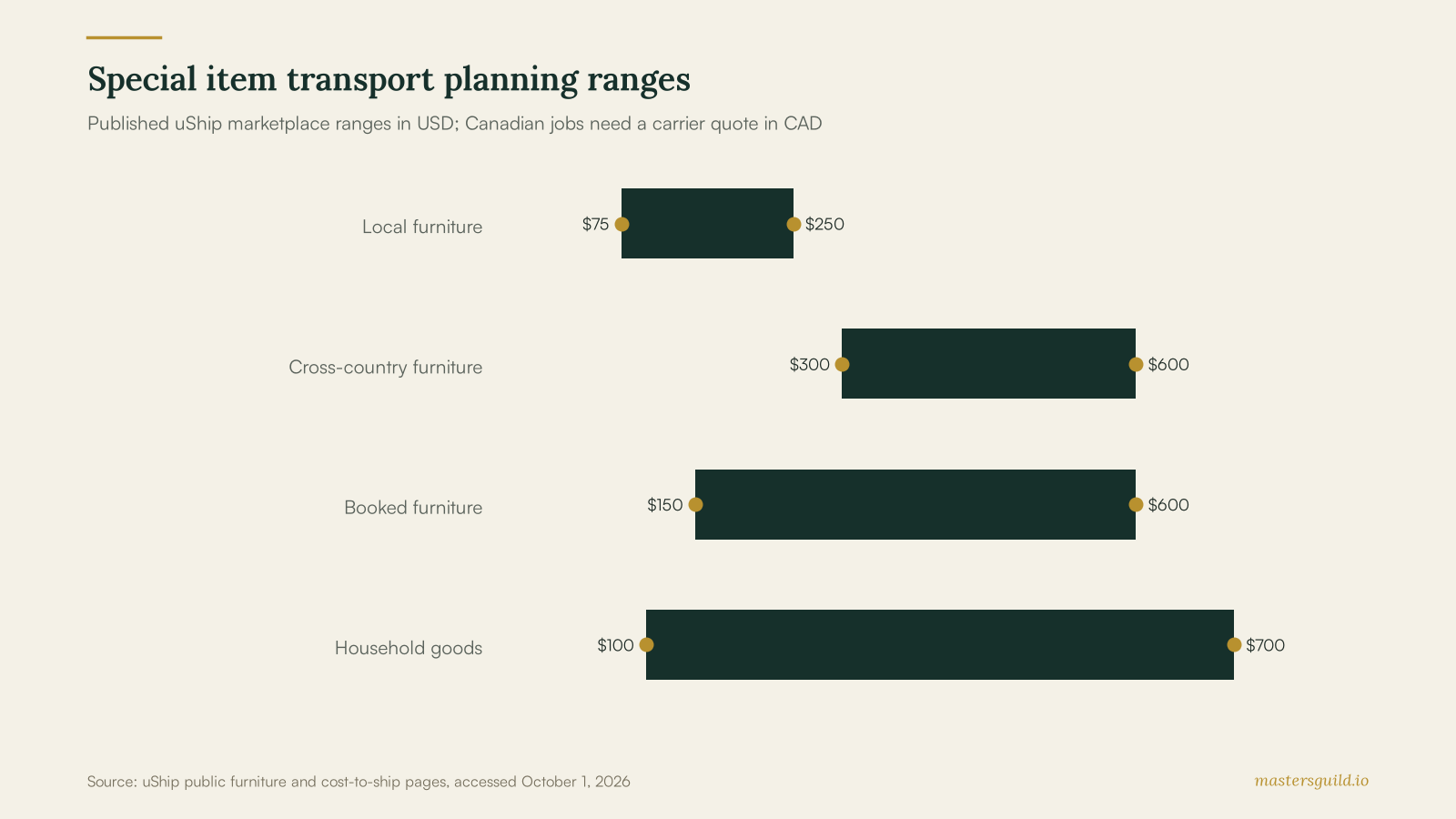
Special item transport cost runs $75–$250 for a local furniture shipment and $300–$600 for cross-country furniture in the United States, based on uShip’s published marketplace figures. Canadian carriers price the same access, handling, and distance variables in Canadian dollars, so ask each carrier for an itemized CAD quote instead of converting a US planning range.
Key takeaways
- Local furniture shipping is listed at $75–$250 in uShip’s published marketplace guidance.
- Cross-country furniture shipping is listed at $300–$600 on the same source.
- uShip lists booked furniture shipments at $150–$600 and household-goods shipments at $100–$700.
- A useful quote request includes dimensions, photos, pickup and delivery access, timing, and the room of delivery.
Published US marketplace ranges set a starting budget
The figures below are planning ranges from uShip’s public marketplace pages. The company says its category averages reflect completed bookings. They are not a promise from a local carrier, and they do not replace a Canadian quote in CAD.
| Shipment type | Published range | Scope | Source |
|---|---|---|---|
| Local furniture | $75–$250 USD | Local furniture shipment | uShip furniture guide |
| Cross-country furniture | $300–$600 USD | Furniture shipped across the country | Same source as above |
| Furniture, booked shipments | $150–$600 USD | Marketplace category average | uShip cost data |
| Household goods, booked shipments | $100–$700 USD | Partial loads or mixed household goods | Same source as above |
| Canadian special-item move | Request a CAD quote | Carrier-specific scope and access | Quote with photos and full access notes |
Access and handling determine the final quote
Give every carrier the same job description. Include the item’s dimensions, clear photos, its condition, the pickup and delivery addresses, parking distance, stairs, elevators, doorway widths, and the room where the crew will place it. State whether the crew must pack, blanket-wrap, crate, disassemble, or reassemble the item.
The public marketplace guidance identifies distance, item type and size, transport method, and delivery timeframe as pricing inputs. Flexible timing and combined shipments can lower a quote when the carrier can use available truck space. uShip’s calculator says it estimates a comparable average from prior member shipments, which makes it a useful benchmark before you request live bids.
For a piano, safe, antique, or other high-risk item, document its value and ask the carrier to explain its protection terms in writing. A general moving price does not describe specialty handling. Use the scope from a piano-moving cost guide as a checklist for photos, stairs, turns, and access before you compare bids.
Canadian quotes need Canadian currency and a complete scope
No public nationwide Canadian price range in the sources above supports a reliable CAD conversion for every special-item move. Carrier availability, route, and access vary between Canadian cities. Ask for the total price in CAD, a written list of included handling, and the charge for each access condition before you book.
Start with the same photographs and measurements for every quote. A carrier can then price the work instead of guessing from a title such as “heavy dresser.” If your shipment is part of a broader relocation, compare the transport quote against the long-distance moving cost guide so you can see whether a combined household move changes the scope.
DIY fits only a controlled, low-risk move
DIY suits a small item when you have a safe lift plan, suitable vehicle, secure tie-down points, and help to load and unload. Hire a trained carrier when the item is fragile, valuable, awkward to carry, or requires stairs, a lift gate, packing, or in-home placement. The U.S. Bureau of Labor Statistics describes material-moving work as physically demanding and notes risks from moving heavy objects, which makes a vague pickup plan a poor substitute for a scoped job.
Quote comparisons work when every carrier sees the same facts
- Send dimensions and photos. Show all sides, existing damage, and any parts that detach.
- Map the access. Count stairs, note elevator reservations, measure tight turns, and show the distance from parking to each door.
- Ask for included handling. Confirm wrapping, loading, transport, unloading, room placement, and debris removal.
- Confirm timing and protection. Put pickup dates, delivery window, cancellation terms, and protection details in writing.
- Compare equal scopes. The lowest number only helps when each carrier priced the same service. You can find special-item transport pros near you and share one complete job description with each provider.
Frequently Asked Questions
How much does local furniture transport cost?
uShip publishes a US planning range of $75–$250 for local furniture shipping. Your carrier’s quote can change with access, item size, handling, and timing.
What does cross-country furniture shipping cost?
uShip lists $300–$600 for cross-country furniture shipping in its public guidance. Use that range as a benchmark, then compare written bids for the same pickup, delivery, and handling scope.
How should Canadians compare special-item transport quotes?
Ask each carrier for a total in Canadian dollars with the same dimensions, photos, access notes, delivery room, timing, and handling requirements. The public marketplace sources used here do not publish a Canada-only nationwide range.
What should a specialty transport quote include?
The quote should name the item, pickup and delivery locations, access details, included handling, timing, cancellation terms, and protection details. Ask the carrier to identify each extra charge before booking.
Post your transport job with photos, measurements, access notes, and your delivery deadline. Masters’ Guild connects you with identity-verified local pros, and payment is released when the job is complete. Get quotes on Masters’ Guild.