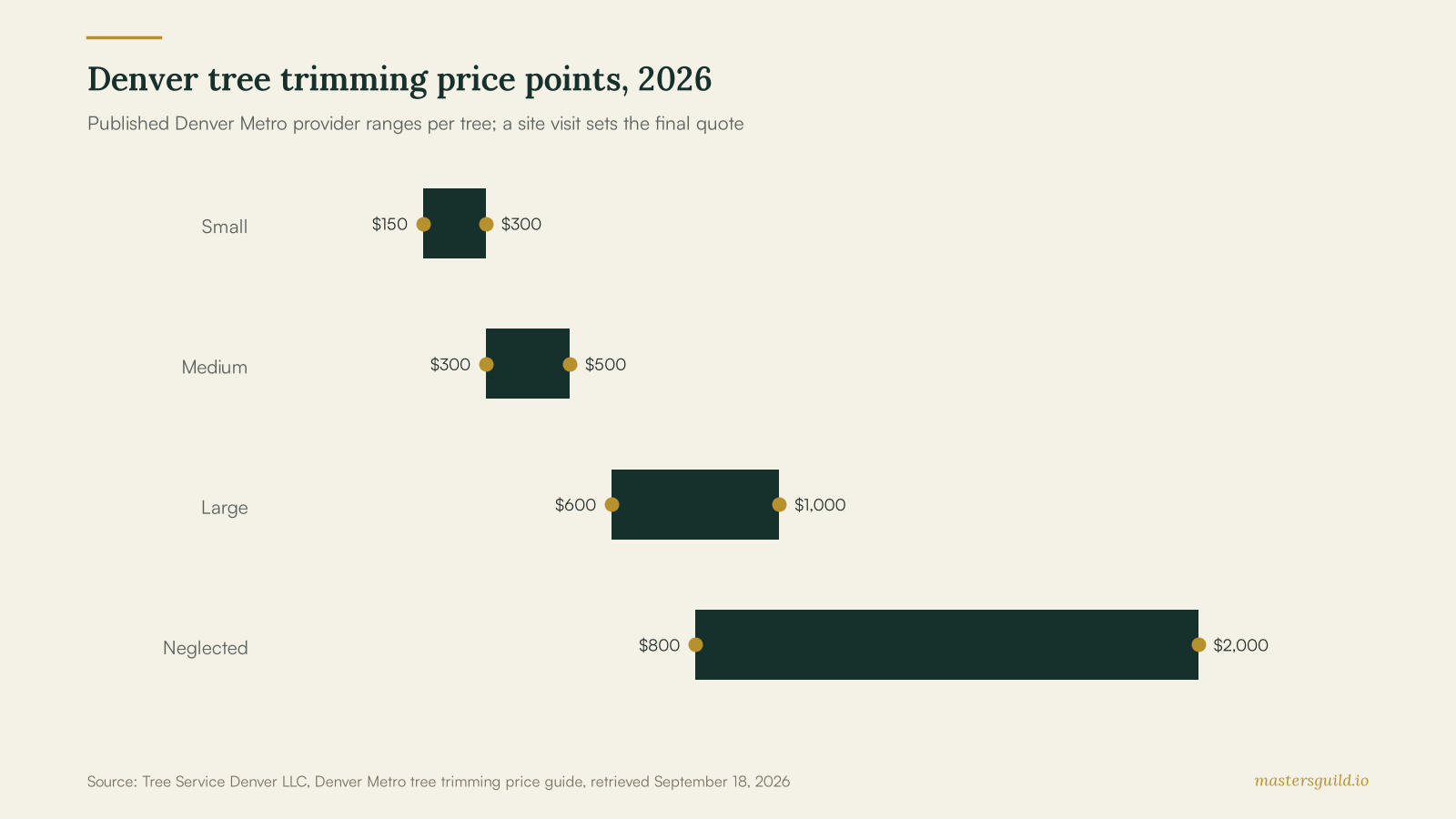
Denver tree trimming costs $150 to $800 per tree in published local pricing. Small ornamental trees fall around $150 to $300, medium shade trees around $300 to $500, and trees above 50 feet can cost $600 to $1,000 or more. Ask each arborist to price the same pruning goal, cleanup plan, access conditions, and safety requirements before you compare bids (Tree Service Denver pricing).
Key takeaways
- $150–$300 is the published Denver range for a small ornamental tree.
- $300–$500 is the published range for a medium shade tree.
- $600–$1,000+ is the published range for a tree above 50 feet.
- A written pruning specification makes bids comparable and gives the crew a clear scope.
Denver Tree Trimming Price Points
The figures below are published Denver Metro provider price points. They do not represent a citywide survey or a binding quote. Tree Service Denver lists these ranges for 2026 and says height, canopy size, pruning type, and access affect the final price (published price guide). A site visit remains the right way to price a tree close to a roof, fence, or utility line.
| Tree or scope | Published Denver price point (USD) | Quote detail to confirm |
|---|---|---|
| Small ornamental, under 25 feet | $150–$300 | Pruning objective and cleanup |
| Medium shade tree, 25–50 feet | $300–$500 | Climbing, access, and debris |
| Large tree, 50 feet or more | $600–$1,000+ | Rigging, drop zone, and haul-away |
| Neglected or storm-damaged crown | $800–$2,000+ | Hazard plan and written scope |
Tree Height and Access Set the Labor Plan
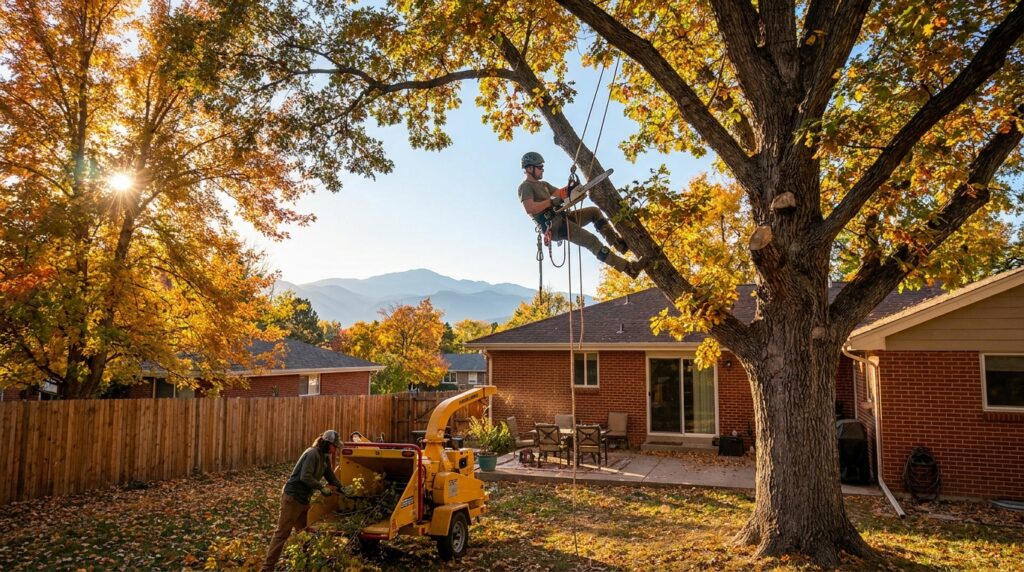
A crew can prune a small tree from the ground with hand tools. A tall tree near a home, fence, or narrow side yard can require climbing, rope work, a lift, or a controlled drop zone. Share wide photos of the tree, its trunk, nearby structures, gates, and overhead lines when you request a quote.
State the goal for each tree. Colorado State Forest Service guidance describes cleaning as removal of dead, broken, cracked, or diseased wood. It describes thinning and reduction as different techniques with different objectives. The same guide advises homeowners to leave pruning of large trees to professional arborists because the work carries serious fall and equipment hazards (Colorado State Forest Service pruning guide).
A Written Scope Protects the Tree and the Budget
Ask each bidder to name the tree or trees, the pruning objective, the maximum live canopy removal, branch-size limits, debris handling, and the final price. Colorado State Forest Service says a pruning specification should identify the trees, pruning type, objective, canopy amount, and maximum live-branch diameter (pruning specification guidance).
Avoid a quote that promises to make a mature tree smaller without describing the cuts. Colorado State Forest Service warns that topping, rounding-over, and lion tailing harm mature landscape trees. A certified arborist can explain whether cleaning, thinning, raising, or reduction suits the tree and site.
Denver Licenses and Detailed Bids Reduce Risk
Confirm the tree location before a crew starts, especially near the sidewalk or public right-of-way. Denver’s Office of the City Forester says a Tree Contractor License is required for tree maintenance in the City and County of Denver. Its licensed-contractor list says applicants provide proof of minimum insurance coverage and recommends detailed written bids from three to five companies (Denver licensed contractor list).
For a tree that needs removal rather than pruning, compare the scope with Masters’ Guild’s tree removal cost guide before you request bids. Use the Denver tree-service page to post the pruning goal, photos, access details, and budget in one request.
Hire an Arborist for Large or Hazardous Work
DIY pruning fits small, reachable branches when you can work from the ground with the right tools. Do not use a ladder, chainsaw, or climbing gear for mature-tree pruning. Colorado State Forest Service states that homeowners should leave pruning of large trees to professional arborists and recommends checking that a tree-care company has a certified arborist on staff (hiring guidance).
Use this hiring checklist:
- Ask for proof of liability insurance and workers’ compensation coverage.
- Ask whether an ISA Certified Arborist will supervise or perform the work.
- Request a written scope, price, cleanup plan, and payment schedule.
- Mark irrigation lines, gates, pets, parked vehicles, and restricted access before the crew arrives.
- Call the utility about branches near power lines and keep homeowner pruning away from that work.
Post Your Denver Tree Trimming Job on Masters’ Guild
Post your Denver tree trimming job with photos, tree height, access notes, pruning goals, and your budget. Identity-verified local pros can send offers, and payment stays held until you mark the job complete.
Frequently Asked Questions
How much does tree trimming cost in Denver?
Published Denver Metro provider pricing lists $150–$300 for small ornamental trees, $300–$500 for medium shade trees, and $600–$1,000+ for trees above 50 feet. Tree size, access, pruning scope, and cleanup set the final quote.
Does Denver tree trimming include debris removal?
Ask each company to state whether chipping and haul-away are included. The written scope should identify cleanup because crews may price debris handling separately from pruning.
Do I need an arborist to trim a large tree?
Hire a professional arborist for mature or large trees. Colorado State Forest Service says large-tree pruning is dangerous work and advises homeowners not to remove large limbs while on a ladder.
What should a tree trimming quote include?
The quote should name the trees, pruning objective, canopy limit, branch-size limit, access plan, cleanup, final price, and insurance coverage. Those details let you compare bids on the same work.