
Local service guide
Denver tree cutting and arborist services
For Denver tree cutting, hire a licensed, insured tree professional who can explain whether pruning, treatment or removal fits your goal. Confirm where the tree stands before commissioning work: a declining street-side ash may qualify for the city's no-cost removal and replacement program. Denver's City Forester provides a licensed-tree-professional resource for screening contractors. [1] [2] [3]
Decide what you want the arborist to solve
Describe the problem before choosing a cutting service: branches over a roof, clearance for a project, suspected decline or a tree you want removed. Have the assessor identify the tree and explain their recommendation. For pruning, agree on the branches and intended clearance. For removal, discuss replacement before approving the work.
Include emerald ash borer in an ash assessment. Denver's Office of the City Forester reports that the insect arrived in Denver in 2025. The city lists upper-canopy yellowing, dieback and thinning among possible signs, and warns that affected trees can take two to four years to show symptoms. Have a professional interpret those signs rather than treating a photograph as a diagnosis. [3]
For an ash you want to keep, discuss a continuing care plan. The city's guidance says treatment requires repetition every two to three years. Have the arborist explain suitability, the proposed treatment and future charges so you can weigh ongoing care against removal and replacement. [3]
Compare the complete job and its cost
Use the City Forester's licensed-tree-professional resource to screen the business performing the work. The municipal guidance identifies professionals who manage pruning, treatment and removal on private property and in the public right-of-way. Obtain current proof of insurance and identify who will supervise your job. [1] [3]
Give bidders photographs of the whole tree, trunk base, nearby structures and equipment route. Describe gate access and surfaces you want protected. Arrange a site visit so the contractor can explain equipment placement, branch lowering and the work area's boundaries.
Set your budget from site-specific written quotes. Compare equipment charges, hauling, disposal, exclusions and the procedure for approving additional work. Identify each tree in the proposal, and distinguish removal from stump grinding and ground restoration.
For stump work, agree on grinding depth, treatment of visible roots and whether the crew will remove the grindings. Name who will supply soil and prepare the area afterward. Record any request to retain logs or chips before the crew arrives.
Plan ash disposal and replacement
Denver's guidance advises against transporting firewood or other ash products because emerald ash borer larvae can travel under the bark. If ash wood must move, the city says to chip it into pieces smaller than one inch. Have the contractor describe how they will handle the wood as part of the removal scope. [3]
Choose replacement species with the planting site in mind. The City Forester discourages further ash planting in Colorado and encourages diverse species. For a city-program replacement, the office's arborists determine placement using spacing requirements and nearby features such as driveways, signs and water meters. They may choose a different location from the removed tree. [2] [3]
Prepare access and agree on rescheduling
Agree on the arrival window and weather rescheduling procedure. Before the crew starts, move vehicles and outdoor furniture from the agreed work area, and confirm how the crew will protect surfaces. Keep children and pets away until the supervisor says you can use the yard.
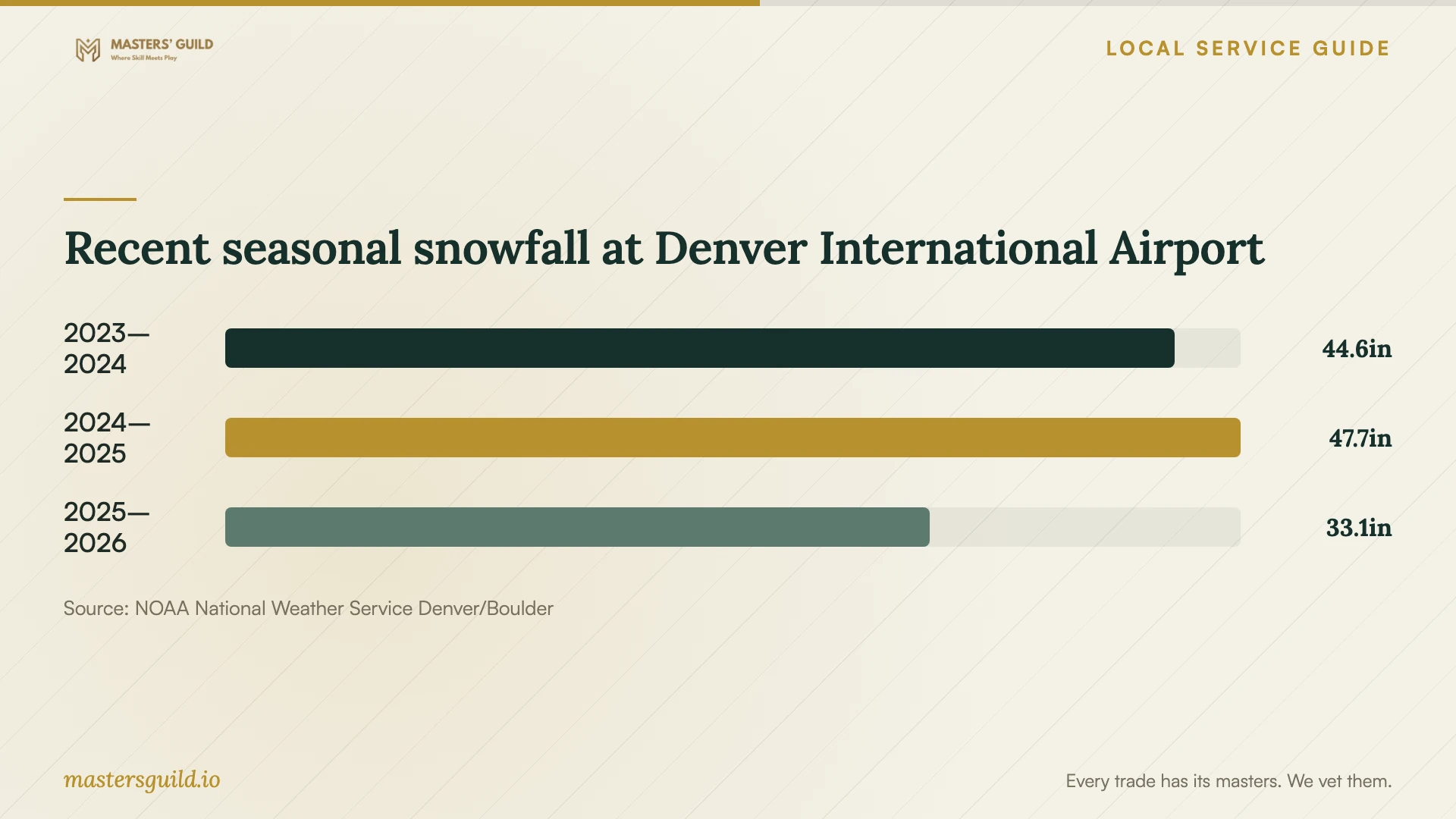
Use the snowfall chart to prompt a discussion about winter equipment access and delays. National Weather Service observers recorded different airport totals across the three seasons shown, and the agency documents differences among Denver-area observation sites. Use the forecast and site conditions when arranging your appointment. [5]
If a damaged tree threatens an occupied area or touches utility lines, keep people away and contact emergency services or the utility as appropriate. Describe the hazard before arranging a visit. Avoid approaching the tree for closer photographs.
Recent seasonal snowfall at Denver International Airport
Local details that affect your job
Check eligibility for no-cost street-side ash removal
Denver's Ash Removal and Replacement Program lists west-side operation for 2026. Declining or dead ash trees in the public right-of-way, measuring 12 inches or less in diameter, may qualify. The city describes the right-of-way as the area between the property line and street, with width varying by property. Apply through the program and have the City Forester confirm eligibility and current availability before commissioning paid removal. [2]
Account for the city program's scheduling sequence
The City Forester evaluates eligibility while leaves remain on the tree; that process can take a few months. The program says contractors typically remove trees within one to three months after contracting and may return for stump grinding. Indicate whether you want a replacement in your application. The city plants replacements in the spring or fall following removal, subject to suitable spacing. Confirm the sequence before arranging landscaping. [2]
Confirm requirements while forestry changes remain pending
As of October 14, 2026, Denver's legislative record listed Bill 26-1451, concerning Chapter 57 tree preservation and protection, as a committee action item. The committee postponed it on October 6. That record does not establish an enacted change or a permit requirement for your tree. Confirm current requirements with the City Forester for the tree's location and proposed work before authorizing removal. [4]
Match the situation to the next step
| Situation | Next step | Resolve before committing |
|---|---|---|
| You want to retain a tree and gain clearance | Discuss a pruning proposal | The branches, clearance target and retained tree |
| You want to retain an ash | Discuss treatment suitability | A care budget covering repeat treatment every two to three years |
| A declining street-side ash meets the 12-inch diameter limit | Check city-program eligibility | Right-of-way location and current availability |
| You need private-property ash removal | Arrange a licensed, insured professional | Wood handling, stump work and the finished site |
| You want a city-program replacement | Indicate that in your application | Spacing and planting location with the City Forester |
Your hiring checklist
- Mark the tree on photographs and describe the result you want.
- Establish the property boundary and the trunk's location.
- Record the responsible business and crew supervisor in the agreement.
- Specify what the crew will leave behind, including logs, chips or grindings.
- Agree on access, surface protection and utility coordination.
- Keep the written scope, payment schedule and added-charge approval procedure together.
Frequently Asked Questions
Does Denver pay to remove an ash in my backyard?
The Ash Removal and Replacement Program excludes private-property trees. It covers qualifying ash trees in the public right-of-way. Property owners remain responsible for ash trees on their own property. [2] [3]
Does the city program include the stump?
Yes. City Forester contractors remove the tree and stump. They may make a separate visit to grind the stump, so confirm the timing before scheduling other yard work. [2]
Can I choose the species of my city replacement tree?
The City Forester cannot guarantee a specific species because availability varies. Its team selects trees suited to the location. Discuss your site concerns during the planting assessment. [2]
Sources and scope
This guide combines the sources below with practical planning guidance. Figures apply to the stated geography and period; request a written quote for your property.