
Local service guide
Mold Removal in Yonkers, NY: Hiring and Planning
For Mold Removal in Yonkers, arrange an independent New York-licensed assessment before requesting remediation quotes for a covered mold project. New York defines these projects as mold assessment, remediation, or abatement of areas greater than 10 square feet undertaken for that purpose. Give the assessor’s remediation plan to contractors, compare their proposed work, and arrange moisture repairs and the post-remediation assessment before cleanup starts. [1] [2]
Choose the right starting point
Record the total visible affected area and the materials involved without opening walls or disturbing damaged surfaces. New York’s small-area household guidance and its homeowner licensing exemption serve different purposes: the exemption allows residential owners to perform mold work on their own property without a mold license and contains no area limit. It does not establish that a particular job suits homeowner cleanup. [1]
For suspected hidden contamination, HVAC involvement, or occupants with severe allergies or asthma, discuss precautions with an experienced professional. EPA identifies these conditions as reasons for a more cautious approach in its schools and commercial buildings remediation guide. That professional planning guidance draws on a publication reprinted in September 2008; use it to frame questions rather than as a residential cleanup prescription. [3]
Photograph visible damage, note when you first noticed moisture, and collect records of previous leak repairs. Describe any musty odor and whether it returns after cleaning. Give the assessor this history and request an explanation of how they will investigate the moisture source and possible hidden spread.
Verify roles and documents before hiring
Use the Department of Labor’s Mold Program page to reach its licensed-contractor search. Its FAQ identifies a separate individual-license search. Check the exact business names and the people assigned to assessment, supervision, and abatement. Treat a training certificate as supporting information, and verify the required New York license. [1] [2]
For a covered project, the assessor prepares a remediation plan that includes an abatement cost estimate. The remediation contractor uses that plan to develop a work plan and quote, and must give you the work plan before abatement begins. New York’s FAQ says contractors should not provide remediation-project estimates without the independent assessment. [1]
Have each provider identify their role, assigned personnel, and deliverables in writing. Keep the assessor’s plan and contractor’s work plan together. Before signing, confirm who will complete the post-remediation assessment, which New York includes among its minimum work standards. [2]
Compare itemized proposals
Obtain project-specific quotes after assessment. Separate cleanup, drying, moisture repairs, reconstruction, and final assessment. Compare contractors against the same scope, and request a written process for approving extra work if the crew discovers additional damage.
Have contractors identify the rooms and materials they will address, the protection they propose for occupied areas, their waste-removal arrangements, and any exclusions. Clarify who will pay for another assessment or corrective work if the final review finds unfinished items. Agree on payment stages and the records you expect at completion.
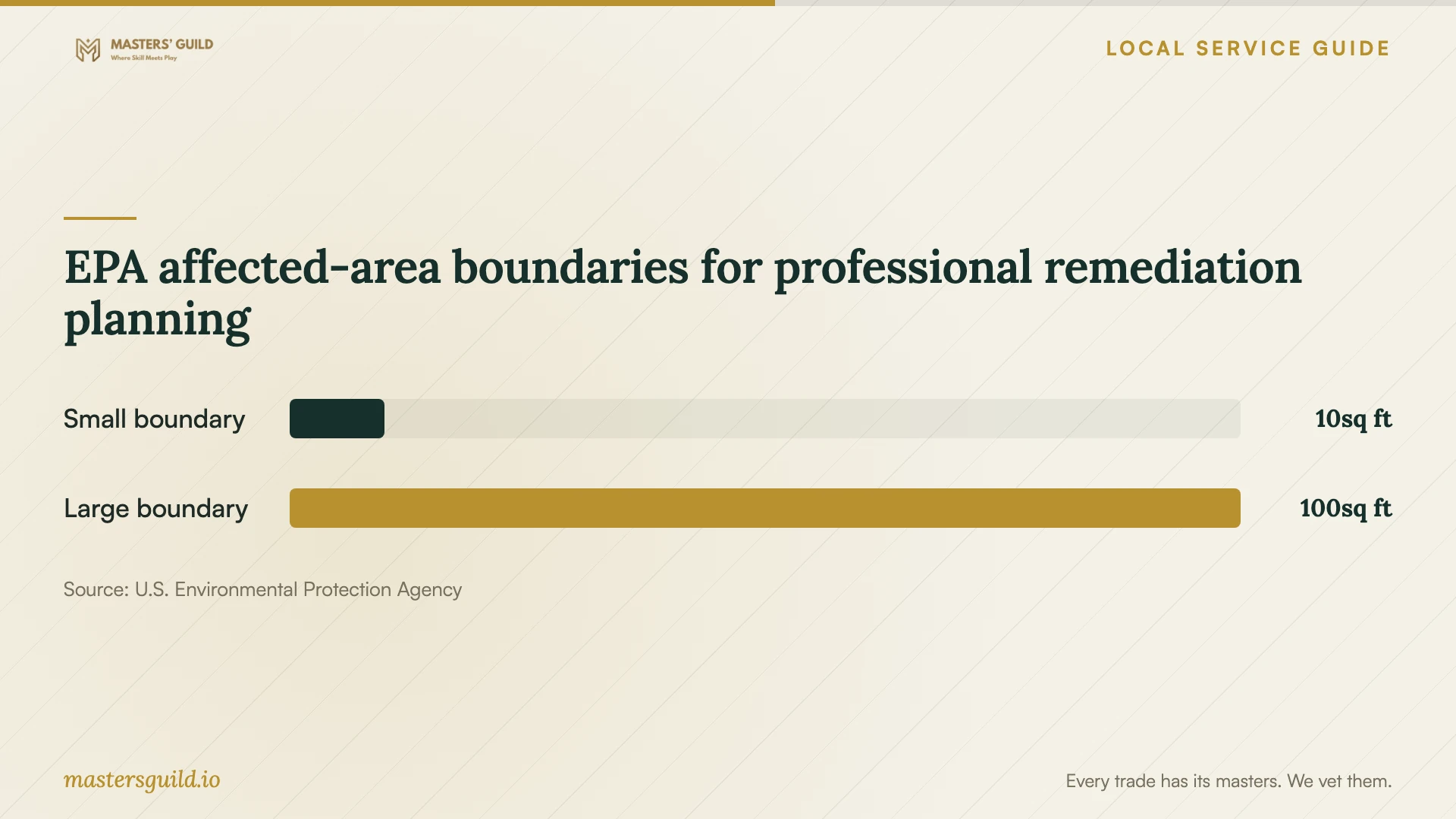
EPA’s professional-building guide considers both affected area and material type when planning protection and containment. Its area categories help professionals select techniques; EPA states that they do not represent health-effect thresholds. Use the chart’s boundaries to discuss the proposed protection, while leaving room for professional judgment about exposure and hidden damage. [3]
Coordinate moisture repair and household access
Assign responsibility for fixing the water problem. New York recommends repairing leaks, removing standing water, managing indoor humidity, and drying water-damaged items within 24 to 48 hours. It advises against painting or caulking over moldy surfaces. Include the relevant moisture correction in your arrangements rather than scheduling cosmetic repairs first. [1]
New York allows mold assessors or remediation contractors to perform underlying moisture repairs, but says repair or construction outside the remediation plan falls outside Article 32. Request a separate description of that work and have the provider identify any additional credentials or approvals needed for the proposed repair. [1]
Agree on access hours, equipment locations, routes for carrying out removed materials, and rooms your household can use. Tell the provider about pets and any household access needs. Obtain an occupancy plan before work starts, and confirm who will communicate changes if the crew discovers more damage.
For suspected sewage or other contaminated-water damage, consult a professional with experience in that situation. EPA’s area-based table addresses clean-water damage and calls for experienced help when the cleanup team lacks contaminated-water expertise. [3]
EPA affected-area boundaries for professional remediation planning
Local details that affect your job
New York’s hiring process applies to covered projects here
For a covered Yonkers project, arrange the independent assessment before collecting remediation quotes. New York requires the remediator to obtain the assessor’s plan and prepare a work plan that fulfills it. Decline a proposal that substitutes your waiver for the assessment. Preserve both plans to compare the agreed work with completion records. [1] [2]
Westchester licensing and work-standard complaints
The Department of Labor lists Westchester under its New York City District and gives the office number as 212-775-3532. Its Mold Program page provides a mold complaint form and says an inspector serving your county will investigate. For a licensing or work-standard concern, retain the contract, license information, plans, photographs, and correspondence so you can describe the issue. [2]
Choose your next step
| Situation | Next step | Reason |
|---|---|---|
| Affected area under 10 square feet; no mold sensitivity | Consider homeowner cleanup or professional advice | New York’s household guidance permits considering cleanup under these conditions. |
| Affected area greater than 10 square feet | Consider professional assessment and remediation | For covered contractor projects, New York requires assessment before remediation. |
| Suspected hidden mold or HVAC involvement | Discuss investigation and protection with an experienced professional | EPA’s professional-building guide recommends a more cautious approach. |
| Suspected sewage or contaminated water | Consult a professional experienced in that cleanup | EPA’s area-based table addresses clean-water damage. |
| Contractor requests an assessment waiver | Require the licensed-assessment process | New York does not allow an owner waiver to replace the assessment. |
Your hiring checklist
- Photograph visible damage and collect leak-repair records without disturbing suspected hidden contamination.
- Describe affected materials, recurring odors, and household sensitivities to the assessor.
- Verify business and relevant individual mold licenses through Department of Labor searches.
- Keep the assessment plan and use it when comparing remediation proposals.
- Request itemized costs and written approval procedures for additional work.
- Assign responsibility for moisture repairs, reconstruction, and household access.
- Agree on final assessment arrangements and completion records before signing.
Frequently Asked Questions
Do I need air testing before hiring someone?
New York says air sampling and mold testing are unnecessary in most cases. Testing and assessment are different: a licensed remediator still needs an independent assessment for a covered project. Have the assessor explain which decision any proposed sampling would help them make. [1]
Can I clean mold in my own home?
New York exempts residential owners performing mold work on their own property from licensing, without an area limit. Its household guidance says owners without mold sensitivity may consider cleaning affected areas under 10 square feet themselves and should consider professional assessment and remediation for larger areas or sensitivity. [1]
Can one licensed provider assess and remediate my project?
New York prohibits a licensee from performing both assessment and remediation on the same project. Confirm the separate roles before hiring and retain the assessor’s remediation plan and contractor’s work plan. [1]
How should I arrange the final check?
New York’s minimum work standards include a post-remediation assessment. Confirm the assessor, completion criteria, fee, and records before cleanup begins. Put responsibility for correcting unfinished work in the agreement. [2]
Sources and scope
This guide combines the sources below with practical planning guidance. Figures apply to the stated geography and period; request a written quote for your property.