
Local service guide
Data Recovery and Backup in Yonkers, NY
For Data Recovery and Backup in Yonkers, hire around your immediate problem: restoring a backup, recovering an unreadable device, or responding to a suspected compromise. Get a device-specific quote, define the files you need back, and confirm who handles equipment and credentials. For business records containing covered private information, include contractual safeguards and a separate breach-response contact. New York Attorney General guidance addresses both provider safeguards and notification obligations after a qualifying breach. [1]
Choose the scope before booking
Describe what happened without guessing the diagnosis. Give the device model, symptoms, last successful access, and any repair attempts. Tell the provider whether you have another copy of the files. For an unreadable or damaged device, obtain handling instructions before attempting further repairs.
A ransom message or suspected intrusion calls for coordinated incident response. CISA advises disconnecting affected systems from the network and prioritizing critical services for restoration on a clean network. It recommends powering down only if you cannot disconnect through other means, because shutdown loses potential evidence in memory. Contact your IT or incident-response lead before reconnecting equipment or restoring business files. [2]
Prepare the handoff and acceptance checks
Create a short priority list: the accounting database, current customer documents, or the workstation needed to run a particular application. For each item, describe a usable result. Opening a document and checking its contents gives you a clearer acceptance step than counting recovered filenames.
Locate encryption recovery keys and passwords in your secure records. CISA warns that losing them can lead to permanent data loss. Share required credentials through a method you approve, after the technician explains the access needed. Keep passwords out of general quote requests. [3]
For collection at your premises, confirm the address, appointment window, named recipient, and receipt. Record serial numbers and document any transfer to another laboratory. Establish who will contact you with the assessment and whether the delivery deadline includes transport and your approval time.
Compare quotes by scope and payment terms
Obtain itemized quotes for assessment, recovery, return storage, transport, and urgent service. Set a spending limit with approval before extra work. Compare quotes for the same device and requested outcome; confirm collection arrangements, laboratory transfers, and deadlines before choosing.
Define what you owe for unsuccessful or partial recovery. Include a file inventory and an opportunity to check representative documents or application data before accepting delivery. Keep recovery work and future backup setup as separate scopes so you can evaluate each result.
Set privacy and incident-response responsibilities
New York Attorney General guidance says people or businesses maintaining private information must adopt administrative, technical, and physical safeguards. Its examples include contractual provider safeguards and protection against unauthorized access during transportation and disposal. Discuss these terms before handing over equipment containing covered information. [1]
Put technician access, subcontractors, transfer protection, retained copies, and deletion arrangements in the agreement. CISA recommends limiting third-party access to devices and servers within their responsibilities. Name the person who approves access and removes it when the work ends. [2]
Keep suspected unauthorized access on a separate response track from file recovery. The Attorney General explains that the SHIELD Act expanded the breach definition to include unauthorized access that compromises private data. Its guidance also describes consumer notification obligations after a qualifying breach. Have your incident-response and legal contacts assess that question while the technician handles recovery. [1]
Specify the backup service you will accept
State how much recent work you can afford to lose and how long you can operate without each application. Have the installer document included systems, backup frequency, retention, storage location, failure alerts, and your responsibilities. Include account ownership and a handover procedure if you change providers.
CISA recommends offline encrypted backups of critical data and tests of backup availability and integrity. Its device guidance advises disconnecting an external backup drive when you are not backing up, because ransomware can delete or corrupt connected backups. Include a restore demonstration to a separate destination and check that you can use the selected files. [2] [3]
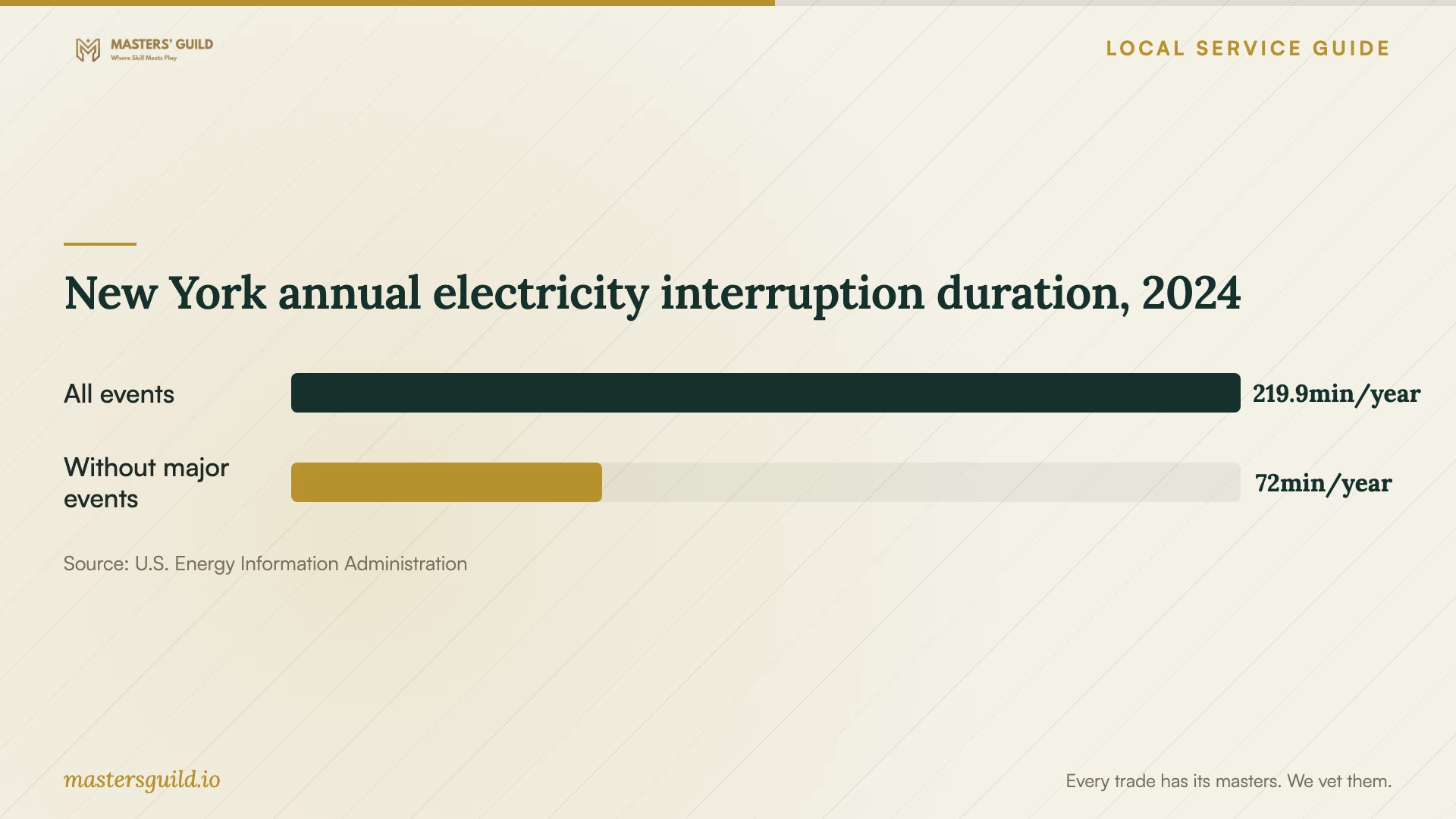
Include power interruption in the installation discussion. EIA reports New York statewide annual interruption-duration averages of 219.9 minutes including major events and 72 minutes excluding them for 2024. Use those historical figures as continuity context. Specify a test of backup restart behavior and failure alerts based on your equipment and working hours. [4]
New York annual electricity interruption duration, 2024
Local details that affect your job
New York safeguards change the recovery agreement
For a Yonkers business maintaining covered private information, New York Attorney General guidance calls for selecting providers capable of appropriate safeguards and requiring those safeguards by contract. Before authorizing a handoff, document who receives the device, who can access the files, and how the provider protects transportation and disposal. Evaluate these arrangements alongside the recovery quote. [1]
New York breach duties change the response team
New York's breach definition includes unauthorized access that compromises private data, and the Attorney General describes consumer notification duties after a qualifying breach. If you suspect access to covered business records, arrange an incident-response contact and legal review alongside recovery. Request preservation of relevant logs and an incident timeline rather than authorizing file restoration alone. This is a statewide obligation relevant to businesses here, separate from the safeguards used to select a recovery provider. [1] [2]
Match the job to the problem
| Situation | Service to request | Acceptance or preparation step |
|---|---|---|
| You have an existing backup | Backup assessment and supervised restoration | Identify priority files and agree on a separate restoration destination. |
| A device is unreadable or damaged | Device assessment and recovery proposal | Obtain handling instructions, assessment fees, and approval limits. |
| You suspect ransomware | Incident response with coordinated recovery | Isolate affected systems; plan restoration on a clean network. |
| You suspect unauthorized access to private records | Incident assessment with legal coordination | Preserve relevant evidence and assess New York breach-notification duties. |
| You need ongoing protection | Backup setup, monitoring, and restore testing | Specify offline encrypted critical-data backups and test usable restoration. |
Your hiring checklist
- Record the device identifiers, symptoms, last successful access, and previous repair attempts.
- List priority files and applications with a usable-result check for each.
- Inventory existing backups and locate encryption recovery keys in secure records.
- Obtain itemized assessment and recovery terms, including partial and unsuccessful outcomes.
- Confirm collection, laboratory transfers, receipts, approval limits, and delivery deadlines.
- Document access permissions, subcontractors, retained copies, and deletion arrangements.
- For suspected compromise, name incident-response and legal contacts before authorizing restoration.
- Include a restore demonstration, failure alerts, and an ownership handover in backup setup.
Frequently Asked Questions
How should I budget for recovery?
Request a device-specific assessment and itemized quote. Confirm assessment fees, urgent service, transport, return storage, and payment for partial or unsuccessful recovery. Set an approval limit before the provider starts additional work.
Can I restore the backup myself?
Consider a supervised restore if you cannot verify the process or result. For suspected ransomware, coordinate with your incident-response contact first. CISA recommends clean-network restoration and precautions against reinfecting recovered systems. [2]
Does recovering the files resolve a suspected breach?
Arrange a separate assessment of unauthorized access. New York Attorney General guidance includes access that compromises private data within the breach definition and describes notification duties after a qualifying breach. Have an incident-response specialist and legal contact assess your circumstances. [1]
How do I check the backup installation?
Have the installer restore selected files to a separate destination and demonstrate that you can use them. Document the backup date and test result, then assign responsibility for repeat tests and failure alerts. CISA recommends testing backup availability and integrity. [2]
Sources and scope
This guide combines the sources below with practical planning guidance. Figures apply to the stated geography and period; request a written quote for your property.