
Local service guide
Concrete Work in Winston-Salem, NC: Planning Guide
For Concrete Work in Winston-Salem, arrange a site inspection and compare written quotes covering dimensions, preparation, drainage, finish, approval responsibilities, and return to use. Before authorizing driveway demolition, check whether the contractor will affect the sidewalk, curb, street, or public right-of-way. The city exempts single-family homes from its driveway-permit requirement but provides separate approval processes for infrastructure cuts and right-of-way excavation. [1] [2]
Prepare the site information contractors need
Photograph the damaged area and its connections to steps, garage thresholds, drains, and adjoining pavement. Show the contractor where you have observed puddles or movement. Request a site inspection and an explanation of what the proposed treatment addresses, what it leaves unresolved, and whether another scope deserves consideration.
For a new patio or driveway, describe vehicle use, walking routes, furniture, and future expansion. Prepare a dimensioned sketch and have the contractor mark proposed elevations and drainage destinations. Keep photographs and the sketch with your quote requests so each bidder works from the same information.
Identify approvals before demolition
The city's driveway-permit guidance distinguishes single-family homes from commercial and multifamily properties. Within city limits, the city requires driveway permits for commercial and multifamily properties and for private streets connecting to public streets. It exempts single-family homes from this driveway-permit requirement. [1]
For a commercial or multifamily driveway within city limits connecting to an NCDOT-maintained street, the city requires both City and NCDOT approval. Applicants submit the NCDOT application and review fees to NCDOT. The city's application calls for a PDF sketch showing buildings, driveways, pavement and right-of-way widths, street features, and storm drainage details, plus a signed application. [1]
The city provides an excavation application for work encroaching on the public right-of-way and a separate permit contact for street, sidewalk, driveway, and curb-and-gutter cuts. Have the contractor identify affected infrastructure and confirm the applicable approval route before arranging removal. Put the responsible person's name and application work in the agreement. [1] [2]
Define the paved area for stormwater permitting
In its post-construction stormwater permitting guidance, the city defines impervious or built-upon area as development covered by impervious or partially pervious surfaces that prevent water from infiltrating into the subsoil. Examples include buildings, pavement, and gravel areas used for roads, parking lots, paths, and recreation facilities. Do not assume a gravel alternative falls outside this definition. [4]
The same guidance identifies pervious concrete that absorbs water and allows infiltration as an example outside that permitting definition. If you want a permeable option, ask the contractor to explain its proposed construction, site suitability, and maintenance. Have the relevant city office confirm how the proposed surface fits the permitting definition; confirm utility billing treatment with Stormwater Billing. [3] [4]
The city states that stormwater permit and control requirements depend on development size and applicable thresholds, exclusions, and exemptions. For redevelopment, its guidance exempts projects whose proposed impervious area equals or falls below the preexisting area from the ordinance's water-quality and water-quantity provisions. Confirm that your full project qualifies before relying on this provision; it does not answer the separate driveway or infrastructure-cut questions. [1] [2] [4]
Check recurring stormwater charges before adding paving
The city bases residential stormwater billing on total property impervious surface area. Its published rate schedule took effect January 1, 2026. Before widening a driveway or adding a patio, contact Stormwater Billing to confirm the recorded total and ask how the proposed addition would affect your category. Use the whole-property area when discussing the bill. [3]
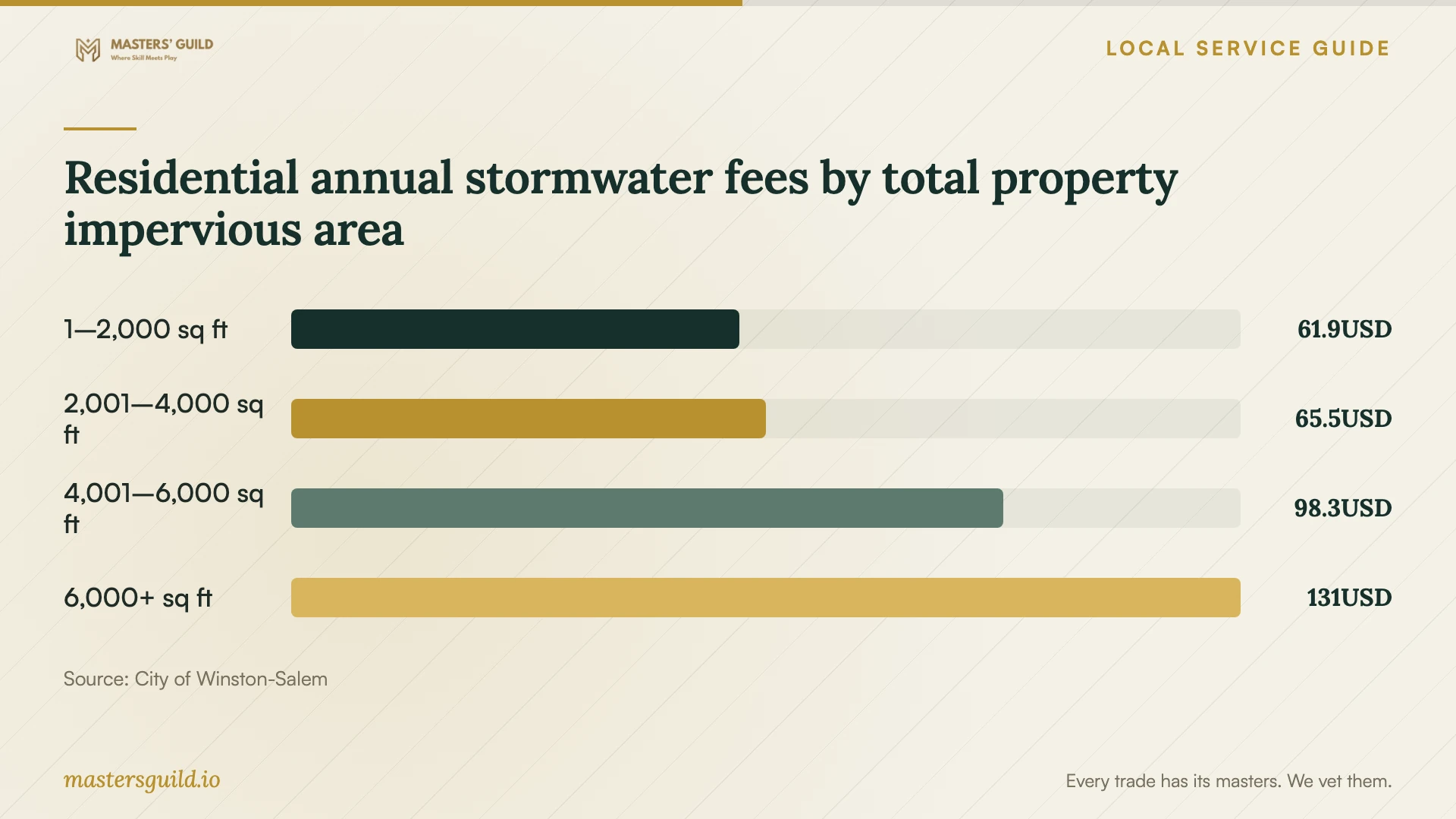
The city publishes annual residential charges of $65.51 for 2,001 to 4,000 square feet and $98.26 for 4,001 to 6,000 square feet. Its highest category says 6,000 plus, overlapping the preceding category at exactly 6,000 square feet. Ask billing staff to resolve that boundary for your property rather than choosing a category yourself. [3]
Use these utility charges to discuss recurring property costs. They do not establish contractor installation prices. Request a site-specific construction quote and keep any projected billing change separate from demolition, preparation, placement, and finishing charges. [3]
Compare specifications and payment terms
Request written descriptions of demolition and disposal, excavation, base preparation, concrete placement, and restoration. Have contractors specify slab thickness, mix, reinforcement, joint layout, and finish for your intended use. If bids differ, ask each contractor to explain the difference and identify excluded work.
Discuss truck access, pumping arrangements, protection of adjoining surfaces, and cleanup. Request insurance documentation and references for similar projects. Agree on payment milestones, written warranty terms, and how you will approve extra work after unexpected site conditions. Keep the approved scope with the contract.
Arrange access, care, and handover
Before accepting a start date, arrange parking and a walking route around the work. Obtain a weather contingency and written care instructions. Have the contractor distinguish when you may walk on the surface, park vehicles, and place heavy items. Ask who will protect the work between crew visits.
Walk through the completed project with the contractor and compare it with the agreed sketch. Review drainage arrangements, adjoining surfaces, restoration, and cleanup. Record unresolved items and agreed follow-up dates. Retain approval records, progress photographs, care instructions, and warranty terms.
Residential annual stormwater fees by total property impervious area
Local details that affect your job
Confirm street and sidewalk cut approval
The city publishes 336-734-1547 as the permit contact for street, sidewalk, driveway, and curb-and-gutter cuts. If your replacement includes an apron, sidewalk, or curb cut, describe the exact work to that office before authorizing demolition. The single-family driveway-permit exemption does not resolve this separate approval question. [1] [2]
Check the recorded billing area
Contact Stormwater Billing at 336-748-3221 with your proposed dimensions and ask staff to confirm your property's recorded impervious area and billing category. The city's published residential annual fees range from $61.87 to $131.01 under its schedule effective January 1, 2026. [3]
Establish the parcel's stormwater jurisdiction
The city's post-construction stormwater permitting reviews apply within Winston-Salem city limits. The city also reviews stormwater plans for county areas within the Salem Lake Watershed under the UDO environmental ordinance. For other properties outside city limits, its guidance directs applicants to the relevant municipal or state authorities. Confirm your parcel's location before choosing an application route. [4]
Choose the next step for your concrete project
| Project situation | Next step | Include in the quote |
|---|---|---|
| Damaged private slab | Arrange an inspection and discuss repair, leveling, and replacement options. | Treatment boundaries, preparation, drainage work, and warranty terms. |
| Single-family driveway replacement | Check cut and right-of-way requirements alongside the city's driveway-permit exemption. | Approval responsibility and demolition limits. |
| Commercial or multifamily driveway within city limits | Arrange the city driveway permit and confirm dual approval for an NCDOT-maintained street connection. | Application coordination, sketch preparation, and approval timing. |
| Patio addition or driveway widening | Confirm the whole-property impervious total and billing category with Stormwater Billing. | Added area, drainage destinations, and restoration. |
| Pervious concrete proposal | Confirm the permitting definition and obtain a separate answer on billing treatment. | Proposed construction, site requirements, and maintenance instructions. |
Your hiring checklist
- 1. Photograph damage, puddles, thresholds, adjoining pavement, and the street connection.
- 2. Prepare a dimensioned sketch and describe how you intend to use the surface.
- 3. Arrange a site inspection and request treatment options with their limits.
- 4. Identify infrastructure cuts and right-of-way work; confirm approvals and assign responsibility.
- 5. Confirm permitting treatment and recorded stormwater billing area before approving added paving.
- 6. Compare written specifications, exclusions, disposal, restoration, and warranty terms.
- 7. Agree on payment milestones, extra-work approval, weather contingencies, and return-to-use instructions.
- 8. Review the completed work with the contractor and retain the project records.
Frequently Asked Questions
Do I need a permit to replace my home's driveway?
The city exempts single-family homes from its driveway-permit requirement. It provides separate processes for infrastructure cuts and excavation encroaching on the public right-of-way. Describe the full scope to the city, including any sidewalk, curb, or street work, before relying on the exemption. [1] [2]
Will adding a patio increase my stormwater bill?
The city bases residential charges on total property impervious area. Contact Stormwater Billing to confirm whether the addition would change your recorded total and category. A proposed patio's dimensions alone do not establish the property's billing category. [3]
Does gravel count as impervious area?
The city's stormwater permitting definition includes gravel areas that prevent infiltration, including examples such as roads and parking lots. Its guidance also describes specific surfaces outside that definition. Have staff assess your proposed construction rather than assuming that all gravel qualifies for an exclusion. [4]
Does pervious concrete guarantee a lower stormwater charge?
The city's permitting guidance identifies pervious concrete that absorbs water and permits infiltration as outside its impervious-area definition. That permitting statement does not establish your billing classification. Obtain a separate answer from Stormwater Billing before budgeting for a lower charge. [3] [4]
Sources and scope
This guide combines the sources below with practical planning guidance. Figures apply to the stated geography and period; request a written quote for your property.