
Local service guide
Winston-Salem appliance installation: Plan your hookup
Arrange appliance installation in Winston-Salem by confirming the model, existing connections, delivery access, and old-appliance removal before you book. Ask the installer to separate the appliance hookup from any plumbing, electrical, or gas changes and identify who will handle permit questions. The city lets licensed contractors apply for trade permits through BuildIT, while homeowners can use guest access to check permit status and inspection comments. [1]
Choose an installer for the complete scope
Describe the job as a specific installation: a replacement dishwasher in the same opening, a washer and dryer using existing connections, or a range that needs connection changes. Give the installer the exact model number and ask them to review the manufacturer's installation instructions. Ask whether their quoted service includes disconnection, positioning, hookup, testing, and removal.
Request separate prices for connection alterations, cabinet work, parts, and haul-away. Ask for the name of anyone who will perform plumbing, electrical, or gas work, along with their credentials and insurance information. For work that may need a permit, ask the installer to confirm the scope with the Inspections Division before you commit to a delivery date.
Use the city's BuildIT process to clarify responsibilities. Licensed contractors with a Contractor ID can apply for trade permits and schedule inspections. Homeowners using guest access can search permits and read inspection comments. Ask for the permit number when applicable so you can follow the work through that public record. [1]
Prepare the opening and delivery route
Measure the appliance opening and the route from the delivery entrance. Include doorways, turns, stairs, and the space needed to open the appliance door. Share photos of the opening, nearby cabinets, floor, and visible connections. Ask the installer to confirm fit against the model's instructions rather than relying on the dimensions of the appliance you are replacing.
For a dishwasher, show the installer the under-sink area and existing supply, drain, and power arrangement. For laundry equipment, photograph the water valves, drain connection, dryer outlet, and vent connection without moving equipment you cannot handle safely. For a gas appliance, ask the installer to inspect the connection and explain the required work; leave disconnection and connection to someone qualified for that scope.
Agree on who brings hoses, cords, fittings, or mounting parts. Ask what happens if the installer finds a connection that needs repair or an opening that does not fit. Get the charge for a return visit and the process for approving extra work in writing. Coordinate delivery and installation after the installer has reviewed your photos and measurements.
Decide how the old appliance will leave
Choose a removal plan before the replacement arrives. Winston-Salem city crews collect appliances during the annual neighborhood cleanup. The city limits that service to single-family homes, excludes apartments and businesses, and makes one pass through each neighborhood. Put eligible items out the weekend before your assigned collection week and keep them separate from yard waste, brush, and recyclables. [2]
For a replacement you are arranging now, request a haul-away price or plan a landfill trip. The city's published 2026 bulky-item schedule ends with the August 31 through September 4 collection week. As of October 10, those listed dates have passed, so do not plan your installation around an upcoming collection in that published schedule. [2]
The city accepts white goods free of charge at Hanes Mill Road Landfill. Its examples include refrigerators, ranges, dishwashers, washing machines, and dryers. It excludes microwave ovens and garbage disposals from the white-goods category. Confirm the disposal route for your particular appliance and arrange help and transport before choosing self-drop-off over installer removal. [3]
Compare dishwasher criteria before ordering
Check capacity, cabinet fit, and connection requirements before choosing a dishwasher. ENERGY STAR classifies standard dishwashers as holding at least eight place settings plus six serving pieces; compact models hold fewer than eight place settings plus six serving pieces. These are capacity categories, so ask the installer to review the dimensions of the actual model you intend to buy. [4]
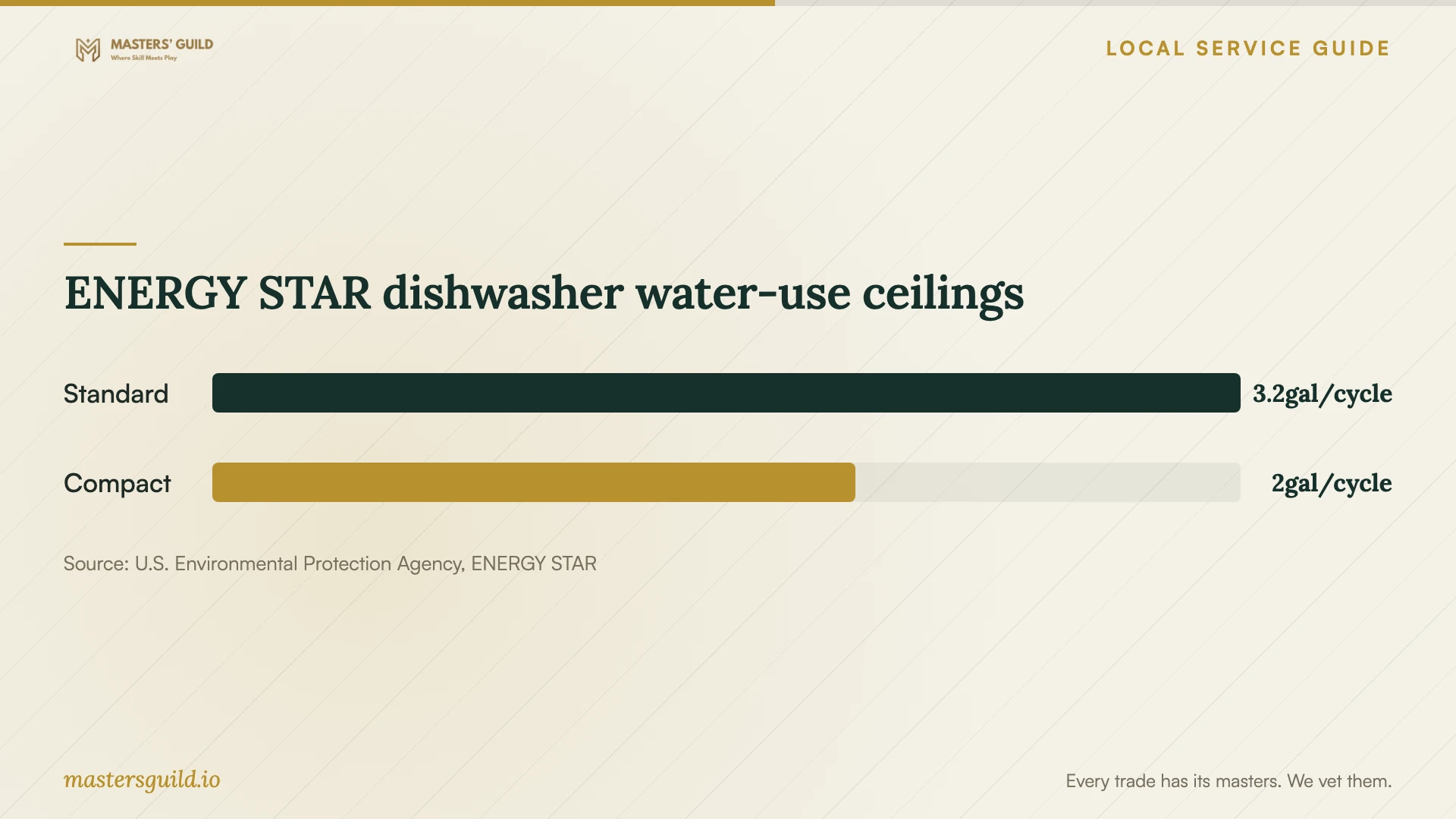
The national reference chart compares ENERGY STAR's water-use ceilings: 3.2 gallons per cycle for standard dishwashers and 2.0 for compact dishwashers. Use those criteria as one part of product selection. They do not establish a household's water bill or installation cost. Compare the specific models' capacity and EnergyGuide information alongside the installer’s fit assessment. [4]
Agree on the handover before work starts
Ask the installer to include the manufacturer's required installation checks in the written scope. Request a demonstration of operation, a check of the connections they worked on, and an explanation of any issue that needs a follow-up visit. Ask them to leave the instructions and document any parts they replaced.
Before accepting completion, review the appliance's position, door movement, and agreed testing with the installer. Keep the invoice and any permit number together. Agree on whom to contact if you notice a leak, movement, or an operating problem after the visit, and ask what the installer’s workmanship coverage includes.
ENERGY STAR dishwasher water-use ceilings
Local details that affect your job
Track trade permits through BuildIT
The city provides guest access for permit searches, inspection comments, and permit status without an account. Guests cannot apply for trade permits or schedule inspections; licensed contractors use Contractor access for those tasks. Ask who will handle the permit and inspection before booking work that changes connections. Call the Inspections Division at 336-727-2624 to clarify the process for your scope. [1]
Curbside collection has eligibility and timing limits
Annual neighborhood bulky-item collection serves single-family homes and excludes apartments and businesses. Crews make one pass, and the city says late items will not be collected. Its published 2026 dates end September 4. For an October replacement, arrange removal or drop-off rather than leaving the old appliance at the curb for an assumed pickup. [2]
Eligible white goods have a free drop-off option
Hanes Mill Road Landfill accepts eligible white goods free of charge. The city lists washers, dryers, dishwashers, ranges, and refrigerators among them, while excluding microwaves and garbage disposals from that category. The bulky-items page gives the landfill address as 325 W Hanes Mill Road. Compare transport and lifting arrangements with the installer's haul-away charge. [2] [3]
Choose the next step for your installation
| Your situation | Next step | Confirm before booking |
|---|---|---|
| Replacement using existing connections | Ask an appliance installer to review the model and connection photos. | Fit, included parts, disconnection, hookup, and testing. |
| Plumbing, electrical, or gas changes | Ask who will perform the trade work and clarify permit requirements with Inspections. | Trade contractor, permit responsibility, inspection arrangements, and separate price. |
| Eligible annual curbside collection | Check the neighborhood collection schedule and single-family eligibility. | Placement the weekend before collection; crews make one pass. |
| Old washer, dryer, dishwasher, range, or refrigerator | Compare installer haul-away with free white-goods drop-off at Hanes Mill Road Landfill. | Transport, lifting help, and the appliance's eligibility. |
| Old microwave or garbage disposal | Confirm another disposal route before delivery. | The city excludes these from its white-goods category. |
Your hiring checklist
- Send the model number and manufacturer's installation instructions to the installer.
- Measure the opening, doorways, turns, and stairs along the delivery route.
- Share photos of visible connections and describe any known damage or access problem.
- Get separate written charges for hookup, parts, alterations, and removal.
- Ask who will confirm permit requirements, obtain any permit, and arrange inspections.
- Choose haul-away or a confirmed disposal plan before delivery.
- Agree on testing, handover documentation, and the contact for installation problems.
Frequently Asked Questions
Does an appliance replacement need a permit?
Confirm the requirements for your exact scope with the installer and Inspections Division. The BuildIT page explains how licensed contractors obtain trade permits, but it does not give an appliance-by-appliance exemption list. Describe whether the work changes plumbing, electrical connections, or gas connections when asking. [1]
Can I check the installer's permit myself?
Yes. BuildIT guest access lets you search permits, view their status, and read inspection comments without creating an account. Ask the installer for the permit number when applicable. Guests cannot apply for trade permits or schedule inspections. [1]
Will the city collect my old appliance after installation?
City curbside appliance collection follows the annual neighborhood cleanup schedule and serves single-family homes, excluding apartments and businesses. The published 2026 schedule ends September 4. For an October installation, arrange haul-away or an eligible landfill drop-off. [2] [3]
Does free landfill drop-off mean free appliance removal?
The city offers free drop-off for eligible white goods at Hanes Mill Road Landfill. You still need to arrange disconnection, lifting, and transport. Ask the installer for a separate removal price so you can compare that service with transporting the appliance yourself. [3]
Sources and scope
This guide combines the sources below with practical planning guidance. Figures apply to the stated geography and period; request a written quote for your property.