
Local service guide
Mold Removal in Vancouver: Hiring and Work Planning
Arrange Mold Removal in Vancouver by asking contractors to assess affected materials, explain their moisture investigation, and quote cleanup and rebuilding separately. Before agreeing to a start date, confirm WorkSafeBC notification requirements and responsibilities for any asbestos work. BC guidance requires a notice of project for mould remediation affecting more than 10 contiguous square metres, with submission at least 48 hours before the applicable work begins. [1]
Get an assessment before choosing a cleanup scope
Prepare photographs, the location of affected surfaces, and a description of any leak or water entry you have observed. Ask the assessor to record visible findings and suspected contamination as separate items. WorkSafeBC describes both visible mould and hidden contamination behind walls, in conduits, and in chases. [1]
Request an explanation of any proposed opening of walls or ceilings. Ask which materials the contractor intends to remove, which they intend to clean, and how they will protect adjoining rooms. WorkSafeBC warns that workers can release spores in high concentrations when they disturb mouldy building materials. Ask for exposure controls before authorizing demolition. [1]
For recurring growth, request a moisture investigation as part of the proposal. Name the person responsible for investigating the suspected source and arranging repairs. Ask the contractor to explain how they will document their findings and flag anything they cannot assess within the agreed scope.
Compare quotes and define completion
Give each contractor the same work description. Ask them to separate assessment, cleanup, disposal, moisture-source repairs, and replacement finishes. For work that depends on opening a wall, request a written allowance or pricing method and a procedure for approving additional charges. Set a spending limit that requires your approval before the crew proceeds.
Ask who will supervise the work and request evidence of relevant training, liability insurance, and experience with the proposed methods. Have the contractor explain containment, equipment placement, debris removal, and access restrictions. Agree on a written completion standard and the records you will receive before signing.
For a condo, discuss access and the proposed work with your strata contact before booking. Ask about equipment delivery, elevator reservations, shared corridors, and proposed work outside your unit. Confirm your building’s arrangements and identify who will communicate with the contractor during the job.
Request a schedule that distinguishes investigation, removal, moisture repairs, and rebuilding. Ask which stages depend on findings from earlier work and who will notify you about changes. Use the contractor’s assessed scope to plan access and room use; ask them to explain any proposed restrictions before you commit.
Confirm BC notice timing before booking
WorkSafeBC’s mould guidance requires a notice of project for remediation, cleanup, or demolition of mould-contaminated areas where the total affected surface area exceeds 10 contiguous square metres. Ask the contractor to document the affected area and explain how they determined whether the requirement applies to your project. [1]
For the listed exposure-related construction activities, WorkSafeBC requires submission at least 48 hours before starting and posting a copy at the construction site before work begins. The regulatory excerpt assigns notification duties to all employers responsible for the activity and either the owner or the engaged prime contractor. Confirm the submission arrangements and request a copy. [1]
Ask the contractor to address municipal approvals for associated repairs as a separate planning item. Have them identify who will confirm requirements for the proposed rebuilding scope and who will obtain any applicable approvals. Record that responsibility before authorizing reconstruction.
Identify who will perform any asbestos work
Ask how the contractor will handle suspected asbestos before agreeing to material removal. WorkSafeBC’s definition of building-related asbestos abatement includes identifying and sampling suspected asbestos-containing material, assessing risks, removing or repairing it, and planning or supervising those activities when undertaken for asbestos abatement. [2]
Employers offering asbestos abatement services to others in relation to buildings require a valid licence. WorkSafeBC lists fire and flood restoration contractors and asbestos surveyors among its examples. Ask which employer will carry out the assessment, sampling, and removal, and request the credentials applicable to those tasks. [2]
WorkSafeBC lists independent operators performing building-related asbestos abatement as exempt from mandatory business licensing, with licensing optional. Anyone doing asbestos abatement in relation to a building at a workplace needs certification. Confirm the provider’s operating arrangement and the certificates of the people performing the work. [2]
WorkSafeBC also distinguishes coordination from performing asbestos abatement: prime and general contractors whose employees do not perform that work can coordinate another employer’s abatement without holding an asbestos abatement licence. Ask your main contractor to name the asbestos provider and explain who will supervise and coordinate each stage. [2]
Plan rain-entry checks and follow-up
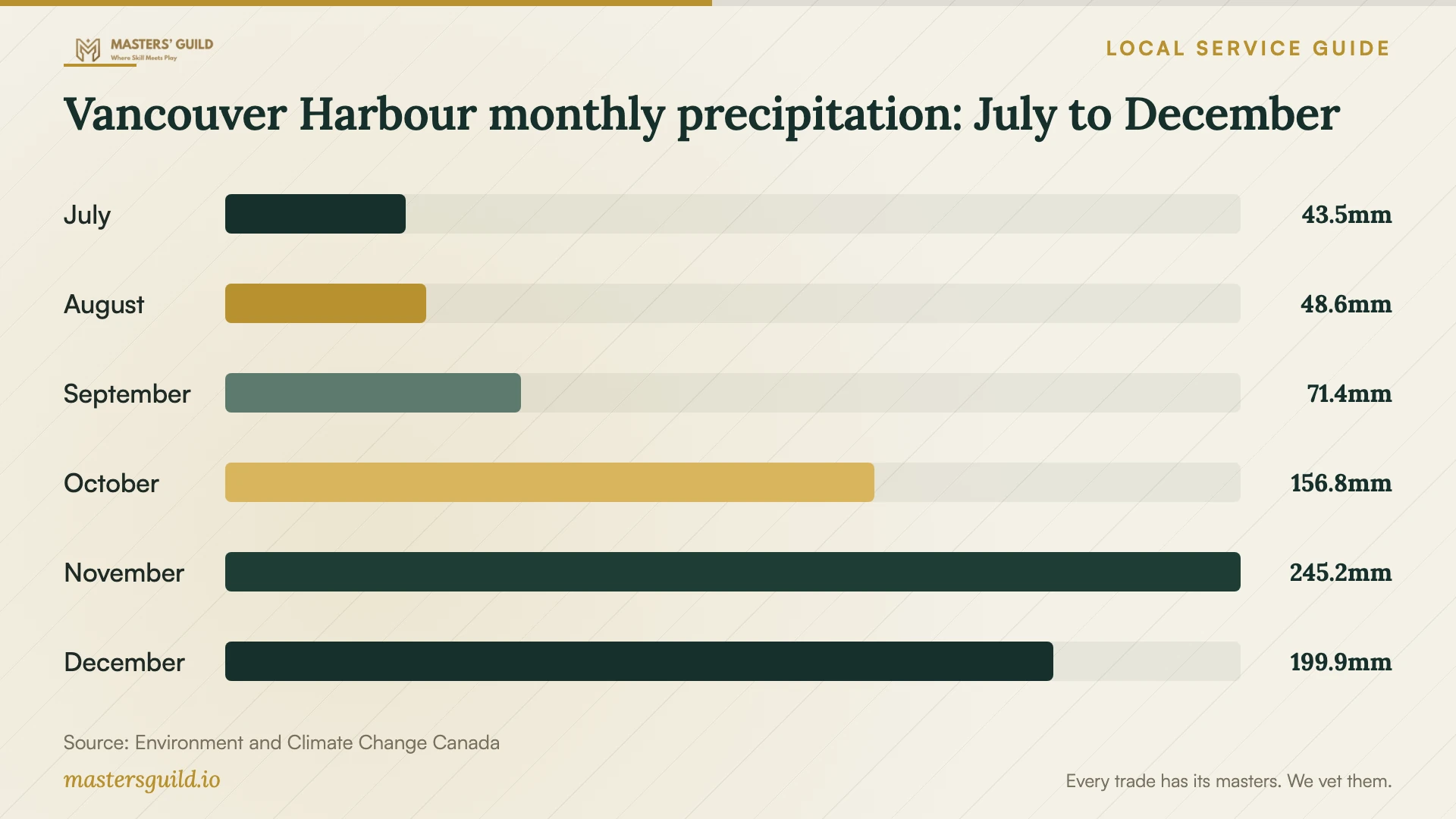
Environment and Climate Change Canada’s 1991–2020 Vancouver Harbour normals record monthly precipitation of 71.4 mm in September, 156.8 mm in October, and 245.2 mm in November. Use these historical averages as context when discussing suspected rain entry and arranging observations after repairs. Ask the assessor to investigate your home’s conditions rather than drawing a diagnosis from outdoor weather data. [3]
Before the contractor leaves, request photographs of completed work, a record of inspected areas, and a list of unresolved concerns. Agree on who will check the repaired area and how you should report renewed staining, dampness, or growth. Keep the assessment, notices, invoices, and completion records together.
Vancouver Harbour monthly precipitation: July to December
Local details that affect your job
BC notification affects the start date
For covered mould work exceeding 10 contiguous square metres, WorkSafeBC requires a notice of project at least 48 hours before starting and a copy posted at the site before work begins. Apply this provincial requirement when planning work in Vancouver: confirm the measured area, notification responsibilities, and submission date before accepting the crew’s start date. [1]
BC asbestos credentials depend on the provider
If the scope includes asbestos abatement, identify the employer or independent operator performing it. WorkSafeBC requires licences for employers providing building-related asbestos abatement to others and lists independent operators as exempt from mandatory business licensing. Anyone performing that abatement at a workplace needs certification. Ask for credentials that match the actual provider and tasks before authorizing the asbestos work. [2]
Choose the next step for your proposed work
| Situation | Next step | Question to ask |
|---|---|---|
| Growth returns after previous cleaning | Request a moisture investigation before authorizing another cleanup. | Who will investigate the source and arrange repairs? |
| Contractor suspects contamination behind finishes | Request an investigation plan and exposure controls for disturbing materials. | Which findings support opening this wall or ceiling? |
| Affected area exceeds 10 contiguous square metres | Confirm the WorkSafeBC notice, 48-hour submission timing, and site posting. | Who submits the notice, and when will I receive a copy? |
| Scope includes asbestos abatement | Confirm the provider’s applicable business licensing and worker certification requirements. | Which employer or independent operator will perform these tasks? |
| Quote includes replacement walls or finishes | Separate rebuilding from remediation and assign approval responsibilities. | Who confirms approvals and authorizes additional charges? |
Your hiring checklist
- Photograph affected surfaces and describe observed leaks, water entry, or recurrence.
- Ask the assessor to record visible findings and suspected hidden contamination separately.
- Request a written removal scope, exposure controls, and debris route.
- Confirm notification responsibilities and timing before agreeing to the start date.
- Identify who will handle suspected asbestos and request applicable credentials.
- Compare cleanup, moisture repairs, disposal, and rebuilding as separate quote items.
- Agree on access restrictions, additional-charge approvals, completion records, and follow-up.
Frequently Asked Questions
Does every mould cleanup require a WorkSafeBC notice?
WorkSafeBC’s cited mould guidance specifies a notice for remediation, cleanup, or demolition when the total affected surface area exceeds 10 contiguous square metres. Its guidance also lists other hazardous activities with notification requirements. Ask the contractor to assess the complete work scope and document the applicable triggers. [1]
What credentials should I check if the job includes asbestos?
Identify the provider and the tasks they will perform. WorkSafeBC requires a valid licence for employers offering building-related asbestos abatement to others, lists an independent-operator licensing exception, and requires certification for anyone performing building-related asbestos abatement at a workplace. Ask for the credentials applicable to your provider. [2]
Can I compare quotes based on photographs?
Use photographs to describe the job, then ask each contractor what they can confirm and what needs an inspection. WorkSafeBC describes hidden contamination behind walls and in other building spaces. Request written assumptions, exclusions, and a procedure for approving work after the contractor opens finishes. [1]
How should I plan the work around rain?
Ask the assessor whether suspected rain entry needs investigation or repair and how they will check the result. The Vancouver Harbour normals provide historical seasonal precipitation data. Choose your schedule using the assessment of your home and the proposed work, and agree on follow-up observations after repairs. [3]
Sources and scope
This guide combines the sources below with practical planning guidance. Figures apply to the stated geography and period; request a written quote for your property.