
Local service guide
Plan art instruction in Toronto: Classes and Lessons
Choose art instruction in Toronto by matching the learner’s goal, age and medium to the teaching format. Compare an instructor-led City course with a private instructor’s proposed lesson plan, and confirm supplies, total cost and cancellation terms before paying. City arts drop-ins offer independent practice rather than instruction, so choose a registered course if you want teaching. [1]
Choose teaching that fits your goal
Start with a concrete goal: learn watercolour washes, practise drawing proportions, or help a child explore materials. Ask the instructor how they would teach that goal to someone at your current level. Request examples of lesson exercises as well as finished artwork; judge whether you understand the explanation and feel comfortable asking questions.
The City lists drawing, acrylic painting, watercolour, oil painting, pottery and other visual arts activities, with different age categories for each. Registered activities provide instructor-led group classes over several weeks. Check the specific activity listing for its age range, location and dates before choosing it. [1] [4]
Consider a private instructor if you want a proposed plan around your own project, schedule or learning needs. Ask how much of the lesson involves demonstration, your own practice and individual feedback. For a shared lesson, ask how the instructor will divide attention between learners with different goals.
Compare the full commitment before paying
Request a written total for the arrangement you want. Specify the number and length of lessons, number of learners, teaching location and medium. Ask the instructor to identify charges for materials, travel, setup, cleanup and any applicable tax. Compare the total commitment alongside teaching time and the supplies you will keep.
Before buying equipment, get a supply list with quantities and acceptable alternatives. Ask whether you can use materials you already own. For pottery, ask about tools, firing, glazing and collection of finished work. For painting at home, agree on table protection, water access, storage and cleanup.
Check cancellation terms before booking a series. The City permits withdrawal or refund requests up to the third class and lists a CAD 14.13 administration fee per person, per activity for those requests. It prorates refunds and credits from the date it receives the request rather than from attendance. Use the City’s process for municipal bookings and request separate written terms from a private instructor. [2]
Check recreation funding before choosing a course
Toronto’s Welcome Policy supports eligible residents with recreation credits. The main applicant must be at least 18, live in Toronto and meet the after-tax family-income requirement. The City publishes thresholds by family size and assesses the application and supporting documents. [3]
The published annual credit is CAD 683.04 for children and youth up to age 24, and CAD 314.60 for adults aged 25 and over. Approved credits last 12 months, cannot transfer between family members and do not carry forward. The policy covers City-operated registered recreation programs; confirm coverage for your chosen course before paying. [3]
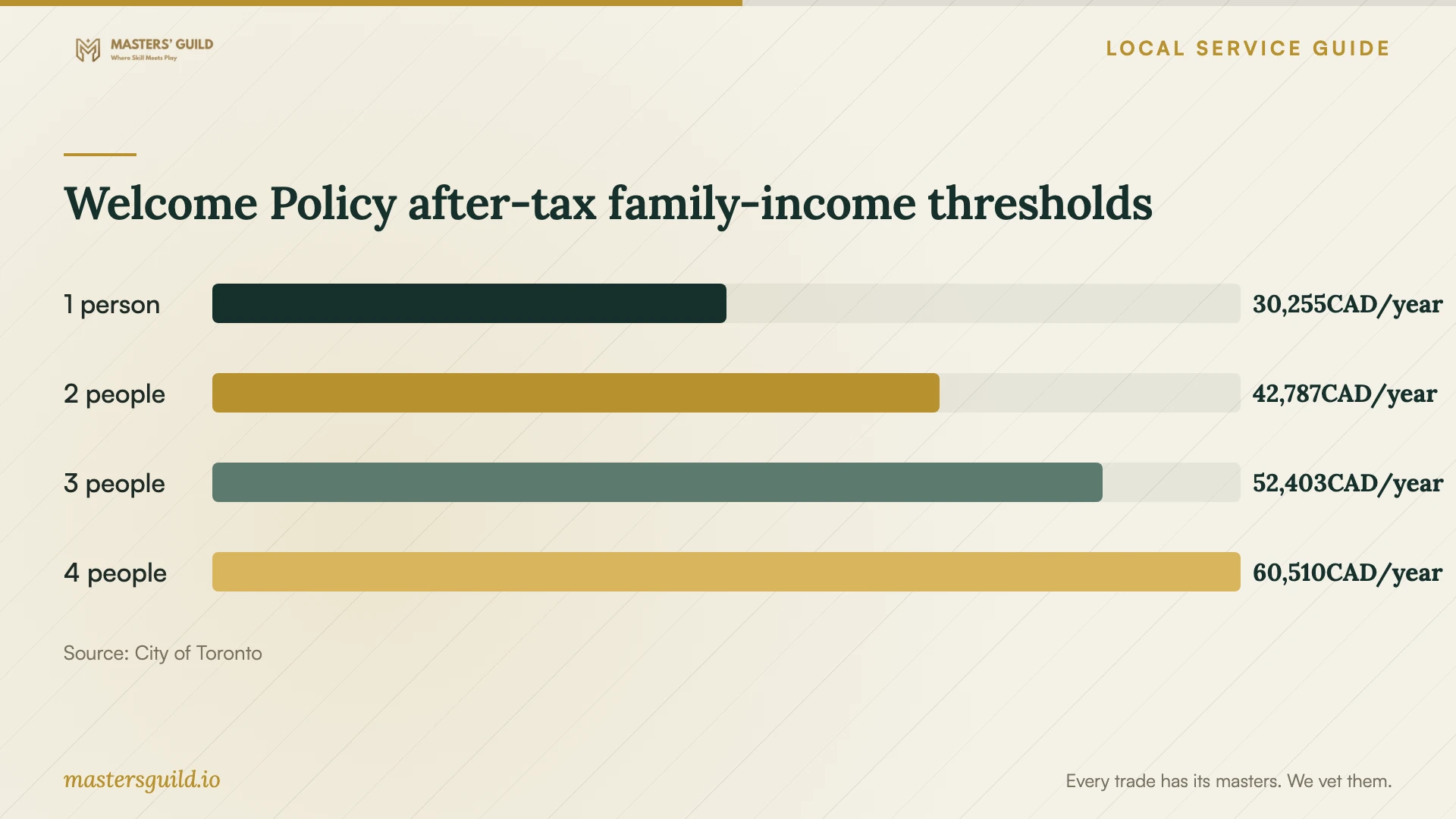
Check your eligibility and account balance before selecting a paid municipal course. The chart shows published income thresholds for selected family sizes. Use these figures to decide whether to investigate the subsidy; they represent income eligibility limits rather than lesson prices or assistance amounts. [3]
Plan registration around the centre and learner
As of October 10, 2026, the City says fall registration is open, with ongoing registration where space permits. Most fall registered programs run between September 26 and November 29, but individual dates vary. For instructional programs, the City allows prorated registration before the third class starts. Before attempting to join an instructor-led art course already underway, confirm that the third class has not started, that a place remains available and which class dates remain. [2] [4]
For winter recreation, the City lists December 8, 2026 at 7 a.m. for Toronto, East York and Etobicoke, and December 9, 2026 at 7 a.m. for North York and Scarborough. It lists separate registration dates for eligible Free Centre residents and Older Adult programs. Confirm the current schedule before registration day. [4]
Create or check your recreation account in advance and save a backup activity. If you join a City waiting list, watch your email and spam folder: you have up to 36 hours to accept or decline an offered place. Joining a waiting list does not guarantee enrolment. [2]
Prepare the learner and teaching space
Send a prospective instructor the learner’s age, experience, preferred medium and goal. Include a sample of current work if the learner agrees. Explain any support needs and ask about seating, room access, lighting or breaks before booking. For a child, agree on caregiver presence, pickup arrangements and how the instructor will communicate progress.
For an in-home lesson, agree on the usable workspace and which materials the instructor may bring. Ask about ventilation needs for the proposed materials and request alternatives if you cannot provide the setup. Confirm liability coverage and how the instructor handles spills or damage.
Ask for a first-session plan and a practice task you can complete afterward. Decide how you will assess progress: a clearer technique, a finished study or confidence using a particular material. Discuss that goal before committing to further lessons.
Welcome Policy after-tax family-income thresholds
Local details that affect your job
Travelling from outside Toronto changes municipal registration
The City charges non-Toronto residents an additional CAD 54.90 per activity, including otherwise free activities, and permits their registration 10 days after registration opens. For recreation registration, the City considers you a resident if you live in Toronto or own residential or business property there; it may request proof. Check your account status before comparing a municipal course with a private lesson. [2]
Caregiver-labelled activities require participation
For City activities with With Caregiver in the title, the caregiver must attend and participate with the child in appropriate clothing and footwear. The City requires the supervising caregiver to be at least 14. Confirm supervision arrangements before booking if you need to leave the child at a class. [1]
Winter registration has separate early categories
The City lists winter Free Centre registration for eligible residents on December 1, 2026 at 7 a.m., and Older Adult program registration for ages 60 and over on December 7, 2026 at 10 a.m. Check those categories before using the later district dates for general winter recreation. [4]
Choose a format for your next step
| Your priority | Format to consider | Check before committing |
|---|---|---|
| Learn through a scheduled group course | City registered arts activity | Confirm age eligibility, medium, centre and dates. For prorated instructional registration, confirm the third class has not started. |
| Work on a personal project | Private instruction | Request a proposed lesson plan, feedback approach and complete quote. |
| Practise independently | City arts drop-in | Expect a non-instructional activity and bring your own materials and supplies. |
| Explore help with municipal fees | Welcome Policy application | Check Toronto residency, family income and documents before planning to use a credit. |
| Attend with a young learner | City With Caregiver activity | Arrange for a caregiver aged at least 14 to attend and participate. |
Your hiring checklist
- Write down the learner’s goal, age, experience and preferred medium.
- Confirm whether the activity includes teaching and individual feedback.
- Request the full cost, lesson dates and written cancellation terms.
- Get a supply list before buying materials.
- Check recreation residency status and subsidy eligibility before municipal registration.
- For a City instructional course already underway, confirm availability, remaining dates and that the third class has not started.
- Agree on caregiver arrangements and any accessibility support.
- Confirm the teaching space, cleanup responsibilities and material requirements.
Frequently Asked Questions
Do City arts drop-ins include lessons?
The City describes arts drop-ins as non-instructional activities and requires participants to bring materials and supplies. Choose a registered activity if you want instructor-led teaching over a series of classes. [1]
Can I join a City art course after it starts?
For instructional programs, the City allows prorated registration before the third class starts. Confirm that cutoff, space availability and the remaining dates for the specific course before attempting to register. [2] [4]
Can Welcome Policy help pay for art classes?
Approved residents can use the credit toward City-operated registered recreation programs. Check eligibility, approval and your available balance before registering. Ask the City about the specific course rather than assuming the subsidy covers private lessons. [3]
What should I ask a private art instructor?
Ask for a lesson plan suited to your goal, examples of teaching exercises, the expected feedback and a complete quote. Confirm supplies, caregiver arrangements, missed-lesson terms and the teaching space before paying.
Sources and scope
This guide combines the sources below with practical planning guidance. Figures apply to the stated geography and period; request a written quote for your property.