
Local service guide
Data Recovery and Backup in Syracuse, NY
For Data Recovery and Backup in Syracuse, NY, ask a provider to quote recovery of your priority files and ongoing backup management as separate jobs. Require written handling terms, approval before chargeable work, and a demonstrated restore before accepting backup setup. For customer records, New York’s SHIELD Act guidance calls for selecting providers with appropriate safeguards and requiring those safeguards by contract. [2]
Choose the job around what you need back
Tell the provider which records you need first: accounting files, appointment records, customer documents, or shared project folders. Describe the device, the last time you accessed the files, the symptoms, and any work you have attempted. Ask the provider to explain its proposed diagnostic steps before you authorize changes to the original media.
Separate retrieval of existing files from rebuilding a working computer or server. Request distinct deliverables for recovered data, application setup, and future backups. For an accounting database, ask to open the restored database in the application you use. For documents, agree on a sample of important files to check and a list of missing or unreadable items.
If you suspect ransomware, follow CISA’s response guidance: isolate affected devices from the network and coordinate recovery with an incident-response professional. CISA recommends powering devices down only when network disconnection is not possible, because shutdown loses potential evidence in memory. Ask who will confirm the recovery environment is clean before restoring business data. [3]
Compare written scope and charges
Ask each provider for the diagnostic charge, the approval point for further work, and the amount due if it recovers none of your priority files. Define partial success in writing. A provider’s recovery of unrelated files should not settle a dispute about the customer database you asked it to retrieve.
Request separate line items for pickup or shipping, recovery work, return storage, application restoration, and ongoing backup support. Ask whether another laboratory will handle the device and who remains responsible for communication. Confirm the return arrangements if you decline the proposed work.
For ongoing support, request the storage allowance, retention period, monitoring responsibilities, restore assistance charges, and cancellation terms. Ask who owns the account and how you can retrieve your data when the contract ends. Choose a schedule around your operating needs, then have the provider explain the recovery time it can commit to.
Protect customer records during the handoff
New York’s SHIELD Act guidance requires people and businesses that maintain private information to adopt administrative, technical, and physical safeguards. Its listed safeguards include choosing capable service providers, requiring safeguards by contract, and protecting private information during transportation and disposal. Apply those requirements to the recovery handoff and any backup subcontractor. [2]
Ask for a receipt identifying the device and the person taking custody. Agree on who may access recovered files, where the provider will hold copies, how it will deliver them, and when it will erase working copies. Use temporary access where practical and agree on an end date. The Attorney General’s business guidance recommends encryption for sensitive customer information and disabling access when vendor engagements end. [4]
Accept backup setup after a restore test
CISA recommends maintaining offline, encrypted backups of critical data and testing backup procedures. It explains that ransomware can delete or encrypt accessible backups. Ask the provider to identify the copy that remains protected if an attacker compromises your daily-use computer or account, and to demonstrate how you would recover from it. [3]
Before choosing a backup schedule, decide how much recent work you could afford to recreate and how long you could operate without your key application. Ask the provider to restore a representative file set to a separate destination, record the backup date, and show you how to open the result. Assign someone to review failures and schedule future restore tests.
Keep an inventory of backup locations and account owners. The New York Attorney General describes an investigation involving exposed database backups in cloud storage that company security staff did not know existed. Ask your provider to document storage locations, access permissions, retention settings, and the person responsible for each copy. [4]
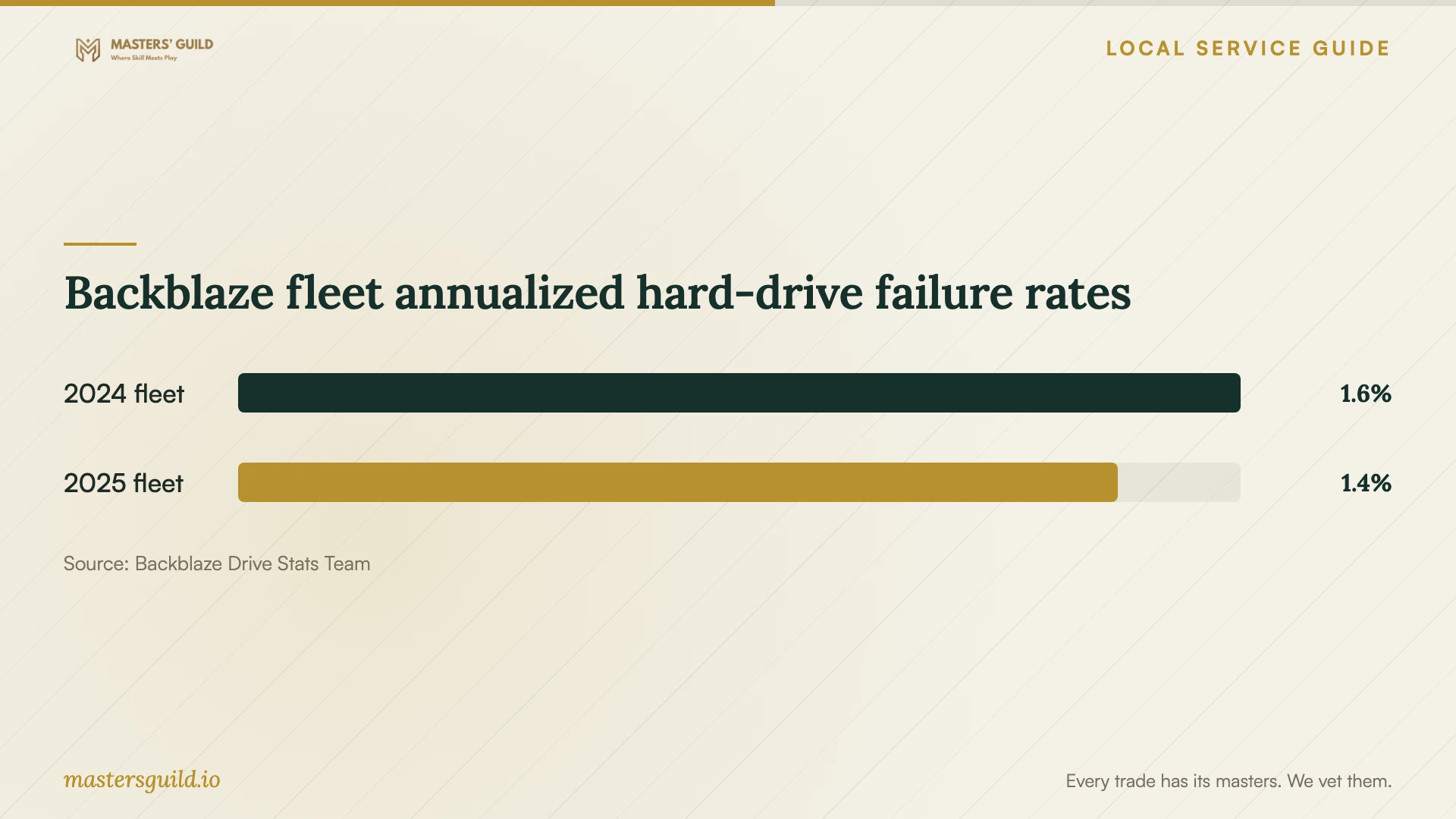
Backblaze reported fleet-wide annualized hard-drive failure rates of 1.55% for 2024 and 1.36% for 2025. These figures provide context for planning backups, but they do not predict your device’s lifespan or a laboratory’s chance of recovering your files. [5]
Backblaze fleet annualized hard-drive failure rates
Local details that affect your job
Onondaga County recycling requires a separate destination
OCRRA states that it cannot accept electronics at any of its locations and does not host electronics collection events. Its directory lists TechBack at 6464 Ridings Road in Syracuse, with no TVs or CRT monitors accepted. OCRRA advises calling ahead about accepted items, fees, and preparation requirements. For a business device, confirm commercial acceptance and data-destruction services rather than assuming household collection terms apply. Keep recycling authorization separate from recovery approval. [1]
New York safeguards belong in the service agreement
For a Syracuse business maintaining private information covered by the SHIELD Act, the Attorney General’s statewide guidance identifies contractual provider safeguards and protection during transportation and disposal. Ask the recovery provider to name any receiving laboratory and document custody, access, and deletion arrangements. Include the same safeguards in a managed-backup agreement; a local drop-off address alone does not answer who will handle your customer records. [2]
Choose a recovery or backup scope
| Your situation | Arrange | Ask before approving |
|---|---|---|
| You have a backup you want to use | A supervised restore to a separate destination | Which backup date will you use, and how will we verify the application opens? |
| You cannot locate usable copies | An assessment focused on your priority files | What will assessment cost, and what counts as successful recovery? |
| You suspect ransomware | Network isolation and incident-response coordination following CISA guidance | Who will preserve evidence and confirm a clean environment for restoration? |
| You need ongoing backup management | Documented protection and restore testing consistent with CISA guidance | Which copy remains protected from compromised accounts, and who tests restores? |
| You plan to recycle the old device | Recovery verification, sanitization, and a confirmed collection destination | OCRRA accepts no electronics at its locations; which destination accepts this business device? |
Your hiring checklist
- List priority files and the applications needed to open them.
- Record symptoms, device identifiers, and previous recovery attempts.
- Agree on diagnostic fees and approval before further charges.
- Define partial recovery and the evidence you will use to accept it.
- Document custody, subcontractors, file access, and deletion terms.
- Request a restore demonstration and written backup instructions.
- Assign responsibility for failure alerts and future restore tests.
- Authorize sanitization and disposal after you verify recovered files.
Frequently Asked Questions
How much should I budget for recovery?
Request a written assessment and approval limit for your device. Compare diagnostic fees, partial-recovery terms, delivery storage, and declined-job return charges. Keep ongoing backup subscriptions separate so you can compare the same recovery scope across quotes.
How do I know the new backup works?
Ask the provider to restore files to a separate destination and demonstrate that you can open them. CISA recommends testing backup availability and integrity in a recovery scenario. Agree on who will repeat the test and respond to failures. [3]
Can I take my old computer to OCRRA?
OCRRA does not accept electronics at any of its locations. Use its directory to identify another destination and call ahead about acceptance and preparation. Confirm business-device eligibility, and authorize wiping or destruction after you approve the recovered files. [1]
What should a provider agree to for customer data?
Ask for custody records, access restrictions, subcontractor disclosure, secure delivery, and deletion terms. New York’s SHIELD Act guidance includes selecting providers with appropriate safeguards, requiring safeguards by contract, and protecting private information during transportation and disposal. [2]
Sources and scope
This guide combines the sources below with practical planning guidance. Figures apply to the stated geography and period; request a written quote for your property.