
Local service guide
Tree cutting in St. Petersburg: Hire and Plan
Tree cutting in St. Petersburg starts with choosing an assessment, pruning or removal, then confirming the approval route before you authorize work. Ask bidders for a written scope covering the trees, utility coordination, hauling and stump work. The city requires permits to remove code-protected trees unless an exemption applies. Florida's residential risk exemption requires a qualifying signed onsite assessment establishing that removal is the only practical means of reducing the tree's risk below moderate. [1] [2]
Choose the assessment and work scope
Describe what concerns you and what you want to achieve. Take photographs from a safe position and point out damaged branches, root disturbance or a conflict with planned construction. Ask the assessor to explain potential targets if the tree fails and discuss pruning, monitoring and removal where appropriate.
For Florida's residential exemption, the assessor must be an ISA-certified arborist or a Florida-licensed landscape architect. The statute requires that professional to perform an onsite assessment using the specified tree-risk assessment procedures and sign it. Ask for a report identifying each tree, the findings and the available mitigation. [2]
The exemption applies to a single-family detached building on a lot in active single-family residential use, with a conforming or legally recognized nonconforming use. The city's guidance excludes duplexes, townhomes, other multifamily buildings and commercial uses. Keep the qualifying documentation before removal; the city encourages owners to email it to tree staff to help avoid compliance misunderstandings. [1] [2]
Confirm protection before approving cuts
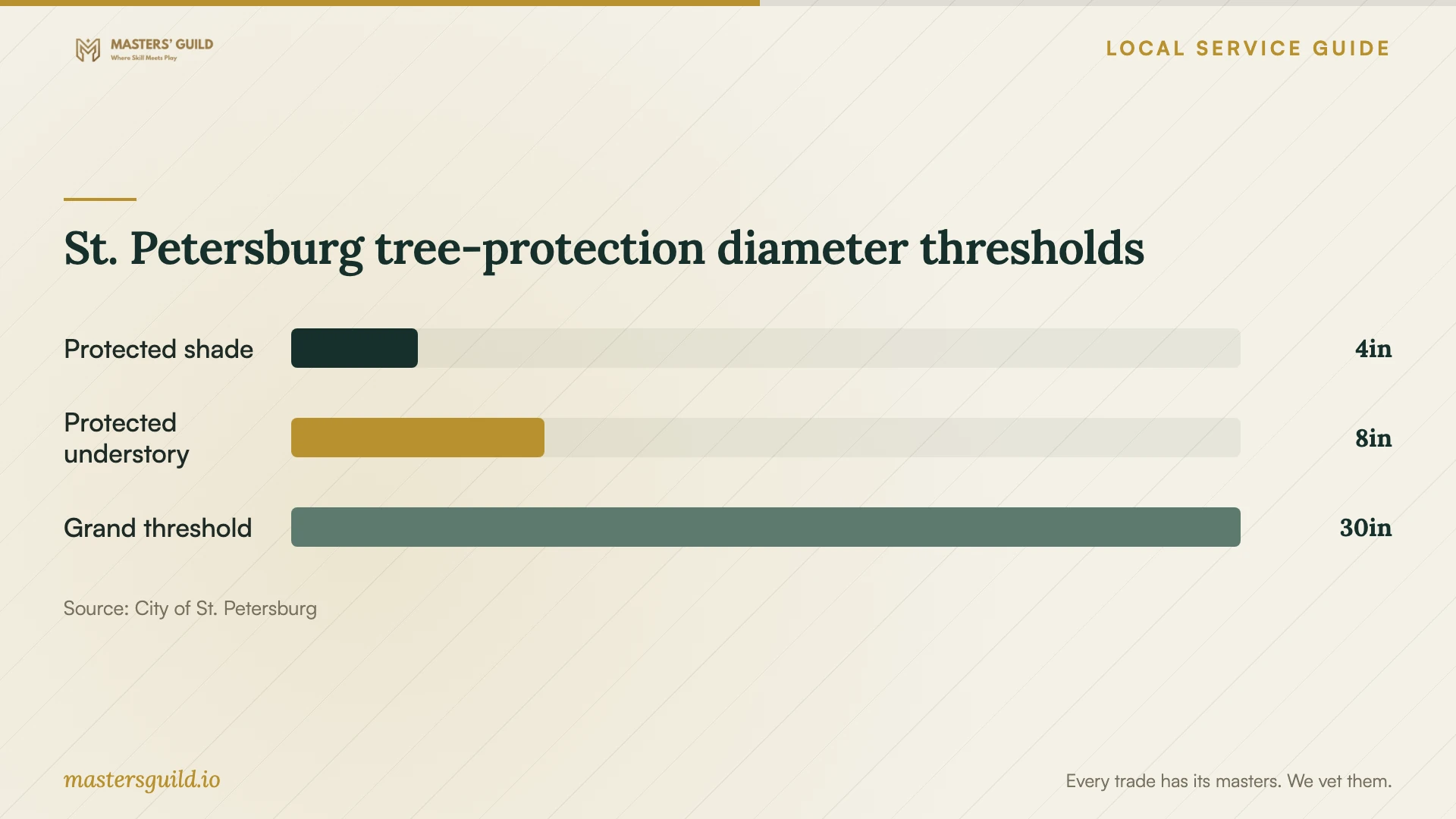
St. Petersburg protects shade trees measuring at least 4 inches in diameter at breast height and understory trees measuring at least 8 inches. The city defines breast height as 4½ feet above ground. Grand trees include code-protected trees measuring at least 30 inches, except Laurel Oaks. Ask city staff to confirm the species and category before treating a diameter measurement as a permit decision. [1]
The city also protects specified Signature trees, including Banyans, Kapoks, Jacarandas and Royal Poincianas, with species-specific size rules. A permit is required for trimming a Grand tree branch at least 8 inches in diameter. Give staff the proposed cuts and branch sizes when checking approval requirements. [1]
For construction planning, the city requires the site plan to show Protected, Grand and Signature trees within 15 feet of proposed construction, including relevant trees on adjacent property. Florida's residential exemption does not override specifically delegated mangrove-protection authority. Confirm the applicable process before including mangroves in a cutting contract. [1] [2]
Arrange utility coordination
Identify overhead lines for each bidder, including the service lines between a pole and your house. Duke Energy warns that contact with any power line can cause injury or death. Workers without line-clearance qualifications must keep themselves, tools, equipment and vehicles at least 10 feet from overhead lines carrying up to 50 kV; higher voltages require greater distances. [4]
Ask who will contact the utility and whether the crew has the qualifications for the proposed work. Duke Energy Florida lists 800-700-8744 for checking voltages and arranging safety clearances before work. If a limb, tree or equipment contacts a line, stop work, avoid the line and anything touching it, and call 911 and Duke Energy Florida at 800-228-8485. [4]
Compare quotes and prepare access
Request prices for the same scope from each bidder. Identify the trees and branches, the intended result, and who handles approval paperwork. Ask bidders to separate assessment, cutting, hauling and stump work so you can compare what each offer includes without assuming a local price range.
For stump grinding, specify the depth, removal of grindings and responsibility for filling the depression. Request current liability insurance information and an explanation of workers' compensation coverage for the proposed crew. Identify the supervisor and agree on payment terms before work begins.
Walk through gates, equipment routes and staging areas with the bidder. Point out irrigation, fences and surfaces you want protected. Agree on access restrictions during cutting, cleanup and responsibility for damage. Discuss weather postponements and equipment access after rain before setting the date.
St. Petersburg tree-protection diameter thresholds
Local details that affect your job
Plan the city inspection and permit
Submit a removal application through the city's Building Permit Portal or email [email protected]. The city lists a $25 initial inspection fee and says staff endeavor to inspect within two weeks after payment; treat this as a planning target. After city arborist approval and payment of the permit fee, display the permit where people can see it from the street. Removal permits last six months. Call 727-463-5680 with questions. The city also offers low-cost assessments through an on-staff ISA-certified arborist; ask about availability and whether the service fits your assessment needs. [1]
Arrange contractor access to brush sites
City brush sites accept eligible material from properties paying an active St. Petersburg sanitation collection charge and require code-protected tree documentation. For contractor deliveries, the utility bill holder must accompany each load with proper identification and the utility bill, or the crew must use the department-approved consent form. The property owner and company must sign and legibly complete that form and provide it each delivery day. Separate logs and send them to 2500 26th Avenue South. The city rejects logs over 300 pounds, 34 inches in diameter or 60 inches long. Ask the bidder to include a disposal plan for oversized wood. [3]
Choose the next step before cutting
| Situation | Next step | Confirm before work |
|---|---|---|
| Code-protected tree proposed for removal | Contact city tree staff about a permit | City approval or a qualifying exemption |
| Risk exemption proposed at a detached single-family home | Obtain the qualifying signed onsite assessment | Property eligibility and removal as the only practical mitigation below moderate risk |
| Grand tree branch at least 8 inches in diameter | Arrange the trimming permit | Grand classification and proposed branch cuts |
| Work within 10 feet of overhead lines | Coordinate with the utility and a qualified line-clearance contractor | Voltage and required clearance |
| Contractor delivery to city brush sites | Arrange utility bill holder accompaniment with identification and utility bill for each load, or approved consent paperwork | Owner and company sign and legibly complete the form; provide it each delivery day |
Your hiring checklist
- Photograph the trees from a safe position and describe your intended result.
- Ask city tree staff to confirm protection status and the approval route.
- Request an assessment identifying each tree and the proposed mitigation.
- Identify overhead lines and assign responsibility for utility coordination.
- Compare written scopes for cutting, hauling and stump work.
- Request insurance information and identify the crew supervisor.
- Agree on equipment access, cleanup, damage responsibility and postponements.
- Ask the hauler to specify the destination and arrange the applicable delivery documents.
Frequently Asked Questions
Can I remove a dangerous tree without a permit?
Florida's exemption requires qualifying residential property and a signed onsite assessment from an ISA-certified arborist or Florida-licensed landscape architect. The assessment must establish unacceptable risk, with removal as the only practical means of reducing risk below moderate. Possess the documentation before removal. [1] [2]
Does pruning require city approval?
Ask city staff about your tree and proposed cuts. St. Petersburg requires a permit to trim a Grand tree branch measuring at least 8 inches in diameter. Include branch sizes and the tree's classification when requesting guidance. [1]
Can my contractor take logs to any city brush site?
Only 2500 26th Avenue South accepts logs. For contractor deliveries, arrange accompaniment by the utility bill holder with identification and the utility bill for each load, or use the department-approved consent form signed and legibly completed by the property owner and company, provided each delivery day. Property eligibility, tree documentation and log limits also apply. [3]
What should I ask about the stump?
Ask whether the quote includes grinding, the proposed depth, removal of grindings and filling the depression. Identify any areas you want protected and agree on the finished condition before accepting the quote.
Sources and scope
This guide combines the sources below with practical planning guidance. Figures apply to the stated geography and period; request a written quote for your property.