
Local service guide
Moving services in St. Petersburg, FL: Hiring Guide
Moving services in St. Petersburg, FL should start with a clear inventory, an access plan and written estimates you can compare. For a move within Florida, check the mover’s FDACS registration first; the state requires registration and a signed written estimate and contract before services begin. Arrange unwanted furniture and household chemical disposal separately, then ask movers to price the belongings you intend to take. [1] [2] [3]
Choose the help your move needs
Separate the work into packing, loading, transport, unloading and any storage between homes. Ask each company which tasks it will perform and which you must arrange. If you want loading help for a rental truck, clarify who supplies equipment, protects furniture and accepts responsibility for damage during loading.
Describe heavy or fragile items individually. Send photos of the items and access routes, then request an inspection before accepting the estimate. FDACS recommends that an estimator see the belongings in person; it treats phone and internet estimates as rough planning tools. [1]
This guide’s registration and contract guidance applies to moves within Florida. Tell prospective movers if your destination lies outside the state and ask them to identify the requirements and documents that apply to that route. [1]
Compare the full written price
FDACS requires an intrastate mover’s written estimate and contract to include its name, physical address, telephone number and state registration number, along with an itemized description and total of costs and services. Both parties must sign. Ask the mover to put packing, loading and delivery dates in writing. [1]
Give each estimator the same inventory and access information. Ask how the company calculates its charge and whether it includes packing materials, appliance servicing, stairs, elevators and long carries. FDACS identifies these as pricing considerations. For an hourly quote, ask about crew size, minimum hours, travel time and the procedure for approving extra work. [1]
Before choosing, compare the total scope alongside the price. Ask each company to explain omissions and record any agreed changes. Set your moving budget using inspected written estimates for your inventory and access requirements.
Agree on damage protection before loading
Ask the mover to explain its liability terms in dollars for your valuable items. FDACS describes a permitted limitation of liability at no less than 60 cents per pound per article, with written disclosure before service. The mover must also explain your opportunity to reject that limitation or select additional valuation. [1]
Check whether your homeowners policy covers loss or damage during a professional move. FDACS recommends this check and notes that additional coverage or valuation may be available. Ask how the mover handles claims, whether it offers arbitration and whether it can provide proof of workers’ compensation and liability coverage. [1]
Photograph furniture condition and keep your own inventory. Carry the signed contract with you. If you discover damage, notify the mover in writing and follow its claim instructions; FDACS accepts complaints when the company does not resolve a claim satisfactorily. [1]
Set the access and handover plan
Walk the route from your front door to the proposed truck position at both addresses. Tell the estimator about steps, narrow doorways and the carrying distance. For a managed building, ask the manager about loading locations, elevator reservations, permitted moving hours and any documents the crew must supply. Share the answers before signing.
FDACS suggests allowing two to six weeks to plan and prepare. It identifies late May through August as a busy moving period and says weekend rates tend to be highest. If your dates are flexible, request quotes for alternative days rather than assuming the price stays the same. [1]
Keep medicines, essential documents and items you need on arrival with you. Label boxes by destination room and maintain a contents list. FDACS recommends checking the carton count against the packing order before signing when the mover packs your belongings. [1]
Budget move-out disposal separately
Choose what to discard before the estimator visits, but keep items on the moving inventory until you confirm their collection or drop-off plan. Ask whether a mover’s disposal quote includes labor, transport and facility charges, and identify the destination facility.
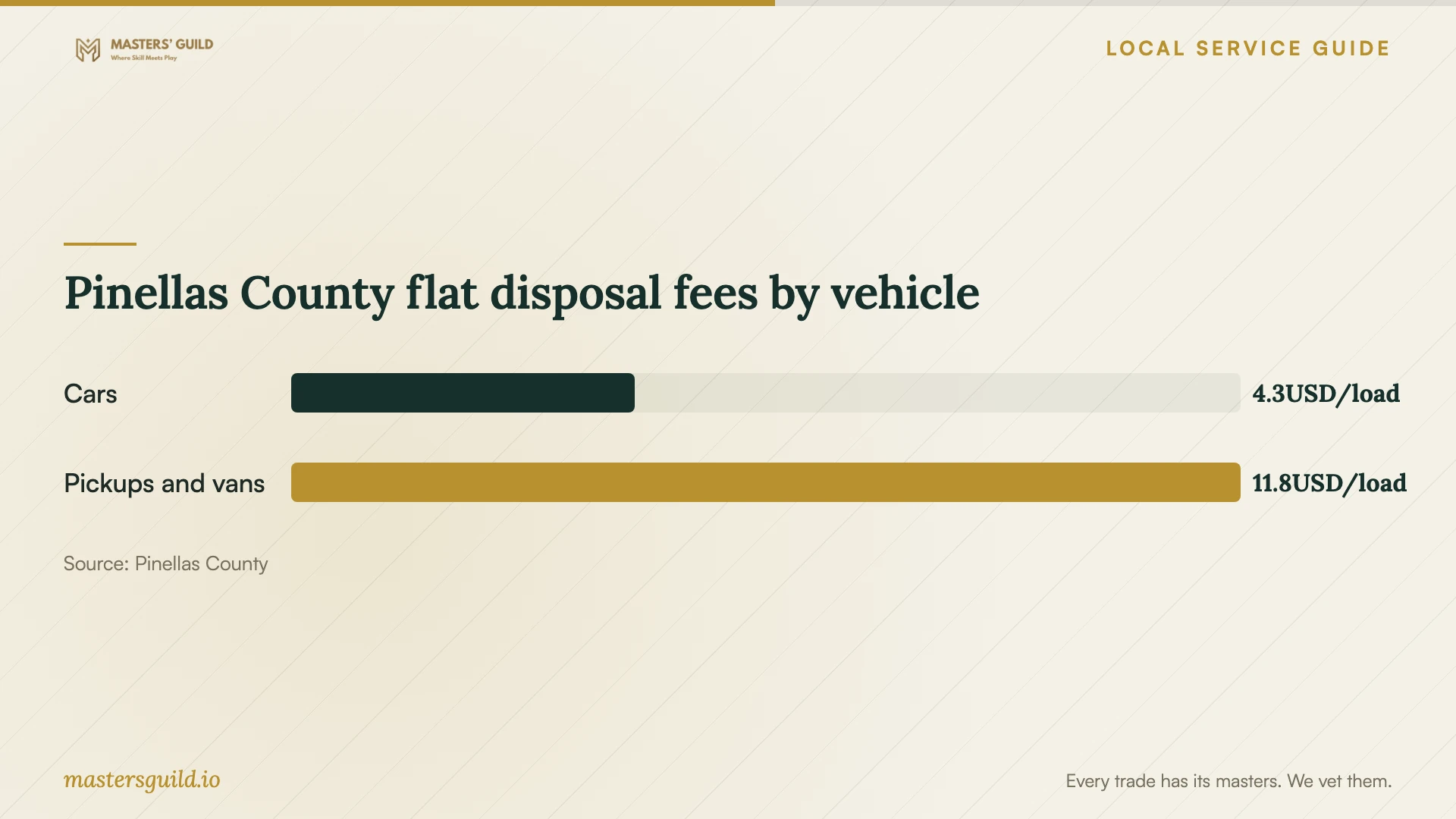
The chart compares Pinellas County’s published flat disposal charges: $4.25 for a car load and $11.75 for an eligible pickup or van load. These are facility fees, not moving or junk-removal prices. Box trucks, trailers and modified pickups fall under weight-based rules; the county’s disposal rate is $63.57 per ton as of October 1, 2026. [4]
Pinellas County flat disposal fees by vehicle
Local details that affect your job
Arrange city furniture pickup before the move
St. Petersburg lists free special pickup for furniture, carpet and appliances up to three cubic yards. Request service through SeeClickFix or call 727-893-7398; include a photo to help the city assess the request. Place items where your trash is collected, whether curb or alley. The city lists $25.65 per cubic yard for items outside its free list and provides an estimate for chargeable collection. Confirm the collection date and fee before relying on this option. [2]
Make a separate household chemical trip
Pinellas County’s HHW Center at 2855 109th Avenue N. accepts eligible household chemicals free from county households and scans government-issued ID to verify residency. Businesses and haulers cannot use this household program. The center opens Tuesday through Friday and the first and third Saturdays, 7 a.m. to 5 p.m., subject to holiday closures. Check accepted items and quantity limits before packing the car; place containers in a box or tray, away from passengers, and do not mix chemicals. [3] [5]
Avoid a Sunday disposal deadline
The county Disposal Complex at 3095 114th Avenue N. opens Monday through Friday, 6 a.m. to 6 p.m., and Saturday, 7 a.m. to 5 p.m.; it closes Sundays. Its schedule differs from the HHW Center’s schedule. If you must hand over the home on Sunday, arrange disposal earlier and check holiday hours before committing to a trip. [5]
Match the arrangement to your situation
| Your situation | Next step | Detail to confirm |
|---|---|---|
| Move stays within Florida | Check FDACS registration and request inspected estimates | Signed written estimate, contract and itemized charges |
| Stairs, elevator or long carry | Show the estimator the access route | Any access charges in the written quote |
| Unwanted furniture before departure | Request city special pickup | Free-list eligibility, three-cubic-yard limit and collection date |
| Household paint or cleaners to discard | Check county HHW acceptance and plan a resident drop-off | Quantity limits, ID and operating day; haulers are excluded |
| Disposal using a rental box truck or trailer | Budget under county weight-based rules | $63.57 per ton rather than passenger-vehicle flat fees |
Your hiring checklist
- Separate belongings into move, keep with you, donate and dispose groups.
- Give each estimator the same inventory and photos of difficult access.
- Ask the building manager about truck access and elevator arrangements.
- Request an itemized quote covering crew, transport, packing and access charges.
- Confirm damage protection and the claim procedure before signing.
- Arrange disposal dates separately from the moving appointment.
- Keep the contract, inventory and condition photos accessible during handover.
Frequently Asked Questions
How do I check a mover for a move within Florida?
Use the FDACS Business License Lookup referenced on its moving guidance page, or call 1-800-HELP-FLA at 435-7352. Match the company details to your written estimate and contract. FDACS requires intrastate moving companies to register. [1]
What should I ask about packing charges?
Ask the mover to separate packing labor from containers and materials. FDACS says movers charge for both. Identify which items you will pack yourself and which the crew will pack, then include that division in the estimate. [1]
Can my moving crew take chemicals to the household collection center?
Pinellas County excludes haulers from its household HHW program. Arrange your own eligible household drop-off and check the accepted materials and limits. The county directs businesses, haulers, hobbyists and nonprofits to its business collection information. [3]
Does the disposal chart show what movers charge?
It shows county facility charges for eligible car, pickup and van loads. Ask the moving or removal company to itemize labor, transport and disposal charges in writing and confirm which facility and vehicle it will use. [4]
Sources and scope
This guide combines the sources below with practical planning guidance. Figures apply to the stated geography and period; request a written quote for your property.