
Local service guide
Junk Removal in St. Louis, MO: Plan Your Pickup
Arrange Junk Removal in St. Louis by separating items you can set out for city collection from items you need a crew to carry away. City residents can use monthly bulk pickup for up to three accepted items, but collectors cannot enter private property. Hire a hauler when you need indoor carrying, a larger cleanout, or an agreed pickup date. Before booking, send an item list and access photos, then ask for a written total and the disposal destination. [1]
Choose city collection or paid carrying
Use monthly city collection if your accepted items fit the three-item limit and you can move them outside. Place them out by 6:00 am on Monday of your collection week. For curbside service, use the curb; for alley service, place items behind your home, away from refuse containers, without blocking the alley. Allow the city the entire collection week. [1]
For a basement sofa or an upstairs cleanout, ask a private crew to quote removal from the item's current location. Photograph the stairs, doorways and route to the truck. Tell the crew which items require disassembly, and ask who will protect floors and doorframes. Agree on the pickup window before arranging building access or taking time away from work.
For city pickup, remove refrigerator doors. Put smaller loose items in a container or bundle that weighs no more than 100 pounds, measures no more than 6 feet long and stays within 2 feet in diameter. The city excludes railroad ties and directs residents to a private waste hauler for them. [1]
Compare quotes for the same job
Send each hauler the same photos and item list. Include appliances, mattresses, loose bags, renovation debris and anything you want left behind. Ask whether the offer covers carrying from inside, disassembly, loading, transport and disposal. Request a list of excluded materials so you can arrange another route before pickup day.
Ask how the crew will establish the final price: a fixed total, measured truck space, weight or another method. If the crew must inspect the load first, ask it to confirm the total before loading. Include stairs, parking distance and any extra trips in that discussion. Request proof of insurance and ask who handles damage during removal.
Keep the disposal plan in writing. City transfer stations reject anyone suspected of hauling for hire, commercial trucks and business refuse. A crew's promise to use your resident allowance would conflict with those rules. Ask which facility will receive the load and request a disposal receipt where available. [2]
Prepare a resident drop-off load
Consider hauling an accepted load yourself if you can lift and transport it. The city allows eligible residents up to 12 loads each year. Homeowners need identification and a recent combined Water/Solid Waste Fee statement showing city property ownership. Renters need identification and a recent utility bill showing city residency; their property owner must pay the Solid Waste Fee. [2]
Check both your load and your vehicle before loading. The city limits load size to what a half-ton pickup could carry. Separately, it specifies vehicle dimensions of no more than 5 feet by 8 feet by 4 feet high. It prohibits trailers, modified pickups and several truck types. Rental trucks must meet the vehicle requirements. Transfer stations operate Monday through Friday, 8 am to 4 pm, except city-observed holidays. [2]
For approved appliances, tires, automotive batteries, motor oil and electronics, use South Transfer Station at 4100 South 1st Street. The city identifies South as the station accepting these BOAT-E items. Check its accepted-material list before leaving; the station excludes waste originating outside city limits, asbestos, compressed gas cylinders and commercial waste. [3]
Separate chemicals before the crew arrives
Arrange a separate route for unwanted household chemicals. The regional Household Hazardous Waste program serves households in St. Louis City, St. Louis County and Jefferson County. It accepts listed materials such as pesticides, solvents and certain batteries, but excludes furniture, appliances, construction debris, tires and electronics. City transfer stations do not accept household hazardous waste. [2] [4]
Book a hazardous-waste reservation before loading your vehicle; the program does not offer same-day reservations. Bring proof of address. Keep containers upright in boxes, retain labels and do not mix chemicals. Staff unload the materials while you remain in your vehicle. Contractors cannot use this household program. [4]
Confirm address-specific hazardous-waste charges during booking. The program publishes conflicting fee guidance: a general first-50-pounds-free statement, a full-pay warning and an explanation that city subsidies depend on grant funding. Do not budget on a guaranteed free allowance. The program lists latex-paint recycling at $0.50 per pound and accepts credit or debit cards. [4]
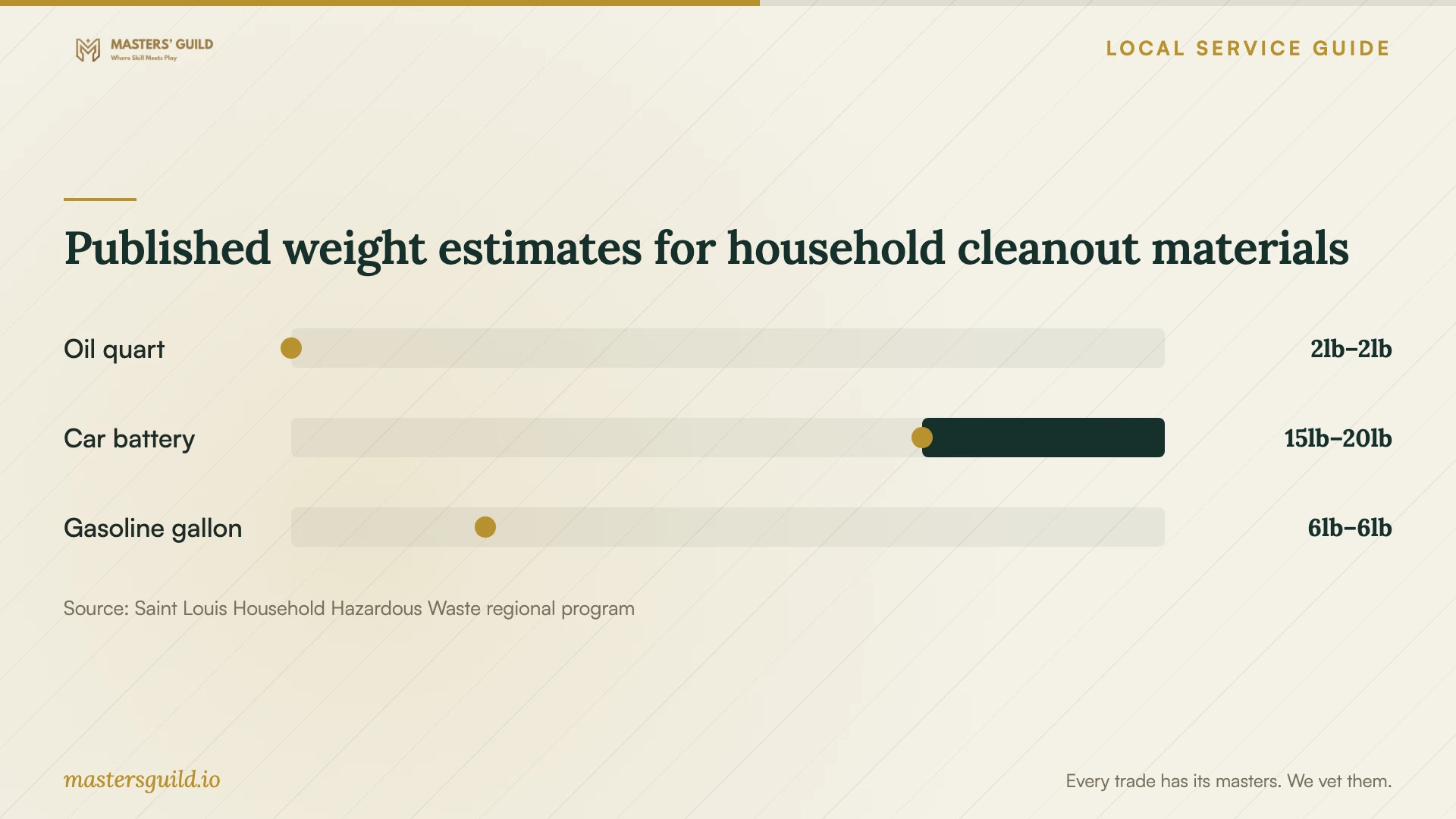
Published weight estimates for household cleanout materials
Local details that affect your job
City pickup stops at the curb or alley
Collectors cannot pick up items on private property. If you cannot move a heavy item outside, arrange carrying help or ask a private hauler to include indoor removal. After the city collection week ends, report missed items to the Citizens Service Bureau at 314-622-4800. [1]
Resident disposal does not cover hired hauling
The city rejects hauling-for-hire loads at its resident transfer stations. Keep a private crew's disposal costs in its quote rather than offering your residency documents as a way to obtain resident disposal service. [2]
South Transfer Station and South County HHW serve different loads
South Transfer Station at 4100 South 1st Street accepts approved residential bulk and BOAT-E items. The regional South County hazardous-waste facility is at 291 E. Hoffmeister and requires a reservation. Choose the destination by material and eligibility before driving. [3] [4]
Choose a removal route
| Your situation | Route to consider | Check before arranging it |
|---|---|---|
| Up to three accepted bulk items you can move outside | Monthly city collection | Set out by 6:00 am Monday of your collection week; allow the entire week. |
| Furniture inside, stairs or a larger cleanout | Private hauling crew | Request indoor carrying, a written total and an identified disposal destination. |
| Accepted household debris you can transport | Resident transfer-station drop-off | Confirm residency documents, annual allowance, load-size limit and vehicle restrictions. |
| Approved appliances, automotive batteries, oil, tires or electronics | South Transfer Station or city BOAT-E collection | Check item acceptance and resident eligibility; keep items out of regular trash containers. |
| Unwanted household chemicals | Regional hazardous-waste reservation | Confirm material acceptance and address-specific fees; contractors and business waste do not qualify. |
Your hiring checklist
- List the items to remove and mark anything the crew must leave.
- Separate chemicals, batteries and appliances for individual acceptance checks.
- Photograph the load, stairs, doorways and truck access.
- Check whether city collection or resident drop-off fits your items and schedule.
- Request a written quote covering carrying, loading, transport and disposal.
- Confirm exclusions, the disposal destination and your approval of any price changes.
- Clear the carrying route and agree on floor and doorway protection.
- Inspect the cleared area before settling the bill and retain the receipt.
Frequently Asked Questions
Is city bulk pickup free?
The city includes monthly bulk pickup in its solid-waste service fee, which the city lists as $14 per month per unit, collected quarterly on the water bill. It covers up to three accepted items rather than unlimited cleanout service. [1]
Can a junk hauler take my load to a city transfer station?
The resident drop-off program rejects hauling for hire and commercial trucks. Ask your hauler to identify a disposal destination that accepts its load and include disposal in the quote. [2]
Can I put remodeling debris in the alley dumpster?
The city tells residents not to overload dumpsters with large quantities of lumber, plaster, roofing or other building materials. Arrange a commercial waste hauler or use an eligible resident transfer-station load after checking acceptance and vehicle rules. [2]
Can dried latex paint go in household trash?
The regional program says completely dried latex paint can go in regular trash, subject to your hauler's restrictions. Its alternative-disposal guidance describes adding absorbent material and allowing the mixture to dry. Keep oil-based paint and other chemicals on their appropriate disposal route. [4] [5]
Sources and scope
This guide combines the sources below with practical planning guidance. Figures apply to the stated geography and period; request a written quote for your property.