
Local service guide
Snow Removal in Seattle, WA: Plan the Right Service
Arrange Snow Removal in Seattle by agreeing on the areas to clear, the service trigger, the arrival window and the total charge before you book. Include the sidewalk beside your property: Seattle holds property owners responsible for preventing snow and ice hazards there. Identify snow-storage areas and drainage paths, then confirm whether ice treatment and return visits cost extra. [2] [3]
Define the clearing area before comparing quotes
Send each provider the same photos and a marked description of your driveway, entrance, steps and sidewalk. Identify the route you need between the house and the street. State whether you want the whole driveway cleared or enough space for a vehicle to enter and leave. Ask the provider to name the equipment they would use and explain how they would reach narrow sections.
Seattle's Department of Transportation says property owners must maintain adjacent sidewalks and make sure snow and ice do not create pedestrian hazards. Include the sidewalk frontage and the connection to your entrance in the work description. Request separate prices if the provider treats those areas as additional work. [2]
Before work starts, point out uneven paving, edging, low fixtures and surfaces you want protected. Ask for proof of insurance and an explanation of how the provider handles damage claims. For a shared driveway or entrance, agree with your neighbor on the clearing boundary and who pays before either household books.
Compare the full charge and the removal method
Ask for a written total that identifies the clearing area, removal method, ice-treatment materials and any minimum charge. Have the provider state whether they bill per visit, by time or under a recurring agreement. Request the charges for additional accumulation, a second visit and work outside the original scope.
Washington's Department of Revenue distinguishes manual removal from machinery-based removal on private property. It classifies work with shovels or brooms as a janitorial service under Service and Other Activities business and occupation tax; the provider pays sales or use tax on materials applied. For removal with power tools such as plows or power sweepers, the provider must collect retail sales tax at the service location's rate. [1]
Ask the provider to explain tax treatment when a quote combines hand clearing, machinery and materials. Compare the total you would pay for the same scope, including any tax and additional charges. Use written quotes for your property to set your budget. [1]
Agree on storm triggers and return visits
Specify what starts service: a stated snow depth, your request or another agreed condition. Ask where the provider measures accumulation and whether they visit during snowfall or wait until it ends. Choose an arrival window that matches the access you need, and ask how they communicate delays or an inability to reach your property.
Treat snow clearing and ice treatment as separate questions. Ask whether the provider checks steps and walking routes after clearing, who chooses the treatment product and whether they need your approval before applying it. Agree on how to request another visit if new snow, ice or a ridge at the driveway entrance obstructs access.
If you consider a recurring agreement, ask about included visits, snowfall limits, cancellation terms and charges beyond the allowance. For a single visit, confirm the booking and the method for reporting completion. Choose the arrangement around your need for access and your ability to handle work between visits.
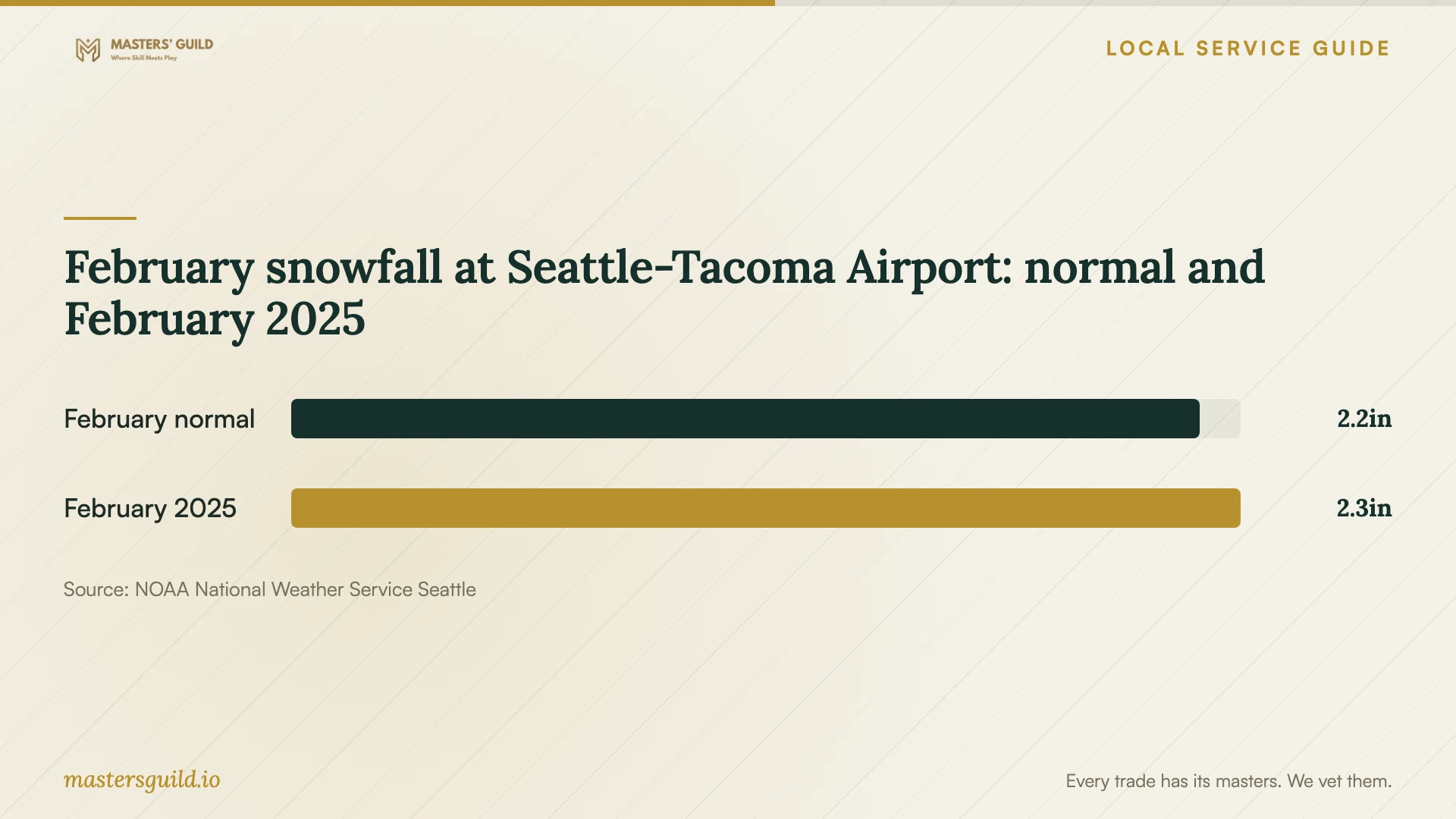
At Seattle-Tacoma Airport, the National Weather Service reported trace snowfall for February 2026, compared with a February normal of 2.2 inches for 1991–2020. Use the chart as background when discussing contract terms. Ask for an ice-response agreement even if you choose a snow-depth trigger; the airport's monthly snowfall figures do not describe conditions at your entrance. [4]
Plan snow placement and drainage together
Walk the property with the provider or mark snow-storage areas on a photo. Keep entrances and the agreed walking route clear, and identify drains before snow covers them. Seattle Public Utilities advises residents to keep snow and ice from blocking drains because snowmelt and rain can obstruct inlets and cause localized flooding. [3]
For a sloped driveway, include the drain at the bottom in your preparation plan. Seattle Public Utilities tells residents to clear that drain and to clear a runoff channel when snow or debris blocks an inlet. Ask whether the provider includes this work or whether you need to arrange it separately. [3]
Follow the utility's safety guidance if you clear a nearby storm drain yourself: work only when safe, stand on the sidewalk or parking strip rather than in the road, and use tools instead of your hands. If you cannot clear it, report the clogged drain to Seattle Public Utilities at 206-386-1800. [3]
February snowfall at Seattle-Tacoma Airport: normal and February 2025
Local details that affect your job
Sidewalk responsibility changes the scope
Seattle requires property owners to maintain adjacent sidewalks and prevent snow and ice hazards. Before accepting a driveway quote, add the sidewalk frontage to the work description and confirm who will address ice there. [2]
Removal methods change private-property tax treatment
Washington classifies manual snow removal on private property as janitorial service and machinery-based removal as a retail sale. Ask the provider to identify the method and explain the tax on the quote, especially when the job combines driveway equipment and hand-cleared steps. [1]
A sloped driveway needs a drainage plan
Seattle Public Utilities advises clearing the drain at the bottom of a sloped driveway. Mark that inlet before the visit, agree on snow placement and ask whether the provider will leave a clear runoff path. [3]
Match the agreement to your access needs
| Your situation | Scope to request | Question before booking |
|---|---|---|
| Driveway and adjacent sidewalk | Vehicle access plus sidewalk clearing; Seattle assigns adjacent sidewalk maintenance to owners. | Does the total include the full sidewalk frontage? |
| Steps or narrow entrance | Specify hand clearing and identify the surfaces to protect. | Which areas will the crew clear by hand? |
| Sloped driveway with a bottom drain | Identify the drain and include a runoff plan, following Seattle Public Utilities guidance. | Who clears the inlet and where will you place the snow? |
| Machinery-based work on private property | Request a total including applicable retail sales tax under Washington guidance. | Which method and tax treatment does this quote use? |
| Access needed between visits | Agree on ice checks and a way to authorize additional work. | What triggers a return visit, and what does it cost? |
Your hiring checklist
- Send photos and define the driveway, sidewalk, steps and entrance areas to clear.
- Identify surface damage, low fixtures and equipment access constraints.
- Agree on the service trigger, arrival window and delay notifications.
- Request an itemized total showing method, materials, tax and extra-visit charges.
- Ask for proof of insurance and the damage-reporting process.
- Mark snow-storage areas, drains and the walking route you need.
- Confirm who checks for ice and who authorizes treatment or another visit.
Frequently Asked Questions
Does clearing my driveway cover my sidewalk responsibility?
Include the sidewalk in the provider's scope. Seattle holds property owners responsible for maintaining adjacent sidewalks and preventing snow and ice hazards. Ask for explicit sidewalk coverage rather than assuming the driveway price includes it. [2]
Should a snow-removal quote include sales tax?
Washington requires providers to collect retail sales tax for machinery-based snow removal on private property. It classifies manual removal with tools such as shovels or brooms as janitorial service, with the provider paying sales or use tax on applied materials. Ask for an explanation when the quote combines methods. [1]
How should I handle a drain blocked by snow?
Seattle Public Utilities advises clearing snow and ice only when safe, using tools and standing outside the road. Clear a runoff channel if an inlet is blocked. If you cannot clear the drain, report it to the utility at 206-386-1800. [3]
Should I choose one visit or a recurring agreement?
Choose based on the access you need and the work you can handle yourself. For either arrangement, confirm service triggers, timing, ice treatment and return-visit charges. For recurring service, read the included-visit allowance and cancellation terms before agreeing.
Sources and scope
This guide combines the sources below with practical planning guidance. Figures apply to the stated geography and period; request a written quote for your property.