
Local service guide
Data recovery and backup in Seattle: Hiring Guide
For data recovery and backup in Seattle, choose a provider around the work you need: recovering missing files, restoring a known backup, or responding to a suspected security incident. Ask for a written diagnostic scope, approval before further work, secure handling terms, and a restore test. If you suspect ransomware, isolate affected devices from the network and engage incident-response help before reconnecting systems or restoring business data. CISA recommends isolation, evidence preservation, and recovery on clean systems. [3]
Match the provider to the recovery job
Start your enquiry with the device type, the symptoms, the last time you accessed the files, and any actions you have taken since. Name the files or applications you need first, such as invoices, customer appointments, or accounting records. Ask the provider to explain its proposed diagnostic steps and the point at which you must authorize paid recovery work.
For a damaged or malfunctioning drive, pause further use and ask a recovery specialist for handling instructions. Avoid opening the device or authorizing a reset before you discuss the data you need. For an existing backup, ask a technician to inspect the available restore points and demonstrate recovery to a separate destination before you approve changes to the original system.
Ask who will handle the device, where the work will happen, and whether another laboratory or subcontractor will receive it. Request a handoff receipt with the device identifier and a written record of transfers. Agree on how the provider will return your original media and recovered files.
Set the budget and approval rules
Request separate amounts for diagnosis, recovery, replacement storage, transport, and follow-up backup setup. For ongoing support, separate the installation charge from recurring storage and management charges. Ask the provider to identify exclusions and obtain your approval before exceeding the agreed scope.
Ask the provider to define success in writing. Specify whether you need named folders, readable files, or a working business application. If the provider offers a no-recovery, no-fee arrangement, ask which diagnostic, transport, or return charges remain payable. Request a file list or a supervised review before accepting the result.
Washington's Department of Revenue includes troubleshooting hardware and software, migration support, and managed IT services within its taxable IT-service guidance. Ask the provider to identify the tax treatment of each part of your proposed recovery and backup project and show the total payable amount. Do not compare a pretax estimate with another provider's final total. [1]
Specify a backup you can restore
Write down which files and systems the provider must protect, how much recent work you could afford to lose, and how long you could operate without access. Use those answers to agree on backup frequency and restoration priorities. Include the application settings, software access, and credentials your team will need to resume work.
CISA recommends maintaining offline, encrypted copies of critical data and testing backup procedures on a regular basis. Its guidance explains that ransomware can delete or encrypt accessible backups. Ask the installer to demonstrate how a protected copy remains outside an affected system's access and how your business will retrieve it. [3]
Make the acceptance test concrete: restore a representative folder to a separate destination, open the files, and have the responsible employee check them. If you rely on a business application, request an application-level test as well. Record the steps, identify who receives failure alerts, and schedule the next test.
CISA advises businesses to formalize managed providers' security requirements in contracts and limit third-party access to the devices and servers needed for their role. Ask for named access permissions, a secure method for sharing credentials, and a process for removing the provider's access when the engagement ends. [3]
Separate incident response from routine restoration
If you see a ransom demand or suspect unauthorized access, disconnect affected devices from the network and contact your incident-response provider. CISA recommends powering devices down only when you cannot disconnect them by other means, because shutdown loses potential evidence in volatile memory. Follow your incident plan and use phone calls to coordinate the response. [3]
Ask the responder to document the affected systems, preserve relevant logs, and assess the compromise before rebuilding. CISA warns that a ransomware event can follow an earlier unresolved compromise and recommends restoring critical services on a clean network. Request a named person who will authorize reconnection. [3]
For a suspected breach involving customer or employee information, involve legal counsel alongside the technical responder. Washington's Attorney General describes notification duties based on unauthorized acquisition, the security of the information, and likely harm. Recovering access to files does not answer those separate questions. [2]
Include power interruptions in the backup discussion
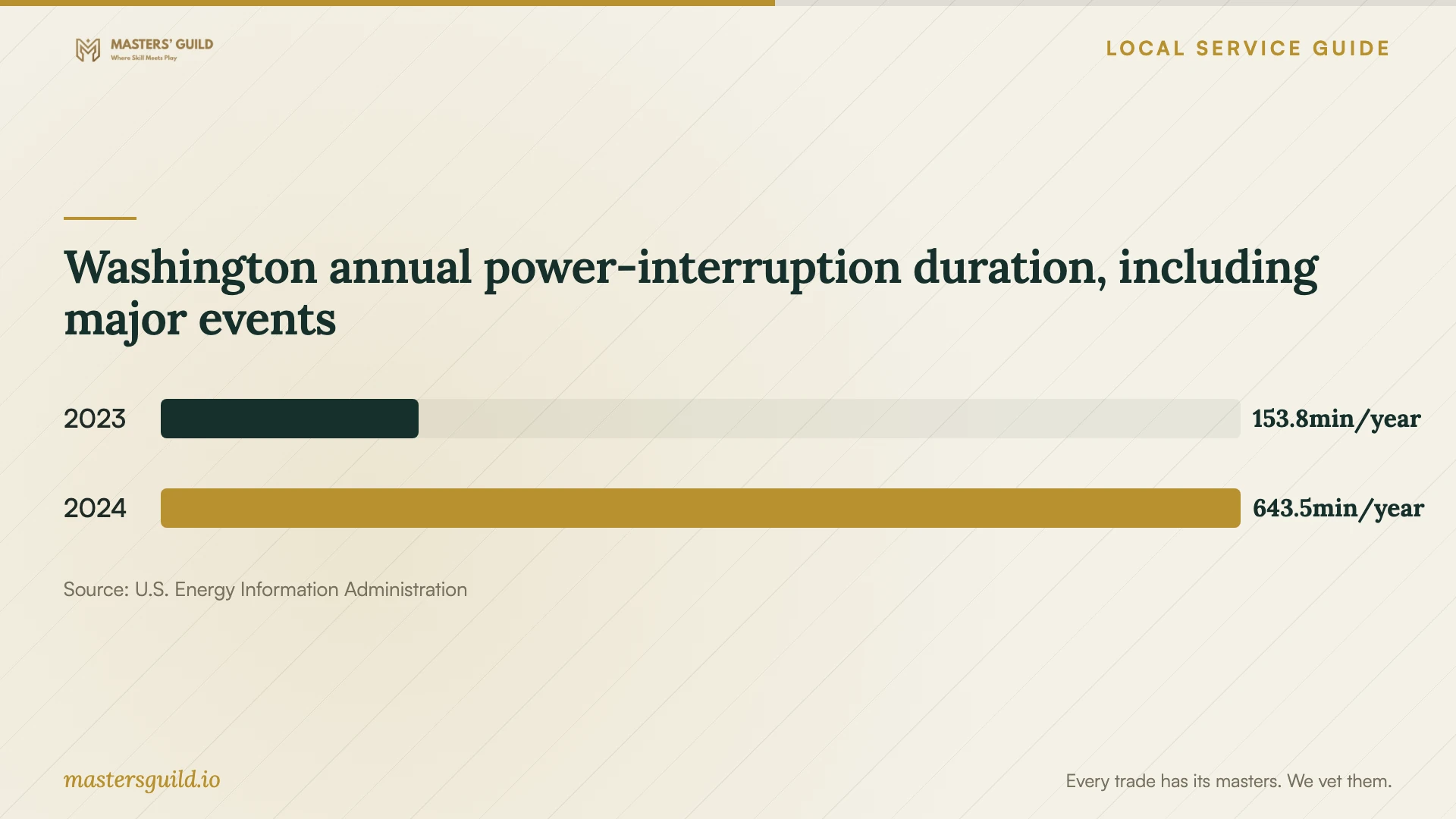
EIA reports Washington's average annual non-momentary interruption duration as 153.8 minutes in 2023 and 643.5 minutes in 2024 when major event days are included. These statewide figures describe reported electricity interruptions, not Seattle business downtime or data loss. [4]
Ask your installer to review backup power and shutdown arrangements for the equipment involved in your backup process. Specify how staff should check the next backup after an interruption. Keep a recovery contact and written restore instructions available outside the affected computer.
Washington annual power-interruption duration, including major events
Local details that affect your job
Washington tax changes affect the quote you request
Covered IT services became subject to Washington retail sales tax on October 1, 2025. The Department of Revenue lists managed IT, migration support, and hardware and software troubleshooting among included activities. For a Seattle business, request separate recovery, setup, and recurring-service lines with their tax treatment before approving the project. [1]
Washington breach deadlines affect who you hire
For qualifying breaches, Washington generally requires notice to residents in the most expedient time possible and within 30 days of discovery, subject to specified exceptions. A breach affecting more than 500 Washington residents also requires notice to the Attorney General within 30 days. Record the discovery date and engage counsel and an incident responder who can document scope and containment. [2]
Choose the scope before requesting offers
| Your situation | Scope to request | Acceptance question |
|---|---|---|
| Missing files with no suspected security incident | Diagnostic assessment and targeted file recovery | Can I review the named files before accepting the result? |
| An existing backup you need restored | Restore assessment and recovery to a separate destination | Can we open the files and test the required application? |
| Damaged or malfunctioning storage | Specialist assessment with written handling instructions | Who performs the recovery, and what needs my approval? |
| Ransom demand or suspected compromise | Incident response, evidence preservation, and clean-system recovery | Who assesses the compromise and approves reconnection? |
| A new managed backup arrangement | Protected backup copies, access controls, and restore testing | Who monitors failures and demonstrates the next restore? |
Your hiring checklist
- Record symptoms, device identifiers, the last successful access, and actions taken since the problem began.
- List essential files and applications in restoration order.
- Identify available backups and the dates of their last successful restore tests.
- Confirm the actual work location, subcontractors, and device handoff process.
- Obtain an itemized total, diagnostic fee, spending limit, and written definition of recovery success.
- Agree on secure file delivery, temporary-copy retention, deletion, and original-media return.
- Require a witnessed restore test and written instructions before accepting backup setup.
Frequently Asked Questions
How much should I budget for recovery?
Use a diagnostic quote for your device and failure rather than assuming a standard local price. Ask for diagnosis, recovery, return storage, transport, and tax as separate lines. Set a spending limit and require approval before the provider proceeds beyond it.
Can I restore a backup myself?
Consider a supervised restore to a separate destination if you understand the backup and have no reason to suspect compromise. Check the restored files before replacing anything. For suspected ransomware, CISA recommends isolation and recovery on clean systems; engage incident-response help. [3]
What should a backup provider demonstrate?
Ask the provider to restore representative files, explain protection of offline encrypted copies, and document your access to the backup. CISA recommends regular tests of backup availability and integrity. Agree on who checks alerts and when you will repeat the restore test. [3]
Does recovering customer files resolve a breach?
You still need to assess unauthorized acquisition and applicable notification duties. Washington generally sets a 30-day discovery-based deadline for qualifying breaches, with specified exceptions. Ask counsel to assess the requirements while your responder documents the incident. [2]
Sources and scope
This guide combines the sources below with practical planning guidance. Figures apply to the stated geography and period; request a written quote for your property.