
Local service guide
Concrete Work in San Jose: Hiring and Planning
Arrange Concrete Work in San Jose by defining the area, intended use and drainage concerns, then comparing written scopes from contractors whose classifications fit the job. California’s C-8 classification covers forming, pouring, placing and finishing concrete. Active C-8 contractors must carry workers’ compensation insurance or valid self-insurance even without employees. Check those credentials and agree on preparation, access and return-to-use instructions before signing. [1] [2]
Define the surface and the problem
Describe whether you want a driveway, patio, steps or work on an existing slab. Give bidders approximate dimensions and photographs of the whole site, damaged sections and delivery route. Explain the intended use, including vehicle parking or outdoor furniture, and ask each contractor to confirm measurements during a site visit.
Show the contractor where you see standing water, uneven edges or movement. Ask them to explain their proposed repair or replacement and how it addresses your concern. Near a doorway, request a written description of the finished height and direction of water flow. Avoid prescribing a repair before the bidder has assessed the site.
Match the contractor’s classification to the scope
California’s Contractors State License Board defines C-8 concrete work to include forming, pouring, placing, finishing and installing specified concrete pavement and flatwork. Ask for the bidder’s license number and classification. Compare the business name on the license record with the name on your quote, and ask the bidder to explain how their classification fits your complete project. [1]
CSLB excludes contractors whose sole contracting business consists of applying plaster coatings or placing and erecting reinforcing steel from the C-8 classification. For a coating-only or reinforcement-only proposal, ask which classification applies. For a combined project, have the bidder identify who will handle those tasks and include that arrangement in the scope. [1]
Check coverage even when the contractor works alone
CSLB requires active C-8 contractors to carry workers’ compensation insurance or valid self-insurance whether or not they have employees. A bidder’s statement that they work alone does not remove this requirement. Resolve any discrepancy between that statement and their coverage documentation before choosing the contractor. [2]
CSLB’s documentation requirements include the contractor’s business name, license or application number, and effective and expiration dates. Ask for documentation that identifies the contracting business and covers your proposed work period. CSLB states that failure to maintain workers’ compensation insurance results in license suspension. Request general liability documentation as a separate hiring check. [2]
Compare specifications and assign responsibilities
Request a scope covering removal of existing material, excavation, base preparation, proposed slab thickness, reinforcement, joints, finish and cleanup. Ask the contractor to identify exclusions and explain allowances. If bidders propose different specifications, have them explain their reasoning before you compare totals. Keep agreed changes in writing.
Walk the delivery route with each bidder. Show them gate openings, driveway access and any route through the yard. Ask how they will move material, protect existing surfaces and handle debris disposal. Record who will restore disturbed landscaping and how you will reach your home while the work area remains closed.
Confirm project requirements with the city before authorizing work. Ask the contractor who will determine permit requirements, obtain any required approvals and arrange inspections. Include those responsibilities in the agreement, along with any approval-dependent changes to the proposed start date.
Set weather contingencies and return-to-use instructions
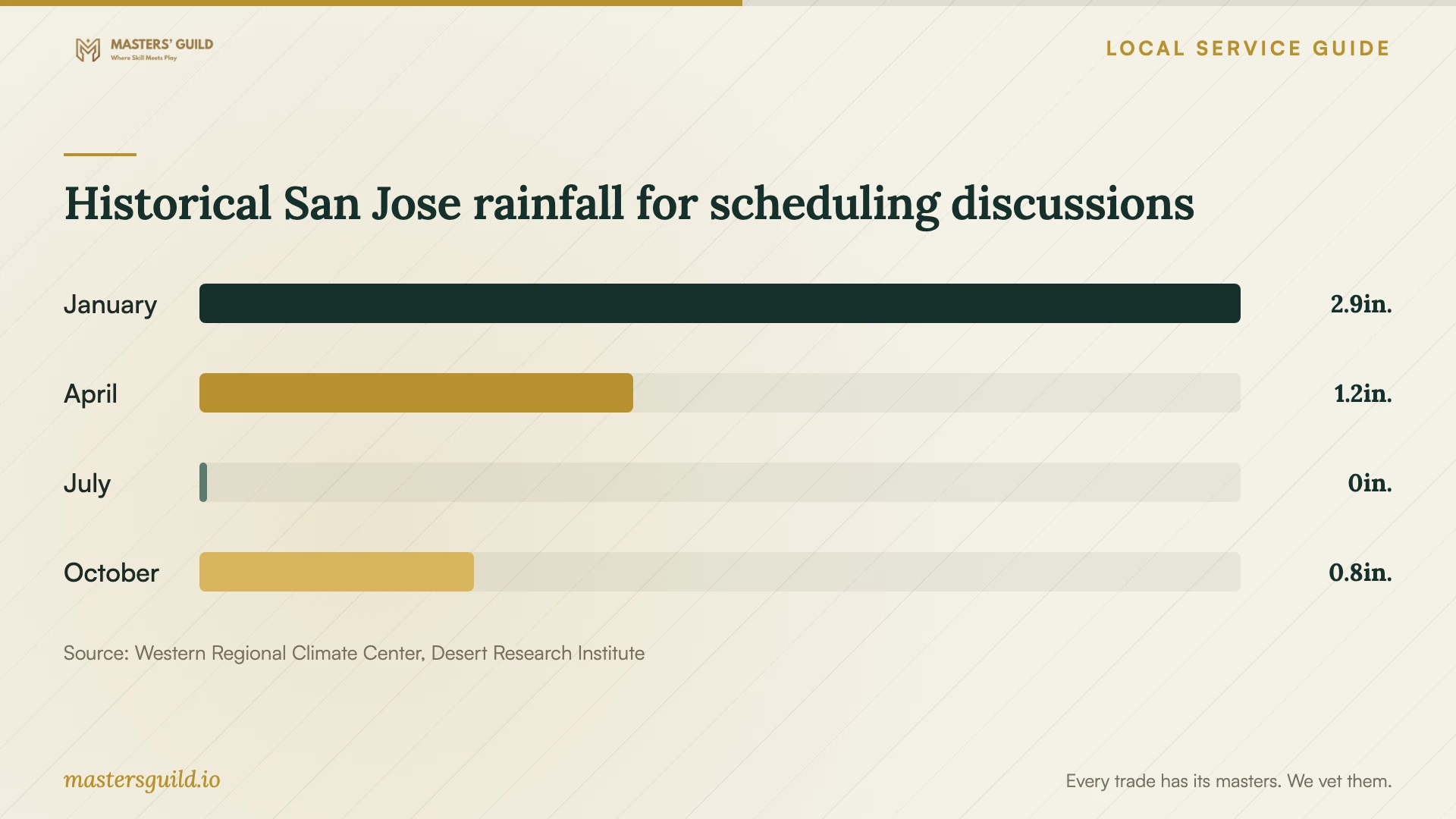
The Western Regional Climate Center’s San Jose station summary reports average January precipitation of 2.88 inches and July precipitation of 0.02 inches across its January 1893 through June 2016 record. Use that historical seasonal difference to discuss rain delays and protection during your proposed work period. Do not choose a pour date from monthly averages; ask the contractor to review the forecast. [3]
Have the contractor write down the work sequence and the conditions for returning the surface to use. Ask for separate instructions for walking, moving furniture back and parking a vehicle. Record who will provide an updated schedule after a weather delay, and ask how the contractor will communicate any changes to surface care.
Historical San Jose rainfall for scheduling discussions
Local details that affect your job
California’s concrete scope changes the license question
The statewide C-8 classification applies to contractor selection here. CSLB includes specified concrete pavement and flatwork in its scope, but excludes businesses whose sole contracting activity consists of plaster coatings or placing and erecting reinforcing steel. If you request only a coating or reinforcing-steel service, ask the bidder to identify the applicable classification instead of assuming C-8 fits that standalone scope. [1]
California requires coverage for active solo C-8 contractors
Under CSLB’s statewide rule, an active C-8 contractor must carry workers’ compensation insurance or valid self-insurance even without employees. If a local bidder claims a no-employee exemption, ask them to resolve that claim against their C-8 status before signing. Check the business identity and coverage dates, and confirm the contractor’s license standing. [2]
Questions to resolve before choosing a scope
| Your situation | Ask the bidder | Resolve before signing |
|---|---|---|
| New driveway or patio | What preparation and concrete specifications do you propose? | Dimensions, base, thickness, joints and finish |
| Uneven or damaged slab | Why do you recommend repair or replacement? | Proposed treatment and the concerns it addresses |
| Coating-only proposal | Which classification covers this work? | C-8 excludes businesses solely contracting to apply plaster coatings |
| Solo active C-8 contractor | Can you provide workers’ compensation or valid self-insurance documentation? | CSLB requires coverage even without employees |
| Weather-sensitive schedule | How will you handle a rain delay? | Rescheduling, protection and access arrangements |
Your hiring checklist
- Photograph the work area, damaged sections and delivery route.
- Describe the intended use and ask bidders to confirm dimensions.
- Ask bidders to explain their classifications and provide coverage documentation.
- Request written specifications for base, thickness, reinforcement, joints and finish.
- Record drainage goals and proposed finished heights near doors.
- Confirm city requirements and assign responsibility for approvals and inspections.
- Agree on weather delays, cleanup and written return-to-use instructions.
Frequently Asked Questions
Does a concrete contractor working alone need workers’ compensation?
CSLB requires active C-8 concrete contractors to carry workers’ compensation insurance or valid self-insurance even without employees. Ask for documentation and check the business name, license number and coverage dates before signing. [2]
What does California’s C-8 classification cover?
CSLB defines it to cover forming, pouring, placing, finishing and installing specified concrete work, including pavement and flatwork. Ask the bidder to explain how their classification fits the complete scope, including any tasks another contractor will perform. [1]
What should I include when requesting a quote?
Provide approximate dimensions, photos, intended use, access constraints and drainage concerns. Request a site visit and a written scope covering preparation, concrete specifications, disposal and cleanup. Ask bidders to identify exclusions and assign responsibility for confirming city requirements.
Can I choose a pour date from the rainfall chart?
Use the station’s historical monthly averages to discuss seasonal scheduling and rain contingencies. They do not predict a particular day. Ask the contractor to review the forecast and explain their postponement and protection plan before the pour. [3]
Sources and scope
This guide combines the sources below with practical planning guidance. Figures apply to the stated geography and period; request a written quote for your property.