
Local service guide
Special Item Transport in San Francisco: Hiring Guide
Arrange Special Item Transport in San Francisco by choosing a mover who can explain how they will handle your item, inspect both access routes and provide a written scope. For household goods, verify licensing and insurance through California’s Bureau of Household Goods and Services. Decide who will arrange truck parking before you commit to a date; SFMTA requires at least five business days to process new temporary-sign requests. [1] [4]
Choose a mover around the item and the route
Start your request with the item’s make or model, dimensions, estimated weight if you have reliable documentation, and photographs. Include its condition and any handling instructions from the manufacturer. Ask the mover to explain the proposed equipment, crew, protective wrapping and loading method. Request examples of how they would handle your particular item rather than accepting a general promise to move heavy objects.
Walk the route at both addresses. Measure door openings, turns and elevator entrances; photograph stairs, landings and the path from the curb. Ask your building manager about elevator reservations, floor protection and delivery hours. For a piano or slate pool table, specify whether the quote includes disassembly, reassembly and final placement. If you need tuning, leveling or other finishing work, ask who will perform it and whether you need a separate appointment.
Verify the company and compare written quotes
California’s Bureau of Household Goods and Services says companies moving household goods within, into or out of California must hold its license. For moves into or out of the state, the bureau also requires Federal Motor Carrier Safety Administration licensing. Check the company you intend to hire and confirm its insurance before paying a deposit. [4]
For moves within California, the bureau requires a visual inspection with the estimate and recommends an in-person inspection. The mover must sign the estimate. Ask each company to describe transportation and service charges, payment method and coverage for damage. Use the same item list and access information for each quote so you can compare the proposed work. [4]
Ask for separate entries for packing or crating, stairs, carrying distance, disassembly, setup, parking arrangements and any storage you request. Have the mover explain exclusions and the process for approving extra work. Ask what compensation applies if the item suffers damage, what documentation you must supply and how to submit a claim.
The bureau says the company must provide a moving agreement or Bill of Lading at least three days before the move. For an in-state move, it should include a Not to Exceed Price, the maximum charge unless you approve change orders. You and the mover must sign before moving begins. If you add items after inspection, sign the required change order before loading. [4]
Plan truck access before setting the arrival time
Use SFMTA’s temporary-sign process when you need to reserve curb space for the moving van. Apply through its online portal or call 311; callers outside San Francisco can use 415.701.2311. Allow at least five business days between application and enforcement, excluding legal holidays. For applications on Port property, SFMTA requires at least 15 calendar days. [1]
SFMTA requires signs at least 72 hours before enforcement in unmetered areas and 24 hours before enforcement at metered spaces. Moving requests must start no earlier than 7 a.m. and end no later than 10 p.m. Assign one person to handle the application, check approval and confirm the posted dates before the crew arrives. [1]
Check the existing curb rules with your mover. SFMTA’s temporary signs do not override street cleaning or other parking and traffic restrictions. Yellow loading zones have posted operating hours, and six-wheel truck zones restrict use to that vehicle type. A driver with a noncommercial plate may use a yellow zone for only three minutes of active loading and must remain with the vehicle. [1] [2]
Budget for curb reservation separately
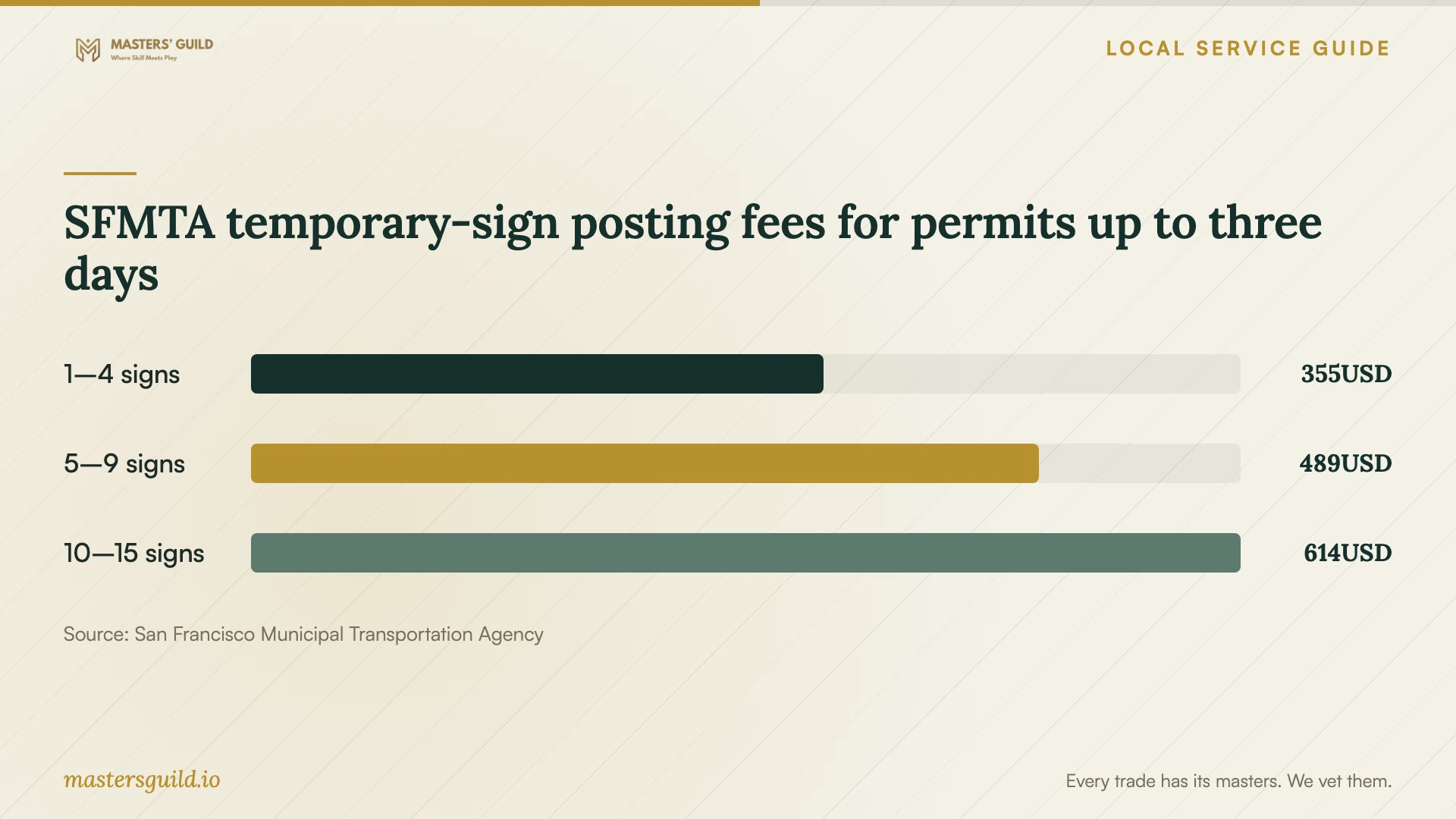
The chart shows SFMTA’s posting fees for temporary signs requested through its portal or 311 for a permit up to three days. Effective July 1, 2026, the published fees are $355 for one to four signs, $489 for five to nine signs and $614 for ten to fifteen signs. SFMTA determines the exact fee after inspecting the requested area. [1]
Meter charges can add to the posting fee: SFMTA lists $21 per meter per day at the time of this October 2026 review. Ask whether the mover will pay the city charges and include them in your quote or whether you will pay SFMTA yourself. These figures describe curb access expenses; they do not establish a transport price for your item. [1]
Confirm container permits and document delivery
If you choose a stationary moving pod, ask the container company to confirm its Public Works authorization and obtain the location permit. Public Works issues these permits to authorized companies rather than residents. Its guidance requires requests at least five business days before occupancy and limits an individual location permit to seven days. A truck or container on wheels does not need this particular permit type. [3]
Public Works requires the property owner to post No Parking signs and upload photos at least 72 hours before container placement. Sidewalk placement needs the Director’s permission. Before renting, confirm the approved location, delivery and removal dates, and who will complete each sign requirement. [3]
Before loading, photograph the item and make an inventory, as the state consumer guide recommends. At delivery, compare the condition with your photographs and check the agreed placement and setup with the crew. Record any damage or unfinished work in writing and keep your estimate, agreement, receipts and correspondence together. [4]
SFMTA temporary-sign posting fees for permits up to three days
Local details that affect your job
Port-property moves need a longer lead time
SFMTA requires at least 15 calendar days between a temporary-sign request and an event on Port property. Check jurisdiction before promising a waterfront pickup date; the normal five-business-day application window may not cover your address. [1]
An existing yellow zone may not suit your vehicle
SFMTA limits noncommercial vehicles to three minutes of active loading in yellow zones, with the driver present. Six-wheel truck zones allow only six-wheeled trucks. Confirm the mover’s vehicle and the posted rules before treating a nearby loading zone as your unloading plan. [2]
A moving pod follows a separate permit process
Public Works requires authorized container companies to obtain permits for stationary pods on the street or sidewalk. Residents cannot obtain these permits themselves. Ask the company to confirm approval before delivery and assign the property owner’s sign-posting and photo-upload duties. [3]
Choose the next step for your transport plan
| Situation | Next step | Before committing |
|---|---|---|
| Household item moving within California | Verify the mover’s BHGS license and insurance. | Obtain the visual inspection and signed written estimate. |
| Truck needs reserved curb space | Request SFMTA temporary signs through the portal or 311. | Allow at least five business days and check existing restrictions. |
| Pickup or delivery on Port property | Check the temporary-sign application requirements. | Allow at least 15 calendar days. |
| Mover proposes a yellow loading zone | Confirm vehicle eligibility and posted hours. | Noncommercial vehicles have a three-minute attended-loading limit. |
| Stationary moving pod on public space | Have an authorized company obtain the Public Works permit. | Confirm approval and the property owner’s sign and photo duties. |
Your hiring checklist
- Send item dimensions, model details, condition photographs and handling instructions.
- Measure both access routes and confirm building delivery arrangements.
- Ask the mover to explain equipment, protection, disassembly and setup.
- Compare identical written scopes and clarify damage coverage.
- Assign responsibility for curb access applications and city charges.
- Confirm the approved loading location and arrival window with the crew.
- Keep condition photographs and review placement and setup at delivery.
Frequently Asked Questions
How much will transporting my piano or safe cost?
Request an item-specific quote after the mover reviews the item and access. Ask for transportation, packing, stairs, setup and coverage details. The published SFMTA fees here cover parking-sign posting, not specialty moving labor, equipment or a total job price. [1] [4]
Do I need temporary parking signs for every move?
SFMTA provides temporary signs when you need a reserved No Parking or No Stopping zone for a moving van. Review the available legal loading space with your mover and decide whether to request a reservation. Temporary signs do not override existing parking restrictions. [1]
Can I arrange a street permit for a moving pod myself?
Public Works issues mobile storage container permits only to authorized container companies. Your rental company obtains the permit. The property owner must post No Parking signs and upload photographs at least 72 hours before placement. [3]
What should I receive before the mover starts?
For an in-state household move, obtain the signed estimate and moving agreement with a Not to Exceed Price. The bureau says the company must provide the agreement at least three days before the move, and both parties must sign before work begins. [4]
Sources and scope
This guide combines the sources below with practical planning guidance. Figures apply to the stated geography and period; request a written quote for your property.