
Local service guide
Flooring installation and repair in San Francisco
For flooring installation and repair in San Francisco, ask contractors to inspect the existing floor before you accept a replacement quote. Compare written scopes for preparation, repair, installation, furniture handling and debris removal. California’s C-15 flooring classification covers surface preparation and wood-floor finishing and repair, but excludes ceramic tile. Match the contractor’s qualifications to your chosen material, and settle removal and access arrangements before agreeing to a start date. [1]
Choose repair or replacement after an inspection
Show the contractor the damage and explain your goal: fixing a limited area, changing the appearance or replacing the floor throughout the room. Ask them to describe what they can retain and what they propose to remove. Request a written repair option if you would prefer to keep the existing floor.
For a patch, ask how the contractor will match the material, height and finish. For replacement, ask them to inspect the surface underneath and identify preparation work before pricing installation. Request an explanation of any inspection limits, such as areas they cannot assess until they remove the existing covering.
Match the contractor to the material and scope
CSLB defines C-15 work to include preparing surfaces and installing carpet, resilient sheet goods, resilient tile and wood floors, including wood-floor finishing and repair. The classification excludes ceramic tile. If your project includes ceramic tile, ask the bidder to identify the qualification that covers that part of the work. [1]
Ask for the contractor’s license number, insurance information and the name of the person supervising the job. Describe any proposed work beneath the flooring as a separate scope. If the contractor proposes structural repairs or other alterations, ask them to confirm permit requirements with the city before you approve that work.
Compare complete written quotes
Request separate amounts for flooring materials, installation, removal, surface preparation, trim and furniture handling. Specify the product, rooms, stairs and transitions between surfaces. Ask each bidder to state exclusions and explain how they will price additional work after opening the floor. Approve changes in writing before the contractor proceeds.
Ask who orders the flooring, where you will store it and what product instructions the installer will follow before installation. Agree on responsibility for clearing rooms and protecting shared hallways. In a condominium, request your building’s work-hour, access and flooring requirements before choosing the installation date.
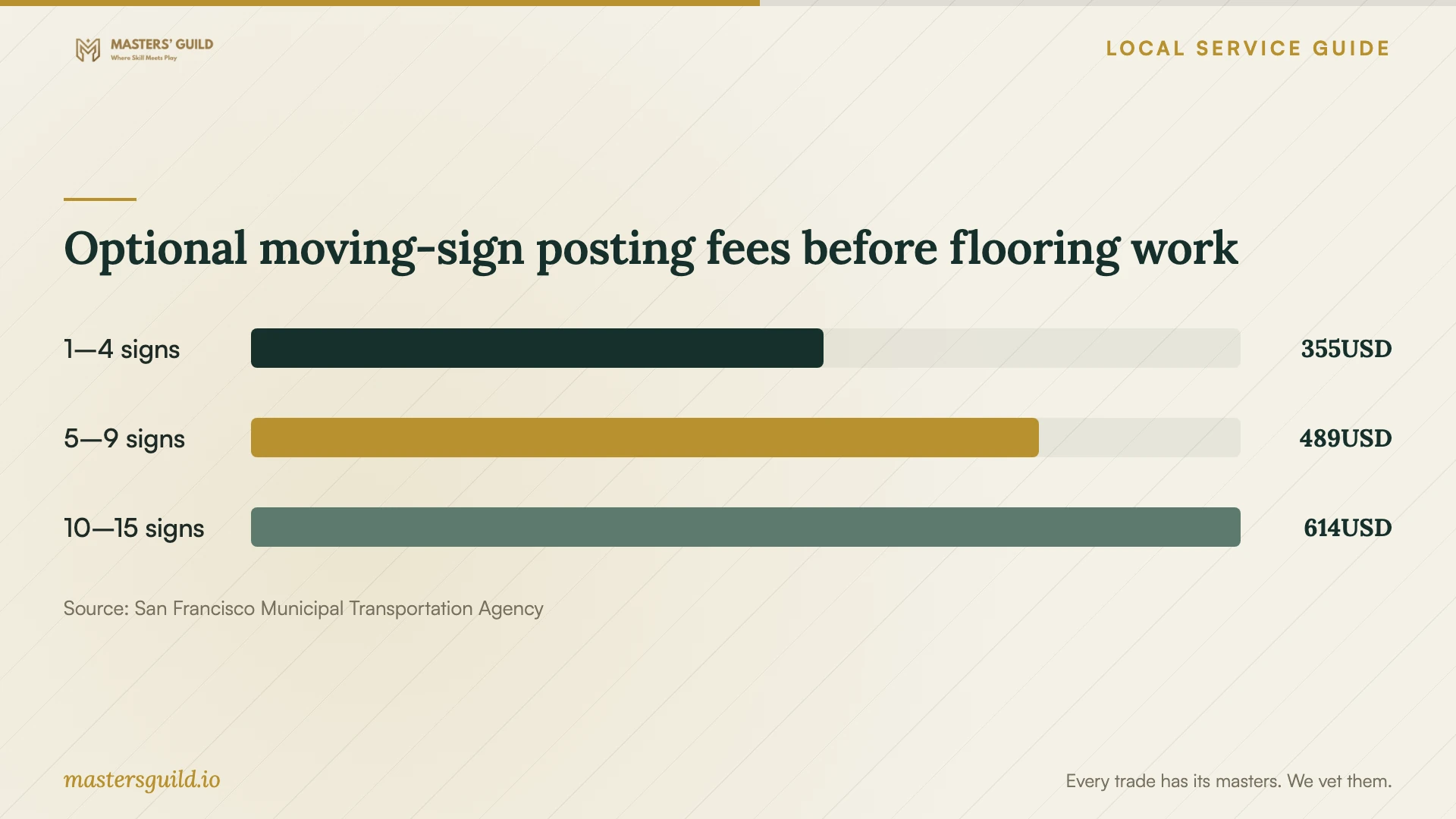
Use site-specific bids for the flooring budget. The published fees in the chart concern optional furniture-moving curb reservations; they do not establish flooring labor or material prices. Ask your mover whether a reservation is appropriate before adding that expense. [4]
Resolve old-floor removal and debris handling
San Francisco requires contractors and owners to reuse or recycle construction and demolition debris removed from a project. For mixed debris, the city requires a permitted transporter, subject to stated exemptions, and delivery to a city-registered processing facility. Ask your contractor to name the hauler and destination and specify what disposal documentation they will provide. [3]
For material separated by type, the city requires delivery to a facility or end use that reuses or recycles it. Companies hauling only source-separated material for reuse or recycling have an exemption from the transporter permit requirement. Ask the bidder which route they plan to use rather than accepting an unspecified disposal charge. [3]
If removal involves asbestos, resolve the applicable handling and notification requirements before scheduling work. The Bay Area Air District requires at least 10 business days’ notice for renovations removing 100 square feet or more of asbestos, with separate thresholds for linear feet and volume. This rule does not establish whether your flooring or adhesive contains asbestos. Ask how the contractor will resolve uncertainty before disturbing the material. [2]
Arrange access before clearing the rooms
Decide whether furniture will stay elsewhere in the home or leave in a moving van. For an eligible moving-van curb reservation, SFMTA asks applicants to allow at least five business days between application and enforcement. Its temporary moving signs do not cover construction work; the agency directs construction parking requests to Public Works. [4]
Ask the flooring contractor and mover to identify their separate access needs. Confirm stairs, elevator booking, carrying routes and who handles furniture after completion. Agree on the point at which you may walk on the floor and return furnishings, using the installer’s product-specific instructions.
Optional moving-sign posting fees before flooring work
Local details that affect your job
Debris boxes need their own street arrangement
San Francisco requires a Public Works street-space permit when you place a debris box in the public right of way. Ask who will obtain it and include the responsibility in the quote. SFMTA also states that its temporary signs do not replace street occupancy or encroachment permits for debris or storage boxes. [3] [4]
Asbestos removal can change the start date
The regional Air District offers a 72-hour advance-notification option, with an additional fee, for residential buildings containing four or fewer dwelling units. Its standard notice period is at least 10 business days for covered asbestos renovations. If your removal falls under these rules, ask the responsible contractor which notification route applies and confirm the removal dates before arranging furniture storage. [2]
Moving-sign posting depends on the curb
For moving reservations, SFMTA requires posting at least 72 hours before enforcement in unmetered areas and at least 24 hours before enforcement at metered spaces. The signs do not override existing parking and traffic restrictions. Have your mover confirm the proposed space and posting arrangements before the move. [4]
Choose the next step for your flooring project
| Your situation | Next step | What to settle before work |
|---|---|---|
| You want to retain the existing floor | Request a repair scope and proposed finish match. | Which areas the contractor will retain, repair or replace. |
| The project includes ceramic tile | Ask for qualifications covering the tile work; C-15 excludes ceramic tile. | Who performs each part of the project. |
| The contractor will haul mixed debris | Ask for the transporter and city-registered destination, accounting for applicable exemptions. | Hauling responsibility and disposal documentation. |
| Removal involves asbestos | Confirm applicable Air District handling and notification requirements. | The notification route and confirmed removal dates. |
| Furniture will leave in a moving van | Ask whether an SFMTA moving reservation fits the planned move. | Application and posting lead times, separate from construction parking. |
Your hiring checklist
- Photograph the damage and identify the rooms and surfaces you want included.
- Request repair and replacement scopes if you want to compare both approaches.
- Ask for the contractor’s classification and qualifications for each material.
- Get written prices, exclusions and a process for approving additional preparation work.
- Ask how the contractor will assess uncertain existing materials before removal.
- Confirm the debris hauler, destination and documentation.
- Agree on furniture handling, building access and any curb or debris-box arrangements.
- Get instructions for walking on the completed floor and returning furniture.
Frequently Asked Questions
Does a C-15 classification cover ceramic tile?
No. CSLB excludes ceramic tile from C-15 flooring and floor covering work. Ask the contractor to identify the qualification covering ceramic tile if it forms part of your project. [1]
Can I put removed flooring in a regular trash bin?
San Francisco prohibits putting construction and demolition debris in a designated trash bin. Ask your contractor to arrange the required reuse or recycling route and identify the destination. [3]
Does a small asbestos removal avoid all requirements?
The Air District’s square-foot notification threshold is 100 square feet of asbestos removal, and it also lists linear-foot and volume thresholds. The agency states that asbestos removal must follow its regulations. Ask the responsible specialist to confirm your project’s requirements rather than treating a smaller area as an exemption. [2]
Can moving signs reserve parking for the flooring crew?
SFMTA states that its temporary moving signs do not cover construction work. Ask the contractor to confirm construction access arrangements through Public Works and keep any furniture-moving reservation separate. [4]
Sources and scope
This guide combines the sources below with practical planning guidance. Figures apply to the stated geography and period; request a written quote for your property.