
Local service guide
Salem tree cutting: hiring and preparation guide
Arrange tree cutting in Salem by defining the work, checking the contractor’s Oregon license and resolving utility coordination before agreeing to a cutting date. Oregon allows an LCB or CCB license for removal and stump grinding. For work near PGE power lines, call PGE before starting. Ask your contractor to separate removal, stump work, cleanup and replacement planting in the written quote, and confirm any applicable local approval requirements before authorizing work. [1] [2]
Choose an assessment, pruning or removal scope
Tell the arborist what you want to solve: a branch over the roof, a tree you are concerned about, clearance for a project or a stump in the planting area. Ask for an assessment before committing to removal if you want to keep the tree. Request an explanation of the proposed work and any alternative the arborist recommends.
Identify each tree in the quote with a photo or a marked site sketch. Specify which branches the crew should address and whether you want wood retained, cut into manageable pieces or hauled away. For stump work, ask for the grinding depth, whether the crew removes grindings and who supplies backfill. Avoid authorizing a broad instruction such as clearing the yard.
Check contractor authority for the whole job
The Oregon Landscape Contractors Board states that either an LCB or CCB license allows tree removal, stump grinding and limb guying. It also states that an LCB license covers tree work including planting and trimming. Ask for the business name and license number, then verify that the license matches the contractor and the proposed scope. [2]
For a removal-and-replanting job, ask who will perform the planting. Oregon says a CCB license alone does not allow planting, with two listed exceptions for residential general contractors: up to $3,850 of planting-related landscaping under a contract to construct a new residential dwelling, or planting residential street trees directly related to building-code or occupancy requirements. Both exceptions exclude irrigation work. Ask the contractor to identify the authority that covers your planting scope. [2]
Request proof of insurance for the proposed work and ask who will supervise the crew. If you are paying for an assessment, identify the person who will inspect the tree and whether you will receive written findings. Keep assessment fees and cutting work separate in the quote so you can decide after reviewing the recommendation.
Resolve location and approval questions before cutting
Use the property address and a site sketch when asking the applicable local authority about approval requirements. Identify whether the tree stands within your lot, along a boundary or beside the street. Ask the authority to confirm jurisdiction and whether the proposed removal or pruning needs permission. Request the applicable requirements in writing before you authorize cutting.
Assign responsibility in the contract: who checks requirements, who submits any application, who pays any fees and who provides confirmation before work begins. Ask whether the homeowner must sign or authorize an application. Keep contractor licensing, property-owner permission and local approval as separate questions when discussing the job.
Coordinate work near PGE power lines
If the work involves PGE power lines, call its Tree Hotline at 503-736-5460 before starting. PGE lists hours of Monday through Friday, 8 a.m. to 3:30 p.m. Confirm your electricity provider before using this guidance, because PGE notes that some lines attached to utility poles belong to other organizations. [1]
PGE distinguishes its routine clearance work from whole-tree removal. It says entire-tree removal during maintenance pruning is uncommon, although a PGE forester may coordinate removal of a dead or dying tree that poses a safety hazard. Ask PGE what it will address before paying a private contractor for overlapping work. [1]
Describe the proposed stump or planting work when discussing underground services. PGE instructs customers to call 811 at least two business days before digging. Ask the contractor to identify who arranges marking and how the crew will account for utilities in the work plan. [1]
Prepare access and agree on weather contingencies
Walk the proposed access route with the contractor. Point out gates, fences, garden beds, irrigation components and surfaces you want protected. Agree on where the crew will place equipment, stack wood and load debris. Ask how the crew will restore any disturbed area and document its starting condition with photos.
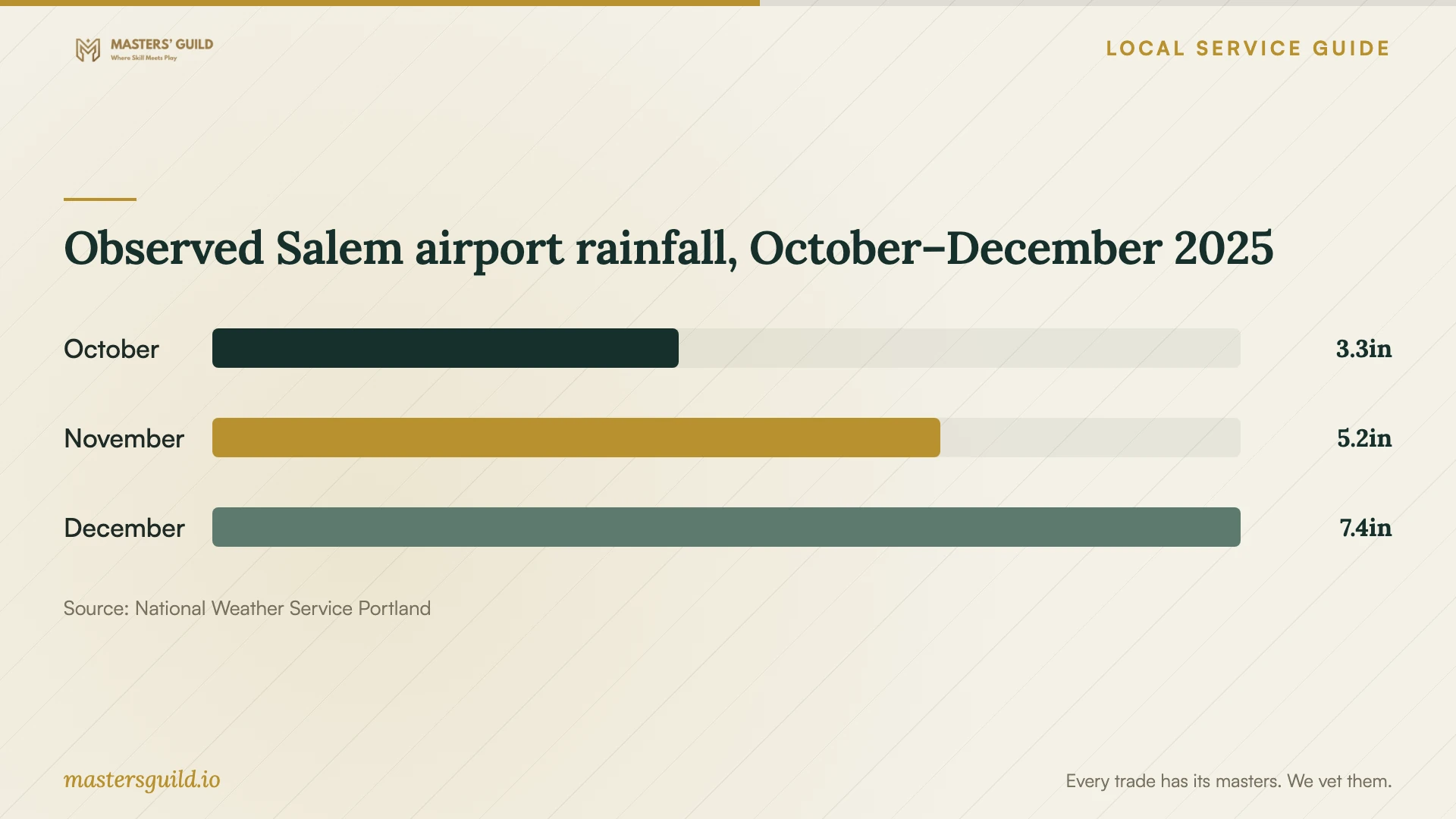
The National Weather Service recorded 3.34 inches of rainfall in October, 5.21 inches in November and 7.36 inches in December 2025 at Salem McNary Airport. Treat those observations as historical scheduling context. Ask the contractor how rain or unsuitable access would change the appointment, equipment plan or cleanup, and put the rescheduling arrangement in writing. [3]
Observed Salem airport rainfall, October–December 2025
Local details that affect your job
A PGE call can change the work scope
For a property served by PGE with work near its lines, call 503-736-5460 before cutting, Monday through Friday, 8 a.m. to 3:30 p.m. PGE prunes branches that strain or abrade service wires, while whole-tree removal during routine maintenance is uncommon. Ask which work PGE will handle before finalizing the private contractor’s quote. [1]
Oregon distinguishes removal from replacement planting
An LCB or CCB license covers removal and stump grinding in Oregon. An LCB license also covers planting. If a CCB contractor proposes replacement planting, ask whether an applicable residential-general-contractor exception covers it or whether an LCB contractor will perform that part. Do not assume removal authority covers the complete replacement project. [2]
Choose the next step for your tree project
| Your situation | Next step | Clarify before booking |
|---|---|---|
| You want to retain the tree | Request an assessment and a proposed pruning scope | Who assesses it and what written findings you receive |
| You want removal and stump grinding | Check the contractor’s LCB or CCB license | Grinding depth, disposal and backfill |
| You want removal and replacement planting | Check authority for both removal and planting | LCB planting scope or an applicable CCB exception |
| The work is near PGE lines | Call PGE’s Tree Hotline before work | Utility work, private work and coordination responsibilities |
| You are unsure about local permission | Ask the applicable authority using the address and tree location | Requirements, applicant eligibility and who handles approval |
Your hiring checklist
- Identify each tree and describe the outcome you want with photos or a site sketch.
- Ask for the contractor’s business name, license number and proof of insurance.
- Confirm the applicable jurisdiction and ask about approval requirements before authorizing cutting.
- Assign responsibility for approval checks, applications and utility coordination in writing.
- Separate removal, stump grinding, wood disposal, backfill and planting in the quote.
- Agree on equipment access, surface protection and cleanup.
- Record payment terms, weather postponements and the final condition you expect.
Frequently Asked Questions
Does an Oregon contractor need a license for tree removal?
Yes. The Oregon Landscape Contractors Board says an LCB or CCB license allows tree removal, stump grinding and limb guying. Ask for the business’s license number and verify it before hiring. [2]
Can the removal contractor plant a replacement tree?
Check the planting scope. Oregon allows planting under an LCB license. A CCB license alone generally does not authorize planting, although the state lists limited residential-general-contractor exceptions for new-dwelling landscaping and required residential street-tree planting. [2]
Will PGE remove a tree near its power lines?
PGE says whole-tree removal during maintenance pruning is uncommon. A forester may coordinate removal of a dead or dying tree that poses a safety hazard. Call its Tree Hotline at 503-736-5460 before arranging work near PGE lines. [1]
How should I compare tree-work quotes?
Give contractors the same tree identification and requested outcome. Compare the cutting scope, access plan, wood disposal, stump work, site restoration and payment terms. Ask each contractor to list exclusions and explain any proposed change before you approve it.
Sources and scope
This guide combines the sources below with practical planning guidance. Figures apply to the stated geography and period; request a written quote for your property.