
Local service guide
Plumbing Services in Salem, OR: Hiring and Permits
To arrange Plumbing Services in Salem, request a job-specific written quote and verify the contractor’s Oregon CCB and BCD plumbing contractor licenses before work begins. Oregon requires both credentials. For a detached one- or two-family dwelling, the state lists water-heater replacement and concealed piping alterations as permit-required work, while ordinary sink, toilet and exposed-faucet repairs or replacements fall within its listed exemptions. For other property types or uncertain work, contact the building department responsible for your address. [1] [2]
Give the plumber a clear job description
Describe the affected fixture, when you noticed the problem and whether you can stop the water. Send photographs of the fixture and accessible connections. For a drain problem, report which fixtures show symptoms and name any cleaning products you have used. Leave the diagnosis to the plumber.
For an active leak, close an accessible shutoff if you can do so without entering a hazardous area. Keep people away from wet electrical equipment. Ask the dispatcher for an arrival window and the initial visit charge. For planned work, provide the fixture or heater model and say whether you want to keep its current location.
Check the business and its credentials
Oregon requires hired plumbing contractors to hold a CCB license and the appropriate BCD plumbing contractor license. The Building Codes Division’s licensed-work page links to both searches. Request both license numbers and compare the business name in the records with the name on your estimate before work starts. [1]
Ask who will perform the repair and who will handle a return visit. Request proof of insurance and the workmanship warranty in writing. Keep your estimate, approvals and completion documents together so you can track the work you authorized.
Identify the permitting authority for your address
Oregon directs homeowners to its Local Building Department Directory to locate the jurisdiction responsible for their property. Use the directory linked from the state residential-permits page, then contact the listed department with your street address and proposed work. Ask it to confirm that it handles permits for that address before discussing the application. [2]
If you need help locating that department, Oregon BCD lists its main contact number as 503-378-4133 and its office at 1535 Edgewater Street NW in Salem. Ask BCD for help identifying the responsible department. That state office address does not establish that BCD issues the permit for your property; Oregon assigns project-specific permitting questions to the local jurisdiction. [1] [2]
Match the permit discussion to the property and work
Oregon’s residential permit examples apply to detached one- or two-family dwellings. Within that scope, the state requires permits for water-heater replacement, new plumbing installations and alterations to piping inside a wall, ceiling or under a floor. It lists ordinary sink, toilet and faucet repairs or replacements as exempt, with the faucet exemption limited to faucets not concealed in a wall. [2]
For those detached dwellings, the state also requires a permit for emergency repair, alteration or replacement of freeze-damaged or leaking concealed piping when new piping exceeds five feet. Do not use that emergency threshold to decide whether another concealed piping alteration needs a permit. Describe the full scope to the responsible building department. For a condominium, attached dwelling or other property type, ask that department for the applicable requirements. [2]
Oregon assigns responsibility for necessary permits to the person performing the work, whether a homeowner or contractor. Ask your contractor to name the permit route in the quote and explain what completion documents you should retain. [2]
Request a quote you can compare
Request a job-specific written quote that distinguishes the initial visit or diagnosis from the repair. Ask whether it includes parts, fixture supply, old-equipment removal, cleanup and wall or floor restoration. Agree on how you will approve additional work before the plumber opens the affected area.
For water-heater replacement in a detached one- or two-family dwelling, Oregon requires a permit and allows a hired plumbing contractor to obtain a minor label permit. Ask which route the contractor will use. Include the replacement model, installation location and proposed connection changes in the written scope. For another property type, confirm the permit route with the responsible department. [2]
If estimates propose different repairs, ask each plumber to explain the diagnosis and what they will check before proceeding. Request separate prices for optional work so you can choose what to authorize.
Include exposed plumbing in seasonal preparation
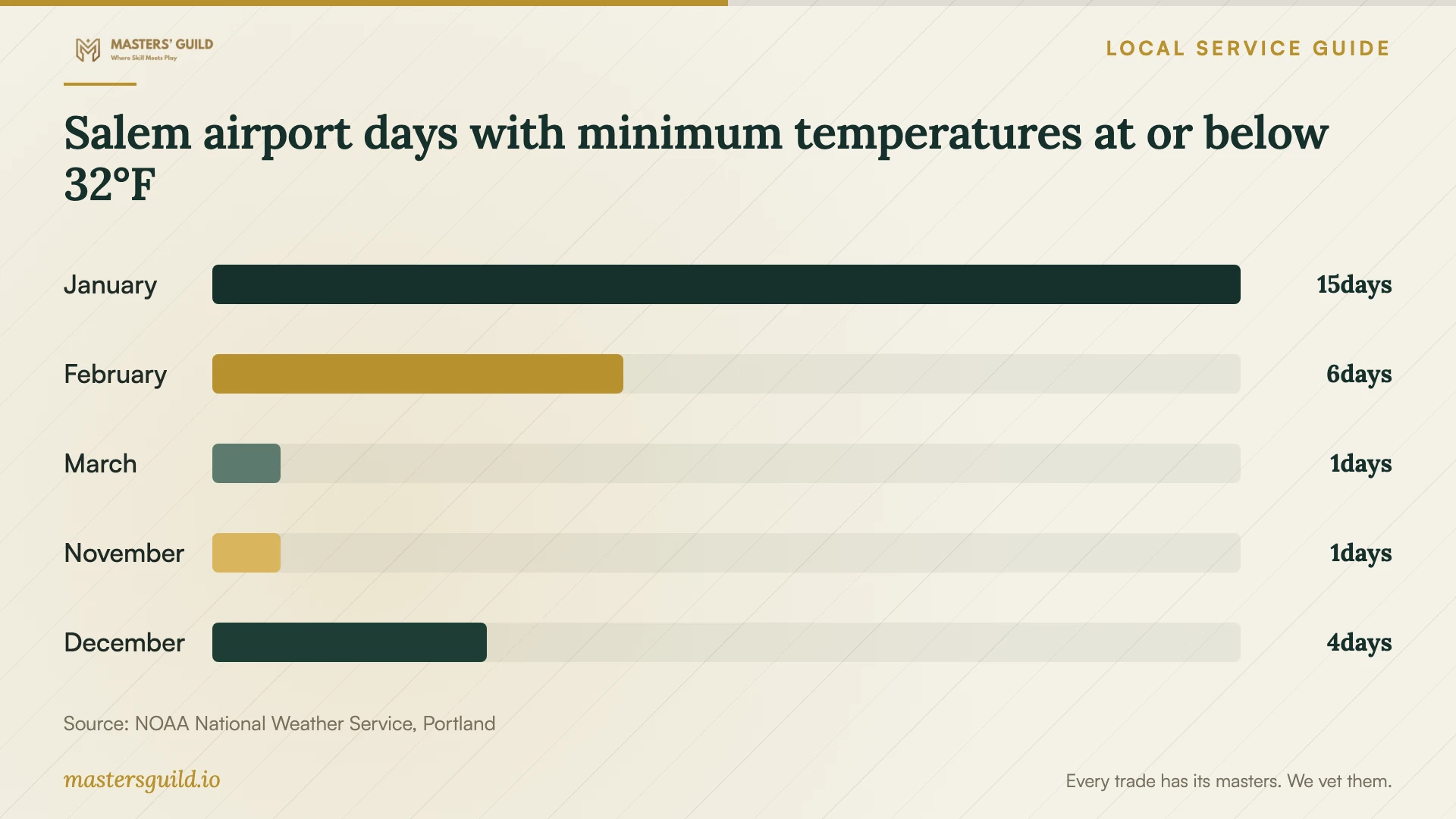
The National Weather Service’s 2025 table records days with minimum temperatures at or below 32°F at Salem McNary Airport. January had 15 such days and February had six. Use the historical observations as a prompt to discuss exposed plumbing with your contractor, rather than as a forecast for your property. [3]
Ask the plumber to assess outdoor faucets and accessible pipes in unheated spaces if those areas concern you. Request preparation instructions suited to your installation, and clear access to the main shutoff before the visit.
Salem airport days with minimum temperatures at or below 32°F
Local details that affect your job
Use Oregon’s dual-license hiring check
For hired plumbing work in Salem, Oregon requires both a CCB license and the appropriate BCD plumbing contractor license. Use the two searches linked from the BCD licensed-work page and match the business to your estimate. Request both numbers before accepting the proposed work. [1]
Locate the department before arranging a permit
Use the Local Building Department Directory linked from Oregon’s residential-permits page to locate the responsible jurisdiction, then ask the listed department to confirm your street address. For help finding that department, call Oregon BCD’s main number, 503-378-4133. BCD lists a Salem office, but the supplied guidance directs property-specific permitting questions to the responsible local department. [1] [2]
Specify the water-heater permitting route
For a detached one- or two-family dwelling, Oregon requires a permit for water-heater replacement and allows a hired plumbing contractor to obtain a minor label permit. Ask the contractor to identify the route and completion documents in the quote. For other property types, confirm requirements with the responsible building department before scheduling. [2]
Oregon permit guidance for detached one- or two-family dwellings
| Proposed work | State guidance within this dwelling scope | Next step |
|---|---|---|
| Ordinary toilet replacement | The state lists ordinary toilet repair or replacement as exempt from a plumbing permit. | Clarify whether the work also relocates plumbing or changes concealed piping. |
| Exposed faucet replacement | The state lists repair or replacement of a faucet not concealed in a wall as exempt. | Confirm fixture supply, connections and cleanup in the quote. |
| Water-heater replacement | The state requires a permit; a hired plumbing contractor may obtain a minor label permit. | Ask which route the contractor will use and what documents you will receive. |
| Concealed piping alteration | The state requires a permit for alterations inside a wall, ceiling or under a floor. | Identify permit responsibility and who restores the opened surface. |
| Emergency concealed piping repair | The state requires a permit for emergency work on freeze-damaged or leaking concealed piping when new piping exceeds five feet. | Ask for the replacement length and confirm the full scope with the department. |
| Another property type | The cited examples apply only to detached one- or two-family dwellings. | Contact the responsible building department for requirements at your address. |
Your hiring checklist
- Photograph the problem, equipment label and accessible connections.
- Describe the symptoms, access conditions and any products you have used.
- Request both contractor license numbers and check the business name.
- Confirm the arrival window and initial visit charge.
- Request a written scope covering equipment, access, removal, cleanup and restoration.
- Ask the contractor to document permit responsibility after confirming the property type and jurisdiction.
- Agree on how you will authorize additional work.
- Keep the invoice, warranty and completion documents.
Frequently Asked Questions
Which licenses should I check?
Oregon requires hired plumbing contractors to hold a CCB license and the appropriate BCD plumbing contractor license. Use the searches linked from the BCD licensed-work page and compare the business name with your estimate. [1]
Does water-heater replacement require a permit?
For a detached one- or two-family dwelling, Oregon requires a permit and allows a hired plumbing contractor to obtain a minor label permit. Ask the contractor to identify the route in writing. For other property types, contact the responsible building department. [2]
Does an ordinary toilet replacement require a permit?
Oregon’s guidance for detached one- or two-family dwellings lists ordinary toilet repair or replacement as exempt from a plumbing permit. Describe any relocation or concealed piping changes to the responsible department. Ask that department about requirements for other property types. [2]
How do I find the department responsible for my address?
Follow the Local Building Department Directory link on Oregon’s residential-permits page, then contact the listed department to confirm your address. If you need help locating it, Oregon BCD lists its main contact number as 503-378-4133. [1] [2]
Sources and scope
This guide combines the sources below with practical planning guidance. Figures apply to the stated geography and period; request a written quote for your property.