
Local service guide
Kitchen Remodeling in Saint Paul, MN: Hiring Guide
For Kitchen Remodeling in Saint Paul, choose a contractor after you agree on the layout, identify the plumbing and electrical work, and compare written bids for the same scope. Minnesota requires a residential contractor or remodeler license for companies contracting with owners of one-to-four-unit homes across more than one special skill, subject to listed exemptions. Ask who will obtain permits, coordinate inspections, and protect occupied rooms during demolition before you sign. [4]
Define the kitchen you want before requesting bids
Write a scope for the kitchen and any adjoining space you want changed. Identify cabinets to retain or replace, countertop material, flooring boundaries, appliance models, lighting, and sink location. Separate required work from optional upgrades so contractors can price the same project.
Ask each bidder to visit the home and examine access to the kitchen, visible plumbing, appliance connections, and the proposed work area. Minnesota's Department of Health recommends describing the project in the same terms to multiple contractors and requesting associated costs, including labor, materials, and waste disposal. [5]
For a layout change, ask who will assess the wall you want removed and who will prepare any needed drawings. Request a written explanation of what the contractor has inspected and what remains unknown. Agree on how the contractor will document concealed damage and seek your approval for added work.
Check the company and the people doing the work
Minnesota's licensing rule applies to direct contracts with owners of residential properties containing one to four units when the contractor provides more than one special skill. DLI groups cabinet, countertop, and floor-covering installation within interior finishing; framing falls under carpentry. Count the actual skill categories in your scope rather than assuming each task represents a separate category. [4]
A residential remodeler can work on existing structures. DLI states that the qualifying person's Q number is a registration, not the company's license. Request the business license information under the name that will appear on your contract, along with current liability insurance and workers' compensation compliance documentation. [4]
Ask who will perform plumbing, electrical, and gas work and who will supervise them. Get names before signing. Request references for kitchens with a similar scope, then ask those customers about communication, cleanup, changes to the agreed price, and completion of unfinished items.
Put permits and inspection responsibilities in the contract
Saint Paul requires a plumbing permit when you install, alter, replace, repair, relocate, reinstall, or change a plumbing system's waste, vent, water, or gas components. Ask the plumbing contractor to identify the permitted work for your sink, dishwasher connections, and any gas changes. Keeping the existing layout does not exempt listed plumbing work. [1]
The city accepts plumbing and gas permit applications through PAULIE and allows users to schedule and track plumbing inspections there. Write down who will apply, pay the fees, arrange inspections, and provide the permit number. Confirm any building or ventilation permit questions with the Department of Safety and Inspections before approving demolition. [1] [2]
The city's electrical page provides homeowner new-work and repair/alter permit routes, along with dwelling rough-in and final inspection checklists. It states that Saint Paul enforces the 2026 National Electrical Code on permits obtained on or after August 17, 2026. Ask your electrician to confirm the applicable requirements before you approve appliance circuits, outlet locations, and lighting plans. [3]
Compare the budget and prepare for kitchen downtime
Request separate amounts for cabinets, counters, appliances, installation, demolition, disposal, trade work, and permits. For each allowance, ask what product or quantity the contractor assumed and how you will pay or receive credit for a difference. Agree on a written change-order process before work begins.
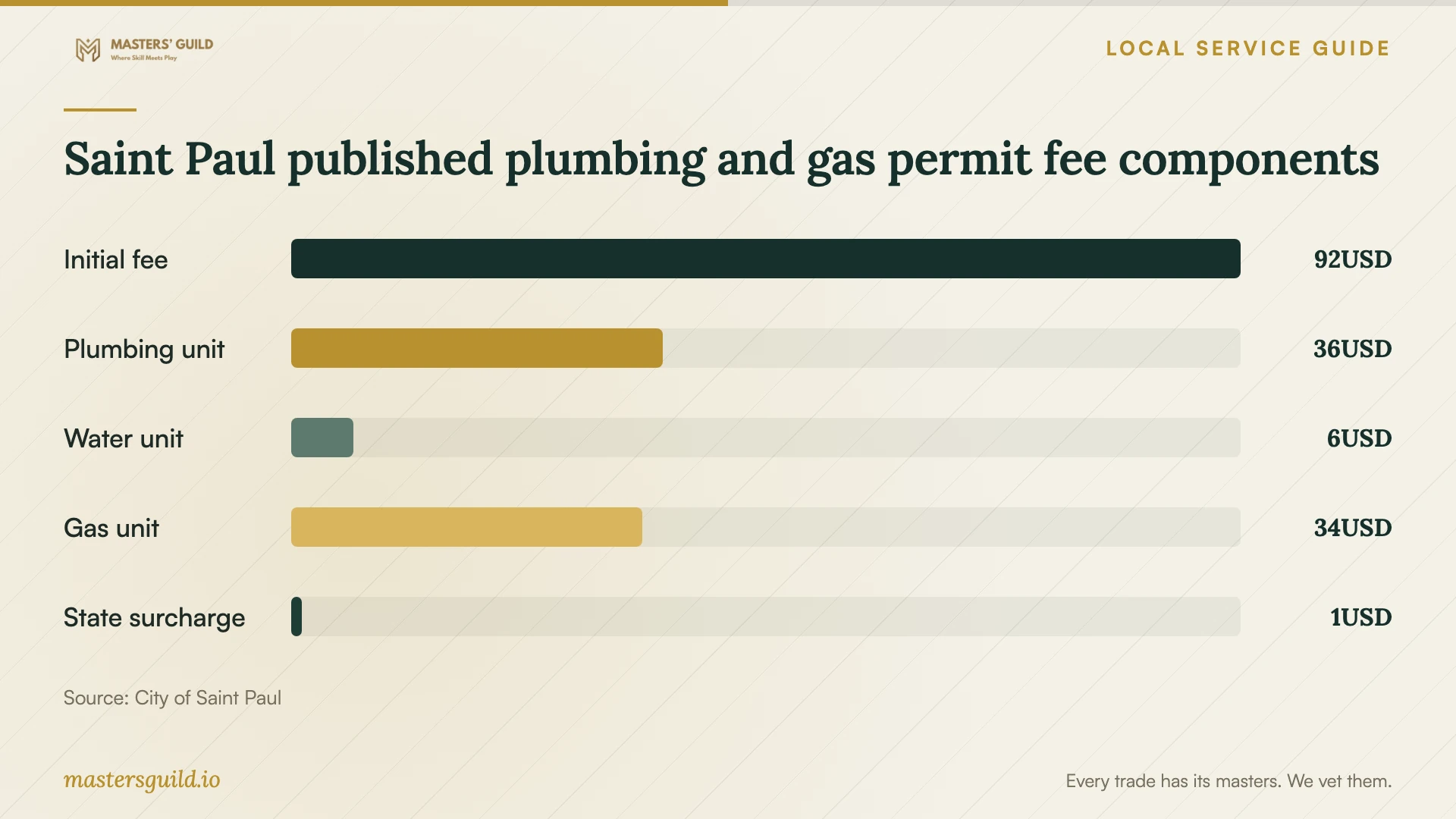
The city publishes a $92 initial plumbing permit fee, $36 per plumbing unit, $6 per water unit, $34 per gas unit, and a $1 state surcharge. These are fee components, not a kitchen-remodel price. Ask the applicant to explain the counted units and other applicable charges instead of treating the chart as a total. [2]
For a home built before 1978, discuss painted surfaces before demolition. Minnesota's Department of Health describes lead-safe renovation certification, containment, cleanup, and cleaning verification. Ask the contractor to explain how workers will isolate the kitchen and protect the route through your home. [5]
Request a schedule that identifies cabinet delivery, demolition, trade work, inspections, countertop measurement, installation, and final corrections. Decide where you will prepare food and wash dishes. Agree on daily access, dust barriers, debris storage, and the point at which the contractor expects you to use the kitchen again.
Saint Paul published plumbing and gas permit fee components
Local details that affect your job
Use PAULIE for plumbing applications and inspections
Saint Paul directs plumbing permit applications and inspection scheduling through PAULIE. Licensed plumbing/gas fitter contractors and homesteading homeowners can apply for plumbing, gas fitting, and inside water piping permits. If you plan to apply yourself, confirm your eligibility and responsibilities with DSI at 651-266-8989 before agreeing to handle the permit for a hired contractor. [1] [2]
Confirm the city's current electrical code notice
Saint Paul's electrical page states that the city enforces the 2026 National Electrical Code for permits obtained on or after August 17, 2026. Give your electrician the intended permit timing and appliance specifications, and ask them to confirm the design against the city's current requirements before ordering equipment. [3]
Plan lead-safe work using Minnesota guidance
Minnesota's Department of Health advises homeowners to request EPA lead-safe certification for renovation work in pre-1978 housing. Its guidance describes certification requirements when workers disturb more than six square feet of interior lead paint per room. Ask how the contractor will determine whether paint contains lead or assume its presence, contain dust, and complete cleaning verification. [5]
Match the proposed work to your next step
| Proposed work | Planning issue | Before signing |
|---|---|---|
| Cabinets and counters | DLI groups these installations within interior finishing. | List the full scope and ask which licensing category or exemption applies. |
| Sink or piping work | Saint Paul includes replacement, repair, alteration, and relocation among plumbing permit triggers. | Have the plumbing applicant identify the permit scope and counted units. |
| Wiring or circuits | The city provides repair/alter permit information and rough-in and final checklists. | Ask the electrician to confirm permits, inspection stages, and applicable code. |
| Painted-surface demolition in a pre-1978 home | Minnesota health guidance addresses lead-safe certification and dust controls. | Request certification and a containment and cleanup plan. |
| Wall or layout change | Ask for an assessment of the proposed removal. | Identify who will assess the wall and resolve building-permit questions with DSI. |
Your hiring checklist
- Give each bidder the same layout, finish selections, appliance specifications, and optional-work list.
- Request the contracting company's license information and current insurance documentation.
- Identify the plumbing, electrical, and gas workers and the person coordinating their schedules.
- Record who obtains each permit, pays the fees, schedules inspections, and supplies completion records.
- Ask about painted-surface testing, containment, and cleanup before approving demolition.
- Compare allowances, exclusions, disposal charges, and written change-order terms.
- Agree on kitchen access, temporary food preparation, delivery dates, and final corrections.
Frequently Asked Questions
Does replacing a sink in the same location require a plumbing permit?
Saint Paul's plumbing permit rule includes replacing and repairing plumbing systems as well as relocating them. Ask DSI or the plumbing applicant to confirm the permit scope for the proposed replacement before work starts. [1]
Must every kitchen installer have a residential remodeler license?
Minnesota generally requires that license or a residential building contractor license when a company contracts with a one-to-four-unit property owner for more than one special skill. DLI lists exemptions and groups several kitchen finish tasks within one category. Ask the company to explain how the rule applies to your complete scope. [4]
Can I use the published plumbing fees as my permit budget?
Use them to question an allowance, then request the applicant's calculation. The city lists an initial fee, per-unit charges, a state surcharge, and an additional gas charge for units greater than 100,000 BTU. Ask the applicant or DSI to confirm the applicable units and gas-fee calculation. [2]
What should I request before demolition in an older kitchen?
For a pre-1978 home, request lead-safe certification and an explanation of paint assessment, dust containment, waste handling, cleanup, and cleaning verification. Minnesota's health department recommends obtaining comparable bids and identifying labor and waste-disposal costs. [5]
Sources and scope
This guide combines the sources below with practical planning guidance. Figures apply to the stated geography and period; request a written quote for your property.