
Local service guide
Tree cutting in Saint John, NB: Hire and Plan
Arrange tree cutting in Saint John by asking an arborist to assess the tree, explain whether pruning or removal meets your goal, and quote the full cleanup. Before agreeing to a start date, check nearby watercourses or wetlands and decide who will handle branches, logs and the stump. New Brunswick requires permits for work such as clearing and landscaping within 30 metres of a watercourse or wetland. City compost collection has branch-size and container limits, so include a disposal plan in your request. [1] [2]
Choose the work before comparing quotes
Tell the arborist what concerns you and ask for a recommendation for each tree. Request an explanation of the proposed cuts, the reason for removal if recommended, and any follow-up care. For a tree you hope to retain, ask the assessor to describe the options and their limits before you approve cutting.
Identify each tree with a photograph and a description of its position. Ask the contractor to repeat those identifiers in the quote. Separate pruning, removal and stump work so you can choose the scope without assuming that removing a tree includes grinding its stump or restoring the ground.
For climbing, large limbs or work beside buildings, ask who will perform the work and what relevant training they hold. Request proof of liability insurance and ask about workers’ compensation coverage. If wires cross the work area, contact the utility before arranging cutting and ask the contractor how they will coordinate the job.
Check water and wetland constraints before booking
New Brunswick’s Watercourse and Wetland Alteration guidance says that work including clearing land and landscaping within 30 metres of a watercourse or wetland requires a permit. For removal, equipment access or stump work near these features, describe the complete project to the provincial department before setting a work date. Ask it to confirm the requirements for your proposed activities. [2]
Use the provincial reference map as a starting point. The department calls it a reference tool and says qualifying wetlands require consideration even when the map does not show them. Its watercourse definition includes certain channels where water flows only at some times of year. If you see a channel or persistent wet ground, request help identifying the feature rather than treating an empty map as approval. [2]
For an application, the province requests the project location, a full description, dimensioned drawings or sketches, photographs and payment. Someone applying on the owner’s behalf must include owner consent. The province also requires necessary municipal approvals and compliance with municipal or planning bylaws for work within an incorporated municipality. Agree with your contractor who will obtain approvals and give them to the crew. [2]
Specify cleanup that fits local collection rules
Saint John’s compost guidance limits brush and branches to 4 feet in length and 2 inches in diameter. It also limits compost bins to 100 pounds and requires the lid to close without debris protruding. Check those limits before choosing a quote that leaves all cut material for you to dispose of. [1]
Ask the contractor to itemize chipping, log handling and hauling. If you want to keep wood or chips, agree on the amount and where the crew will place them. For retained branches, ask who will cut them to collection dimensions and load the bin. Choose a hauling option for material that cannot meet the city’s collection requirements. [1]
Specify the finish for stump work: the agreed grinding depth, whether the crew removes grindings, and who supplies soil or repairs the lawn. Before accepting a price, ask the contractor to view the access route and discuss protection for fences, paving and garden beds. Keep the written scope for your completion walkthrough.
Plan access and a weather contingency
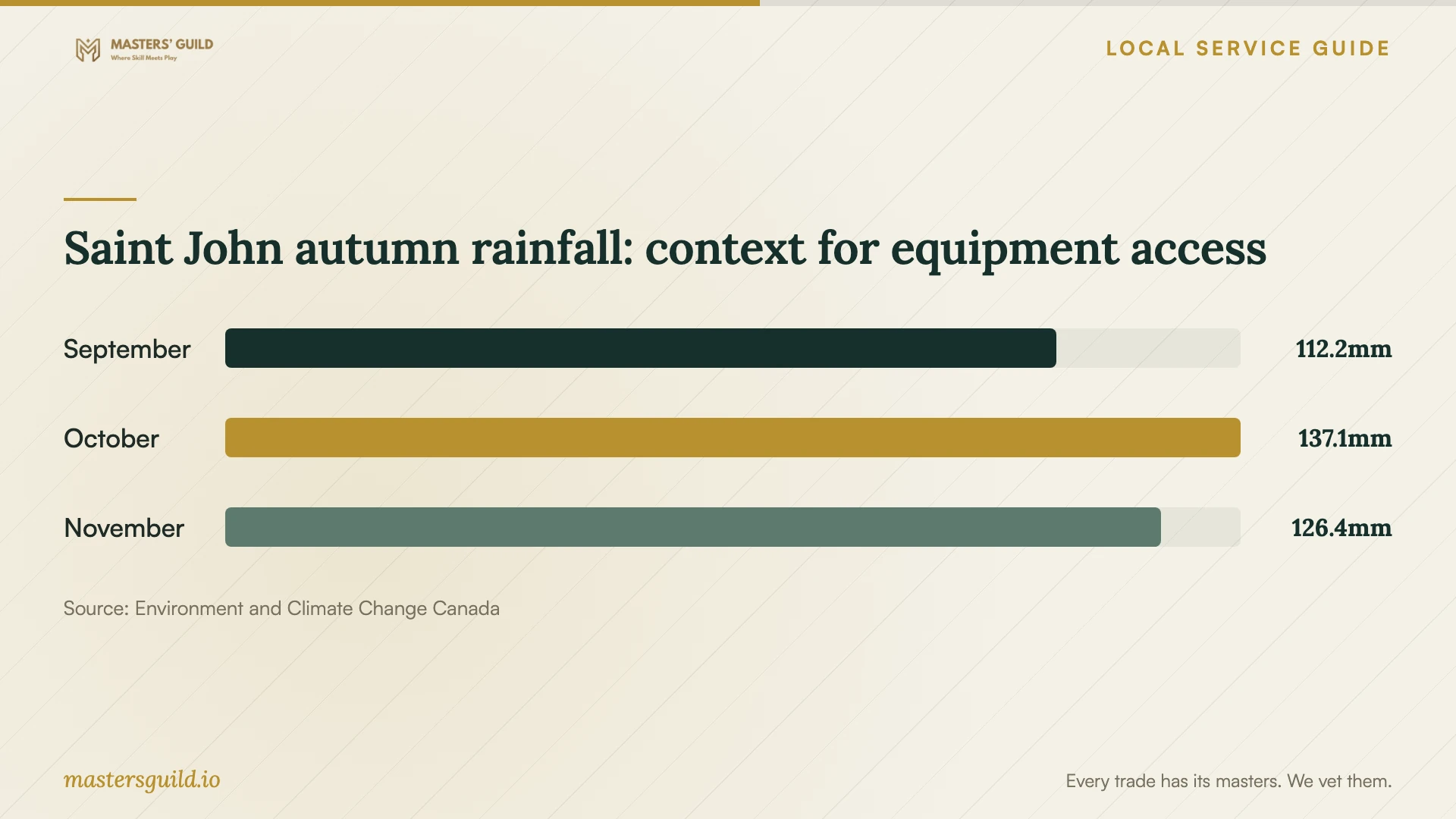
The Saint John airport composite recorded normal rainfall of 112.2 mm in September, 137.1 mm in October and 126.4 mm in November for the 1991–2020 period. Use that seasonal context to ask about access across wet ground and a postponement plan. These historical station values cannot predict conditions in your yard on the work date. [3]
Give the contractor photographs of the gate, driveway and route to the tree. Include nearby structures and places where you want to protect the ground. Ask where the crew will park, stage equipment and move branches. Agree on how you will handle a weather delay before paying a deposit.
On the work day, move vehicles and outdoor furniture as agreed, keep children and pets away from the work area, and confirm the marked trees with the crew leader. Walk through the finished job together and compare the cleanup, retained wood and stump treatment with the quote before accepting completion.
Saint John autumn rainfall: context for equipment access
Local details that affect your job
Curbside collection limits change the cleanup scope
Saint John accepts brush and branches within its stated 4-foot length and 2-inch diameter limits. Compost bins must stay within 100 pounds and close without protruding debris. Ask for a separate hauling price instead of assuming municipal collection will cover the debris from your job. [1]
Provincial water permitting can change the start date
For clearing or landscaping within 30 metres of a watercourse or wetland, check New Brunswick’s permit process before booking. The province can help identify features through desktop analysis or a site visit if deemed necessary. Its reference map does not settle whether an unmapped wetland needs a permit. Contact the Watercourse and Wetland Alteration branch at 506-457-4850 with the location and proposed work. [2]
Choose the next step for your property
| Situation | Next step | Include in the scope |
|---|---|---|
| You want to keep the tree | Request an assessment before approving cuts | Pruning objectives and follow-up advice |
| Clearing or landscaping within 30 metres of water or wetland | Confirm provincial permit requirements before scheduling | Approval responsibility and the complete work area |
| Branches exceed 4 feet long or 2 inches in diameter | Arrange processing or hauling to meet disposal needs | Chipping, log handling and debris removal |
| You want to use the space after removal | Request a separate stump-work scope | Grinding depth, grindings removal and ground finish |
Your hiring checklist
- Photograph and identify each tree, then state the problem you want the arborist to address.
- Request an assessment and an explanation of pruning and removal options.
- Check nearby water features and confirm applicable approvals before agreeing to a start date.
- Ask for relevant credentials, liability insurance documentation and workers’ compensation information.
- Compare matching scopes for cutting, equipment, hauling, retained wood and stump work.
- Agree on access protection, crew staging and the response to unsuitable weather.
- Confirm the trees with the crew leader and inspect the agreed cleanup at completion.
Frequently Asked Questions
Do I need a permit to remove a tree?
Check the proposed work and its location before booking. New Brunswick requires a permit for work such as clearing and landscaping within 30 metres of a watercourse or wetland. Its guidance also requires necessary municipal approvals. Ask the province and city about your specific project; this guidance does not establish a blanket municipal rule for all tree removals. [2]
Can I leave the branches for compost collection?
Check their size and the bin load. Saint John limits branches to 4 feet long and 2 inches in diameter, caps compost bins at 100 pounds and requires a closed lid. Ask the contractor to include hauling for material that will not meet those requirements. [1]
How should I compare tree-work prices?
Give each contractor the same tree identifiers, photographs and desired outcome. Request written prices for the same cutting, access, debris and stump scope. Ask them to identify exclusions and explain how you would approve additional work. Use an on-site assessment to resolve details before accepting the quote.
Does a provincial map showing no wetland mean I can proceed?
Ask for confirmation if you see possible water features. New Brunswick describes its map as a reference tool and says qualifying unmapped wetlands still fall under permit requirements. The department accepts requests for help determining whether a feature exists and whether the proposed work requires a permit. [2]
Sources and scope
This guide combines the sources below with practical planning guidance. Figures apply to the stated geography and period; request a written quote for your property.