
Local service guide
Tax Preparation and Accounting in Raleigh, NC
Arrange Tax Preparation and accounting in Raleigh by defining the work before requesting a quote: your business return, personal return, bookkeeping cleanup, and any county reporting. Ask who will handle each task, verify credentials if you hire a CPA, and get a written engagement letter with the scope and cost. For a business with tangible property in Wake County, ask whether the accountant will handle the annual business-property listing. [1] [3]
Choose the work you need before choosing the accountant
Write a short description of your business, how you keep records, and the returns you want prepared. Tell the accountant about separate entities, rental income, a move across state lines, or a tax notice. Ask them to describe their experience with your situation and identify the person who will review your work.
The North Carolina CPA Board recommends comparing a CPA’s usual accounting work with your needs. It also recommends asking about office hours, year-round availability, and telephone inquiries. For ongoing accounting, ask who will answer questions between filing appointments and how you should submit them. [3]
Verify the CPA and the firm
If you choose a North Carolina CPA, check the Board’s database for a current, active license and current, active firm registration. Review any public enforcement documents on the individual or firm record. A referral can help you build a shortlist; complete these checks before signing an engagement. [3]
North Carolina permits qualifying CPAs licensed in other US jurisdictions to serve clients through practice privileges. If the accountant works outside the state, ask where they hold their license and how they qualify to serve you. The Board notes that some qualifying out-of-state firms can serve North Carolina clients without state firm registration. [3]
Compare fees against the same written scope
Request a quote that identifies each return, the tax year, included accounting work, and the person responsible. Ask whether the quote includes reconciling accounts, correcting prior records, responding to notices, or preparing amended returns. Compare proposals after each accountant has reviewed the same description of your records.
Before work begins, the CPA Board recommends a written engagement letter detailing the work, the employees who will perform it, and the cost. If the firm outsources work, confirm how it secures private information. Ask the accountant to explain when they would seek approval for extra charges. [3]
Set a document-delivery date and ask when you can expect a draft for review. Agree on how you will approve the return and receive a complete copy. For recurring bookkeeping, specify the reporting frequency and who will resolve unexplained transactions.
Prepare records for business and personal tax work
Gather prior returns, bookkeeping exports, bank and card statements, income documents, expense records, and an asset list. Flag missing statements and transactions you cannot explain. Ask the accountant for a secure transfer method before sending tax identifiers or financial documents.
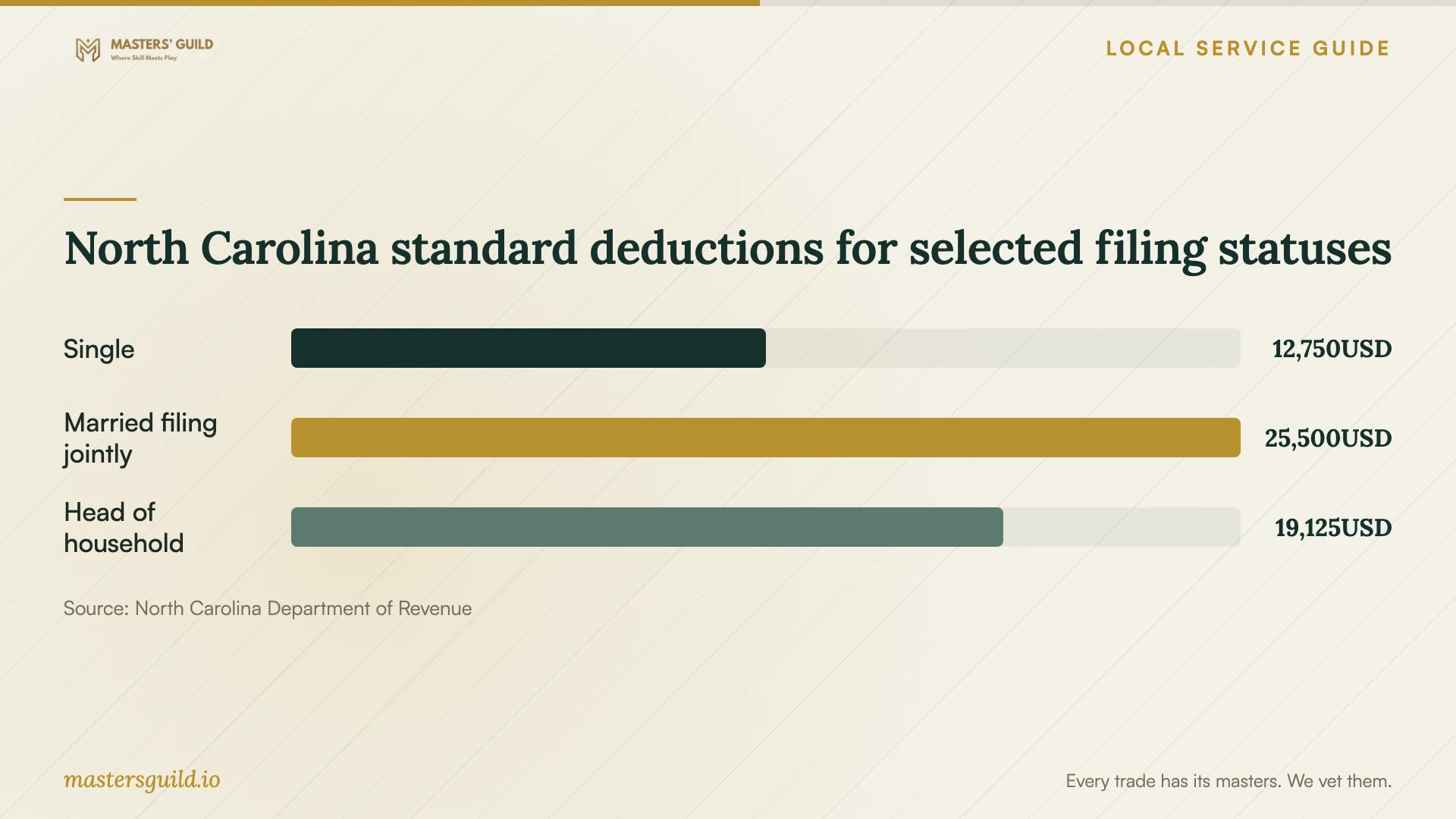
For personal-return work, bring records relevant to mortgage interest, property taxes, charitable contributions, and medical expenses. NCDOR’s 2025 guidance says North Carolina standard and itemized deductions differ from federal amounts. Ask the preparer to evaluate the state deduction rather than copying the federal amount. [4]
If you moved into or out of North Carolina, prepare a timeline of residence changes and income sources. NCDOR’s 2025 guidance requires qualifying part-year residents and nonresidents to complete Schedule PN and review Schedule PN-1 for applicable adjustments. Ask which state returns and allocation work the quote includes. [2]
North Carolina standard deductions for selected filing statuses
Local details that affect your job
Wake County business-property listing
For a Raleigh business with tangible property used in business or income production in Wake County, arrange the county listing as a separate responsibility. Wake County says the annual listing period runs January 1 through January 31; you can mail a listing form or file through its Online Property Listing system. State law allows penalties for late listings. Ask whether you or the accountant will submit the listing, what asset records they need, and who will retain confirmation. [1]
North Carolina filing after a move
A move to Raleigh can change the personal-return work you need alongside your business accounting. NCDOR’s 2025 rules distinguish residents, part-year residents, and nonresidents, with filing obligations depending on income and filing status. North Carolina filing thresholds also differ from federal thresholds. Give the preparer your move dates and income by source, then request a scope that names each state return. Use the instructions for the tax year being filed. [2]
Match the engagement to your situation
| Your situation | Work to request | Question before signing |
|---|---|---|
| You want business and personal returns prepared | A scope naming both returns and the tax year | Does the fee cover both, and who reviews them? |
| Your account balances or records need correction | Bookkeeping cleanup before return preparation | What cleanup is included, and how will you approve extra work? |
| You use tangible business property in Wake County | Annual county property-listing responsibility | Who will submit the January 1–31 listing and retain confirmation? |
| You moved into or out of North Carolina | Review of state filing obligations and income allocation | Does the quote include applicable Schedule PN work and other state returns? |
| You want accounting help throughout the year | A recurring scope with reporting and contact arrangements | Who answers questions between filing appointments? |
Your hiring checklist
- Describe your business structure, income sources, and requested tax years.
- Separate return preparation, bookkeeping cleanup, and ongoing accounting in the quote.
- Ask who will prepare the work, review it, and answer later questions.
- Verify any claimed CPA credential and review the relevant firm record.
- Assign responsibility for the Wake County business-property listing.
- Gather prior returns, account statements, asset records, and any notices.
- Agree on secure document delivery, review dates, and approval steps.
- Get the scope, cost, exclusions, and extra-charge process in writing.
Frequently Asked Questions
How much should I budget for preparation and accounting?
Request quotes for your specific returns and accounting work. Describe your records and compare the same scope across proposals, including cleanup, county reporting, and follow-up work. The CPA Board recommends a written engagement letter that states the services and cost. [3]
Can an out-of-state CPA serve my business?
North Carolina allows qualifying CPAs licensed in another US jurisdiction to serve clients through practice privileges. Ask where the CPA holds a license and how their individual and firm practice privileges apply. Check the relevant licensing record before hiring. [3]
Does income-tax preparation include Wake County property reporting?
Ask the accountant to include it in the written scope if you want them to handle it. Wake County requires annual reporting of tangible property used in business or income production during January 1–31. Assign the task and request filing confirmation. [1]
Will the CPA Board resolve a disagreement over fees?
The Board says it does not adjudicate fee or contractual disputes and cannot award damages. Before work begins, clarify the cost, exclusions, and approval process for additional work in the engagement letter. [3]
Sources and scope
This guide combines the sources below with practical planning guidance. Figures apply to the stated geography and period; request a written quote for your property.