
Local service guide
Tree cutting in Providence, RI: Hiring and Permits
Tree cutting in Providence starts with confirming ownership, checking city permission and identifying the arborist assigned to your work. Contact Forestry before work on a city tree or removal of a significant tree, including one on private land. For non-exempt paid work on another person's property, Rhode Island requires a licensed solo arborist or licensed supervision of a crew. Request a written assessment and scope before booking. [1] [2]
Confirm ownership and permission before booking
Photograph the trunk, curb, sidewalk and surrounding property. If ownership is unclear, ask Forestry to confirm before authorizing work. Providence directs tree-related service requests through PVD311. Describe the location and concern so the city can distinguish an inspection request from your proposal to arrange work. [1]
Providence requires a free permit before work on a city tree. Its listed activities include pruning, removal, digging or trenching, and planting in the right-of-way. Ask who will submit the Tree Work Permit Application and obtain the permission before the crew starts. The city warns that it assesses fines for unauthorized damage or removal. [1]
Private ownership does not remove the significant-tree approval requirement. Providence protects trees at least 32 inches in diameter, measured 4.5 feet above ground, on public and private land. File a removal request with the City Forester before authorizing removal. Ask your arborist to record the measurement and explain the tree's condition. [1]
Identify the licensed arborist assigned to your property
For non-exempt arboricultural work on another person's property for compensation, Rhode Island requires a person working alone to hold a valid arborist license. At a crew job site, at least one person must hold a valid license and monitor the other workers from close proximity throughout their work. Ask for that person's name and current license before accepting the offer. [2]
The regulation exempts pruning of Christmas trees or trees grown for agricultural crops on private land, and activities qualifying under the Right to Farm Act. If a provider claims an exemption, ask them to explain how your proposed work qualifies before relying on it. [2]
Rhode Island distinguishes a Standard Arborist License from a Limited Utility Arborist License. The limited category concerns clearance for utility lines and equipment. Licenses expire on December 31 each year. Ask how the assigned arborist's credential covers your scope, and check renewal if you arrange work across year-end. [2]
Request evidence of liability insurance and ask how the provider covers its workers. Identify subcontractors and agree who handles damage to your driveway, fence or neighboring property. Keep those answers with the written quote.
Set the pruning objective and coordinate around wires
Describe the problem you want to solve before asking for removal: a damaged limb, roof contact, concern about the trunk or access for a project. Ask the arborist to explain their assessment, alternatives and proposed cuts. For removal, request a written reason and discuss whether any part of the tree can remain.
Providence publishes infrastructure guidance of 8 feet of clearance over sidewalks, 12 feet over streets and a recommended 6 feet from structures. Use these figures when reporting a city-tree obstruction to Forestry. Ask the arborist to explain the proposed pruning rather than treating clearance figures as instructions to cut branches yourself. [1]
Providence identifies Rhode Island Energy as responsible for clearance around utility poles and wires. The city lists 855-743-1101 for non-emergency contact and directs readers to call 911 for electrical emergencies. Contact the utility before approving a cutting plan involving wires, and keep away from the affected area. [1]
Compare removal, hauling and stump work
Give bidders the same photographs and request a site visit before accepting a firm scope. Identify the trees covered by the quote, the equipment route and the place for cut wood. Settle any proposed use of a neighbor's property before workday.
Request separate quote entries for pruning or removal, hauling, stump grinding and restoration. Specify whether you want logs or chips left on site. Ask about grinding depth, who removes the grindings and who supplies replacement soil. Have the provider list exclusions so you can compare the same result.
Walk the site with the supervisor before cutting starts. Confirm the agreed trees and limbs, surface protection and cleanup. For additional work, request an explanation and written price before authorizing it. Inspect the remaining stump work and cleanup against your agreement.
Plan equipment access and weather postponement
Ask how the crew will check ground conditions before driving equipment onto your lawn. Agree on who decides to postpone, how they contact you and whether a changed equipment plan requires another quote. Clear the agreed route of vehicles and outdoor furniture, and keep pets away from the work area.
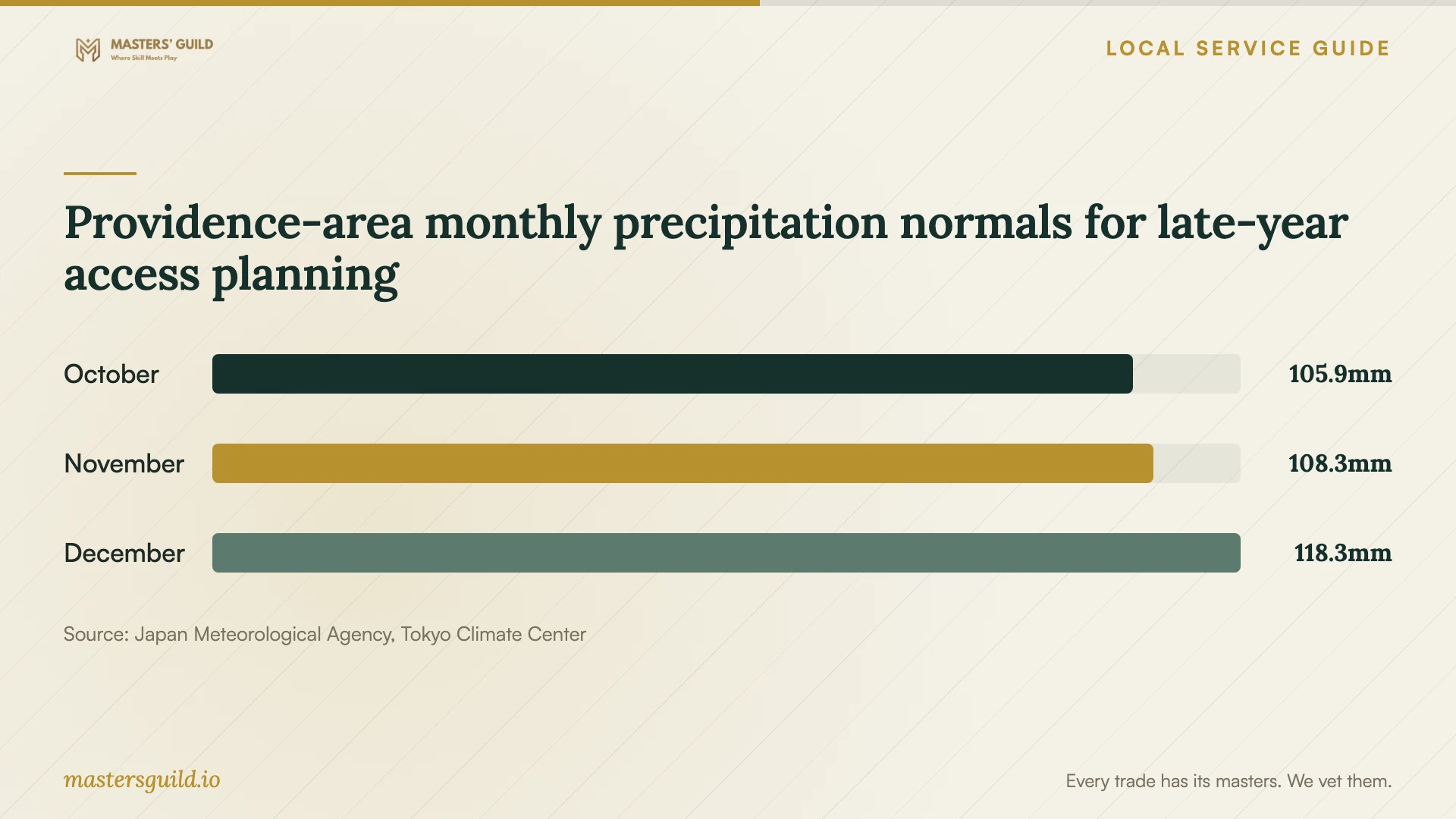
The Japan Meteorological Agency publishes monthly precipitation normals for the Providence/Green State airport station. Its table lists 105.9 millimeters for October, 108.3 for November and 118.3 for December. Use this regional context to discuss a weather contingency; ask the provider to assess your property's conditions before bringing equipment onto it. [3]
Providence-area monthly precipitation normals for late-year access planning
Local details that affect your job
Separate a city service request from permission to work
Use PVD311 to request help with a city tree. Providence prioritizes pruning requests by receipt order and risk. If you arrange work yourself, obtain the free city-tree permit first, including for associated digging or trenching. Ask Forestry which route applies before committing to a contractor's date. [1]
Check large private trees before removal
A tree on private land can fall under Providence's significant-tree protection at 32 inches in diameter measured 4.5 feet above ground. Submit a removal request to the City Forester. The city identifies danger to human safety, health and welfare as a principal approval criterion; ask your arborist to document the concern. [1]
Arrange utility coordination before cutting
Providence assigns utility-pole and wire clearance to Rhode Island Energy. For non-emergency coordination, use 855-743-1101. For an electrical emergency, call 911. Ask the provider to explain the utility's involvement before accepting work around wires. [1]
Choose the next step before booking
| Situation | Next step | What to settle |
|---|---|---|
| Ownership is unclear | Ask Forestry to confirm ownership | Whether city-tree permission applies |
| You plan work on a city tree | Request the free Tree Work Permit | Permission for the proposed cutting or digging |
| Removal involves a tree at least 32 inches in diameter at 4.5 feet above ground | File a request with the City Forester | Significant-tree removal approval, including on private land |
| Branches involve utility wires | Contact Rhode Island Energy; call 911 for an electrical emergency | Utility coordination before cutting |
| You hire a crew for non-exempt work on another person's property for compensation | Identify the licensed arborist supervising the site | Valid license and continual monitoring from close proximity |
Your hiring checklist
- Photograph the tree, its base, nearby structures and equipment access.
- Resolve ownership and ask Forestry which permissions apply.
- Request the assigned arborist's name and current license; ask for an explanation of any claimed exemption.
- Obtain insurance documentation and identify subcontractors.
- Request the assessment and pruning or removal scope in writing.
- Compare hauling, stump work, disposal and restoration as separate items.
- Agree on access, surface protection, postponement and price changes.
- Walk the site before work and inspect the agreed cleanup afterward.
Frequently Asked Questions
Do I need permission to remove a tree in my yard?
Providence requires City Forester permission to remove a significant tree on private or public land. Its threshold is 32 inches in diameter measured 4.5 feet above ground. Ask Forestry about the proposed removal before booking. [1]
Does each crew member need an arborist license?
For non-exempt work on another person's property for compensation, Rhode Island requires at least one licensed arborist at each crew site, monitoring others from close proximity. A solo worker needs a valid license. Exemptions include agricultural Christmas-tree or crop-tree pruning on private land and qualifying Right to Farm activities. [2]
How should I compare removal quotes?
Ask providers to quote the same tree and finished scope. Separate removal, hauling, stump grinding, disposal of grindings and restoration. Include access arrangements, surface protection and written approval of extra work.
Who handles a city street-tree request?
Providence directs tree-related service requests through PVD311. Describe the location and concern. If you intend to arrange work on the city tree, request the free permit before work starts. [1]
Sources and scope
This guide combines the sources below with practical planning guidance. Figures apply to the stated geography and period; request a written quote for your property.