
Local service guide
Snow removal in Phoenix: Plan for a rare event
Arrange snow removal in Phoenix as a one-time clearing job when accumulation blocks the access you need. Before buying a seasonal contract, consider that the National Weather Service describes measurable snow as rare across most of the city, with more snowfall reports in higher north-valley foothills. Ask a provider to confirm service at your address, the areas they will clear, their arrival window and the full visit charge. Include a separate plan for exposed irrigation and plumbing, which Phoenix Water Services identifies as vulnerable to winter freeze damage. [1] [2]
Choose service around the access you need
Start with the route from your door to your vehicle or property exit. Photograph the accumulation and identify the areas you need cleared. Tell the provider about slopes, steps, narrow gates, parked vehicles and surface materials. Ask them to confirm whether they can complete the work with hand tools or need equipment access.
For a homeowner without a recurring access problem, seek an event-based quote before committing to seasonal payments. NWS Phoenix distinguishes higher north-valley foothills from most of the city, where measurable snow remains rare. If your property sits in those foothills, describe its conditions rather than assuming an airport observation represents your driveway. [1]
Consider a standby agreement if you need someone to check the property while you are away or cannot clear your own entry. Ask what triggers dispatch: a homeowner call, observed accumulation or a specified depth. Agree on how the provider will confirm conditions before charging for a visit.
Get a quote with clear limits
Send each provider the same photos and list of surfaces. Request a total visit price, any minimum callout charge, treatment-material charges and the price of a return visit. Ask whether the quote includes moving cleared snow to an agreed location and cleaning up treatment residue. Keep irrigation inspections and repairs as separate line items.
Before accepting, confirm the provider's insurance, equipment and service area. Ask how they will protect paving, gravel edges and visible irrigation components. Identify where they may place cleared snow while preserving your entry route and access to gates. Get the arrival window and cancellation terms in writing.
Treat roof work as a separate request. Do not assume a driveway-clearing quote includes climbing onto your roof or assessing its structure. Describe the concern and ask what qualifications and insurance the provider holds for the proposed work.
Prepare exposed water equipment before a freeze
Phoenix Water Services advises residents to insulate exposed outdoor pipes, faucets, evaporative cooler equipment and sprinkler vacuum breakers, and to drain exposed lines when frost or freezing threatens. Its homeowner FAQ also recommends insulating outdoor irrigation valves and removing, draining and storing garden hoses. Add these tasks to your winter preparation list even if you have no snow to clear. [2] [3]
Mark sprinkler heads and valves before a clearing visit. Share an irrigation layout if you have one; the city recommends keeping a diagram of sprinkler heads, valves and lines for inspection. Ask the provider to leave damaged water equipment alone and photograph any leak they notice. [2]
For a leaking valve or damaged backflow preventer, arrange a separate assessment. The city advises consulting an irrigation professional before repairing or replacing sprinkler valves and using a qualified professional to replace backflow-preventer parts because water can be under extreme pressure. [2]
Use temperature records as context
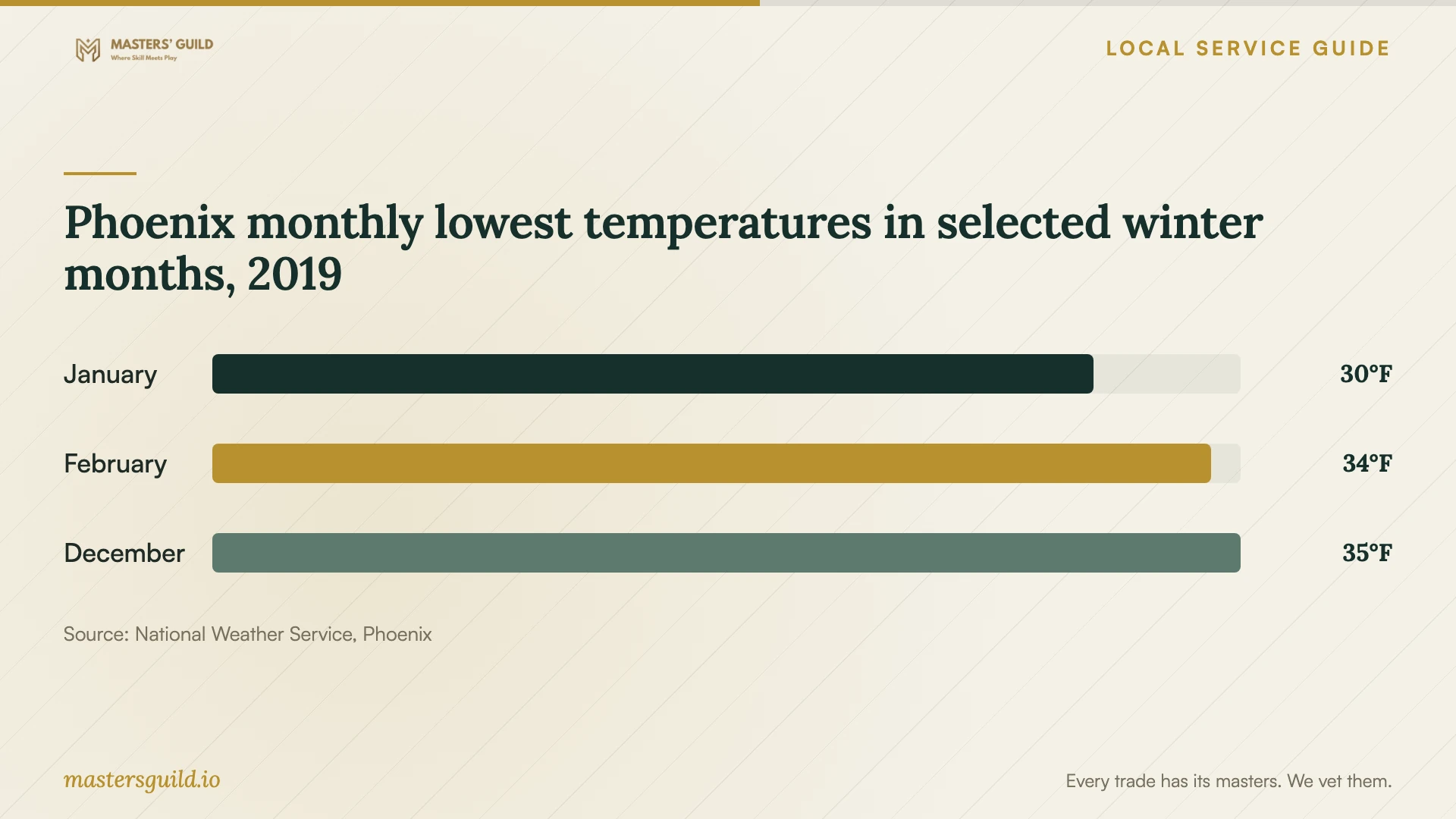
The NWS 2019 Phoenix review lists monthly lowest temperatures of 30°F in January, 34°F in February and 35°F in December. These observations help explain why freeze preparation belongs in a local winter plan. They describe one historical year at the official Phoenix reporting station, not the temperature at your home or a forecast for this winter. [4]
Before arranging a visit, check the forecast for your address and inspect the access route you need. Tell the provider whether you see snow, ice, standing water or a leaking fixture. Ask them to specify which of those conditions they will address and which require another professional.
Phoenix monthly lowest temperatures in selected winter months, 2019
Local details that affect your job
Higher north-valley foothills need an address-specific plan
NWS Phoenix reports more snowfall observations in residential areas at higher north-valley foothill elevations, while describing measurable snow as rare across most of the city. If that describes your property, ask a provider to confirm access and dispatch terms for your exact address before relying on a citywide service promise. [1]
Use the household shutoff after a freeze-related break
Phoenix instructs residents with a freeze-related broken pipe to turn off water at the valve near where the service enters the home. If that valve fails or is broken, contact the city to shut off service at the meter. Do not operate the meter shutoff yourself. The city lists 602-261-8000 for emergency water-line issues. Arrange the repair separately from snow clearing. [3]
Agree on treatment cleanup near storm drains
Phoenix Water Services explains that storm-drain runoff reaches rivers, washes and retention basins without wastewater treatment, and tells residents not to dump chemicals into storm drains. Before approving a treatment product, ask the provider to identify it, follow its application instructions and explain how they will collect excess material rather than wash it into a drain. [3]
Choose the work to request
| Your situation | Work to request | Confirm before booking |
|---|---|---|
| Accumulation blocks your entry or driveway | One-time clearing of the necessary access route | Surface list, tools, arrival window and total charge |
| Higher north-valley foothill property | Address-specific assessment and optional standby agreement | Dispatch trigger and ability to reach the property |
| Exposed irrigation equipment before freezing weather | Freeze preparation as a separate task | Insulation scope and suitable draining procedure |
| Leaking sprinkler valve or damaged backflow preventer | Irrigation assessment and qualified repair | Who will perform the repair and its separate price |
| Freeze-related broken household pipe | Water shutoff and plumbing repair | Use the household valve; contact the city if it fails |
Your hiring checklist
- Photograph the driveway, entry path, steps and any accumulation before requesting quotes.
- List the surfaces to clear and identify slopes, gates and equipment-access limits.
- Ask each provider to confirm service at your exact address and an arrival window.
- Compare total visit charges, treatment costs, return visits and cancellation terms.
- Mark irrigation components and agree on a place for cleared snow.
- Request separate prices for freeze preparation or irrigation repairs.
- Confirm insurance and the tools the provider proposes to use.
Frequently Asked Questions
Should I buy a seasonal snow-removal contract?
Seek a one-time quote first unless you need a standing access arrangement. NWS describes measurable snow as rare across most of Phoenix and notes more snowfall reports in higher north-valley foothills. For a standby contract, specify dispatch triggers, charges without accumulation and cancellation terms. [1]
How much should a clearing visit cost?
Request written quotes for your address, surfaces and arrival window. Ask for the full callout charge, included work, treatment materials and the cost of a return visit. Give each provider the same scope so you can compare the total charges.
Can the clearing provider repair my irrigation equipment?
Confirm their qualifications and quote the repair separately. Phoenix advises consulting an irrigation professional for sprinkler-valve repairs and using a qualified professional for backflow-preventer replacement parts. Do not assume a clearing agreement includes that work. [2]
Does a mild monthly average rule out a freeze?
No. In January 2019, NWS reported an average daily minimum of 45.0°F for Phoenix and a monthly lowest observation of 30°F. Those historical station observations do not predict conditions at your home. Check your address forecast before preparing exposed equipment. [4]
Sources and scope
This guide combines the sources below with practical planning guidance. Figures apply to the stated geography and period; request a written quote for your property.