
Local service guide
Duct cleaning in Phoenix: scope and hiring
Arrange duct cleaning in Phoenix after a provider shows you substantial contamination and gives you a written whole-system scope. EPA advises cleaning as needed for substantial visible mold, pests, or excessive debris, rather than on a routine schedule. Ask how the crew will protect your duct materials, contain dust, and restore cooling before you book. [1]
Decide whether cleaning addresses your problem
Ask the provider to show you the condition that warrants cleaning. EPA identifies substantial visible mold inside hard-surface ducts or other system components, vermin infestation, and excessive dust or debris as reasons to consider the work. A dusty grille is a different finding from deposits inside the system. [1]
Describe what you noticed, where it happens, and whether it began after renovation work or water damage. Request photographs that identify the inspected component. If the provider suspects mold, ask how they established that finding. EPA cautions that appearance alone cannot confirm mold and that an expert may need laboratory analysis. [1]
Correct the underlying cause before paying to clean affected ducts. EPA warns that contamination can recur when owners leave moisture or other causes unresolved. Wet or moldy duct insulation requires replacement rather than cleaning. Ask for a separate repair scope if the inspection finds that condition. [1]
Compare the same work in each estimate
Request a component-by-component quote covering supply and return ducts, registers, grilles, the air handler, blower, coils, and drain pans. EPA describes duct cleaning as work on the heating and cooling system and warns that leaving a contaminated component untreated can recontaminate the system. Have each bidder identify anything they exclude. [1]
Give bidders the number of systems you want inspected, photographs of accessible equipment, and any access restrictions. Ask whether the price covers each system, who handles access openings, and what happens if the crew discovers damage. Require your approval before additional work and request a written total before the appointment.
Avoid using a national price reference as a current Phoenix quote. The EPA page carries guidance dated October 1997 and lists a broad service-cost range. Obtain site-specific estimates instead. Compare the included components, access work, chemical treatments, and repairs alongside the total. [1]
Check the cleaning method before booking
Ask the crew to identify sheet metal, flexible duct, and fiberglass-lined sections before choosing tools. EPA recommends soft-bristled brushes for fiberglass materials and says providers should protect ductwork, seal access holes, and restore insulation. Ask how the provider will avoid damaging the materials in your home. [1]
Ask where the vacuum exhaust will go. EPA recommends equipment that exhausts particles outside the home, or HEPA vacuum equipment when the exhaust stays indoors. Include protection for furniture and floors in the scope, and agree on where the crew will place equipment and hoses. [1]
Keep chemical treatment separate from the cleaning decision. EPA describes unresolved questions about biocides and coatings and advises owners to understand their risks and proposed uses. Ask for the product label, the duct material it will contact, and the reason physical cleaning and moisture correction would not address the problem. [1]
Prepare access and verify the finished work
Clear a route to the equipment and registers, move fragile belongings, and arrange a place for pets away from the work. Ask the provider which rooms they need, whether someone must remain home, and when you can use the system again. Share concerns about heat-sensitive occupants before agreeing to the appointment.
Before payment, ask the crew to show you the cleaned supply and return sections and the other components included in your agreement. EPA recommends a visual inspection and asks owners to check clean coils, blower components, drain pans, secure registers, and sealed access openings. Ask the crew to demonstrate system operation after cleaning. [1]
For ongoing care, use the filter efficiency your equipment manufacturer recommends and check that the filter fits without bypass gaps. EPA recommends regular filter changes, more frequent changes when filters clog, and attention to cooling coils and drain pans. Agree with your HVAC service provider on checks appropriate to your equipment. [1]
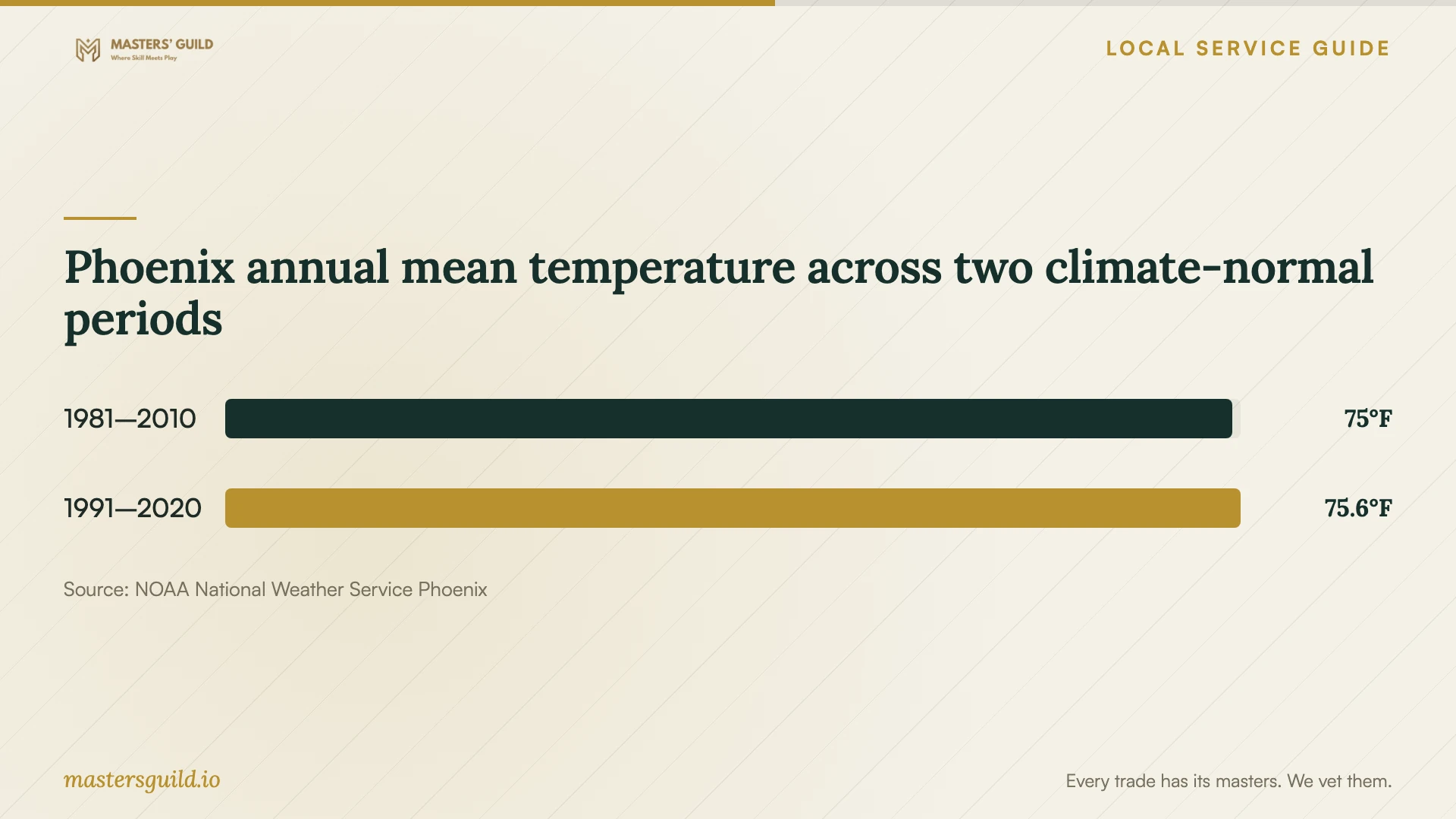
Phoenix annual mean temperature across two climate-normal periods
Local details that affect your job
Plan dust containment around Phoenix dust storms
Maricopa County describes Phoenix-area dust storms as unpredictable and advises residents to close doors and windows. Before a visit, ask how the crew will route hoses and outdoor exhaust while limiting openings into your home. Agree to pause or reschedule work that requires open exterior access if a dust storm approaches. After an event, inspect filters and accessible registers before deciding that whole-system cleaning is necessary. [1] [2]
Set a cooling interruption plan for hot-weather work
Maricopa County reports summer temperatures that frequently exceed 110 degrees Fahrenheit and advises checking air-conditioning duct insulation. For appointments involving attic or outdoor access, ask about a cooler morning start and the expected cooling interruption. Request a separate inspection or repair quote for damaged insulation rather than assuming cleaning will address it. Arrange a cooled place for vulnerable occupants if the provider expects an extended shutdown. [1] [2]
Choose the next step from the inspection finding
| Finding | Next step | Question to ask |
|---|---|---|
| Dust on a return grille | Clean the accessible grille and inspect before commissioning duct cleaning. | Can you show contamination beyond this grille? |
| Excessive debris or particles coming from supply registers | Consider cleaning after identifying and correcting the cause. | Which system components need cleaning? |
| Suspected mold on hard surfaces | Request evidence and address moisture before treatment. | How did you identify the growth and its moisture source? |
| Wet or moldy duct insulation | Arrange qualified assessment and replacement of affected insulation. | Can you quote replacement and moisture correction separately? |
| Dirty cooling coils or blower | Request a component-specific HVAC maintenance scope. | Does your quote include these components and a final operating check? |
Your hiring checklist
- Describe the observed problem and request photographs of the affected components.
- Get comparable written scopes and totals before choosing a provider.
- List each system, included component, exclusion, and proposed add-on.
- Ask the provider to identify duct materials and explain their cleaning tools.
- Agree on hose routing, dust containment, weather delays, and cooling downtime.
- Require separate approval for chemicals, repairs, or replacement.
- Clear equipment access and arrange space for pets and heat-sensitive occupants.
- Walk through the results and ask the crew to demonstrate system operation.
Frequently Asked Questions
Does desert dust mean I should clean my ducts every year?
EPA recommends duct cleaning as needed rather than routinely. Maricopa County's dust-storm guidance supports keeping exterior openings closed during an event. Inspect filters and accessible registers, then ask for evidence of substantial internal contamination before buying whole-system cleaning. [1] [2]
Will duct cleaning lower my cooling bill?
EPA finds little evidence that cleaning ducts alone improves system efficiency. Cleaning dirty coils, fans, or heat exchangers may help. Ask the provider to distinguish those maintenance tasks from duct cleaning and to explain the condition they found. [1]
Can I confirm a cleaner's license from the EPA page?
The page's state licensing discussion refers to 1996, so it does not establish today's Arizona requirements. Ask the provider for relevant current credentials and verify requirements for the proposed scope before authorizing repairs or equipment changes. EPA does not certify duct-cleaning companies. [1]
How should I check the job before paying?
Ask for photographs and a walkthrough of the components in your written scope. EPA recommends visual inspection, secure registers, sealed access openings, and a check that the system operates after cleaning. Ask the provider to correct deficiencies before accepting the work. [1]
Sources and scope
This guide combines the sources below with practical planning guidance. Figures apply to the stated geography and period; request a written quote for your property.