
Local service guide
Senior Care in Philadelphia: Arrange Help at Home
Arrange Senior Care in Philadelphia by writing down the help your relative needs, asking Philadelphia Corporation for Aging about assessment and support options, and comparing providers against that task list. Before agency or registry services begin, request the required information packet covering the worker, schedule, costs, competency requirements, and employment status. For health care at home, check Pennsylvania home-health licensing and ask about Medicare certification if you plan to seek Medicare payment. [1] [3] [4]
Describe the care before requesting offers
Make a task list with your relative, respecting their preferences about privacy, routines, and who enters the home. Separate companionship, meals, errands, bathing, dressing, and help moving around from tasks you want a clinician to assess. Describe the actual help needed rather than asking for a caregiver who can do everything.
For each visit, identify the arrival time, tasks, access arrangements, and family contact. Tell prospective providers about stairs, mobility equipment, pets, communication preferences, and any concerns about memory or supervision. Ask which tasks the proposed worker can perform, what training they have, and which requests require another professional.
Explore PCA services before committing to a schedule
PCA starts with a request or referral, discusses potentially available services, and may arrange an in-home assessment or refer you elsewhere. Its assessment examines daily tasks and safety concerns in the home. Ask for this route if you need help deciding the level of assistance to arrange. [1]
PCA describes a further enrollment process for someone assessed as nursing facility clinically eligible who wants care at home. The participant works with the state’s Independent Enrollment Broker. Depending on the financial eligibility determination, the route may involve Community HealthChoices and a managed care organization, or OPTIONS services coordinated by PCA on an income-based sliding scale. PCA does not handle the financial eligibility application. [1]
Ask who owns the next step, which documents you should gather, and whether anyone has confirmed a service start date. If you need help before enrollment finishes, request a separate written proposal for interim care and decide how you will pay for it.
Compare the contract and staffing arrangements
Pennsylvania requires home care agencies and registries to provide an understandable information packet before services begin. It must identify the services, worker, service hours, hourly or weekly fees and total costs, hiring and competency requirements, and contacts for licensing information and complaints. It must also disclose employee or independent-contractor status and the resulting tax, insurance, and other responsibilities. [3]
Give each provider the same task list and schedule. Ask for minimum visit charges, cancellation terms, holiday charges, transport expenses, and the total for your proposed schedule. Ask who supervises the worker and who will cover an absence. Put the answers beside the quoted rate so you can compare the commitments you would accept.
Consumers have a right to participate in service planning, with reasonable accommodation of needs and preferences subject to worker safety. Agencies and registries must generally give at least 10 calendar days’ written notice before terminating services. The rule allows shorter notice for specified nonpayment circumstances or when the worker’s health and welfare are at risk. Ask the provider to explain its termination policy and your backup arrangements. [3]
Check the provider for health care at home
The Pennsylvania Department of Health licenses all home-health agencies in the state and conducts initial and periodic unannounced licensing surveys. Its Home Health page includes a facility-search link. Use that starting point to check the agency you are considering for health care services at home. [4]
Medicare may pay for services from home-health agencies that seek and receive federal certification. State licensing alone does not establish that certification. Ask the agency and your care team to confirm the proposed services, certification, payment arrangements, and any amount you would owe before care begins. [4]
Agree on the first visit and review plan
Ask the provider to walk through the first visit with you and your relative. Confirm the worker’s name, how they will identify themselves, where instructions will be kept, and whom they should contact about a change in needs. Decide how the worker will record completed tasks and how your relative can raise a concern.
Set a review point after care starts. Check whether the agreed tasks fit the available time, whether your relative feels comfortable with the worker, and whether family members understand their own responsibilities. Request an updated written schedule and price before accepting additional hours or tasks.
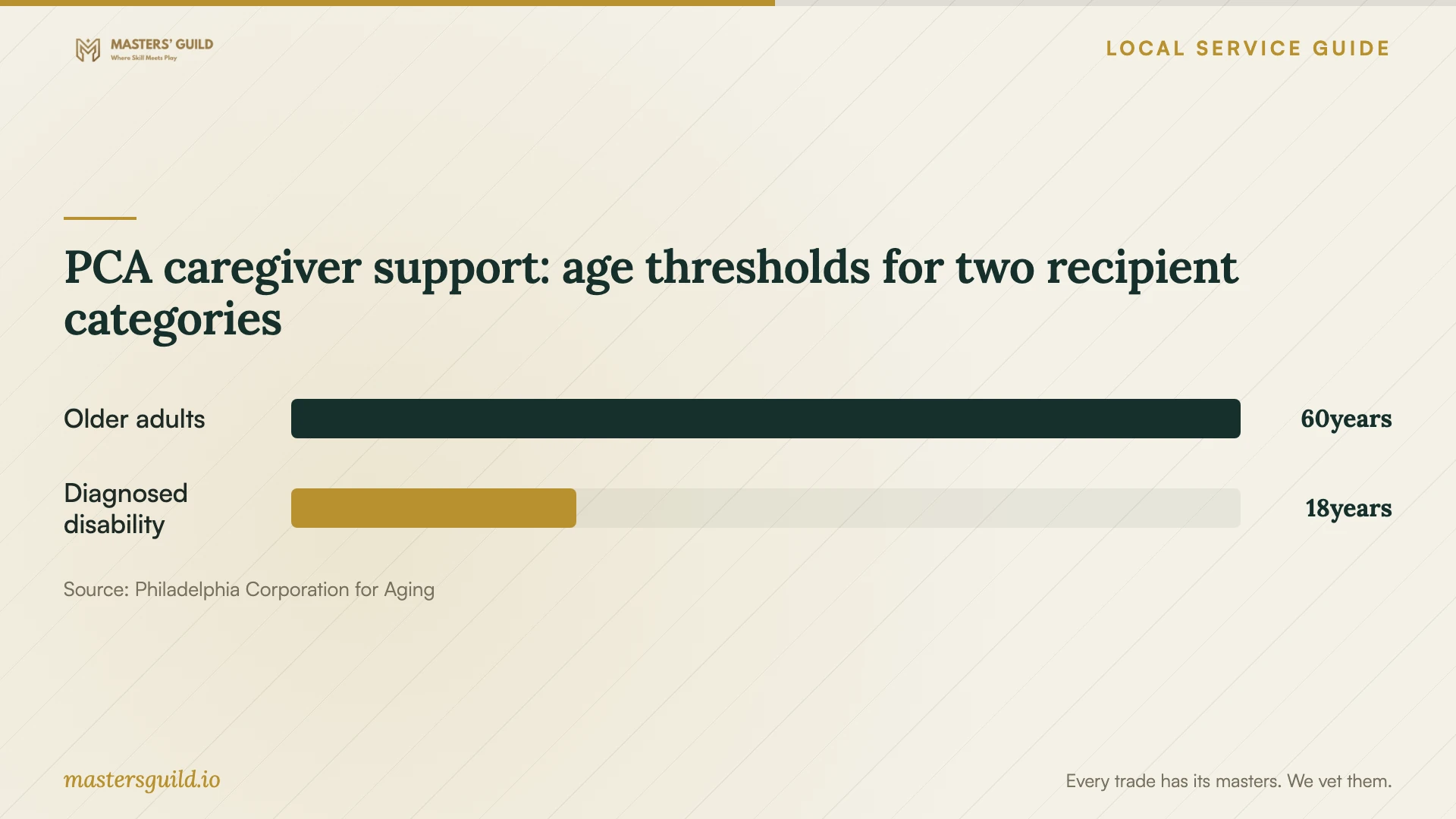
PCA caregiver support: age thresholds for two recipient categories
Local details that affect your job
Philadelphia’s assessment entry point
Call the PCA Helpline at 215-765-9040 Monday through Friday, 8:30 a.m. to 5 p.m., except major holidays. PCA also offers an online assistance form and says its team will contact you within three business days. Use the phone route to discuss assessment or referrals; the form response timeframe is not a care-start commitment. [1]
Support for Philadelphia’s unpaid caregivers
Call PCA’s Caregiver Support Program at 215-995-4372 to discuss education, care management, referrals, and possible reimbursement for caregiving services or supplies. Financial support uses a sliding scale based on the household income where the care recipient lives. The caregiver must provide routine assistance and hold primary responsibility; the recipient must meet a listed age, disability, or dementia category and need help with at least one activity of daily living. Ask about your eligibility and proposed expense before budgeting for reimbursement. [2]
Choose your next step
| Your situation | Starting point | Question to resolve |
|---|---|---|
| You need help identifying services | PCA Helpline | Should PCA arrange an assessment or refer you elsewhere? |
| An unpaid primary caregiver needs support | PCA Caregiver Support Program | Do the caregiver, recipient, and proposed expenses qualify? |
| You are comparing home care agencies or registries | Required pre-service information packet | Who provides the care, what is the total cost, and who carries which responsibilities? |
| You need health care at home | Pennsylvania Department of Health Home Health page | Is the agency licensed, and does its certification fit the proposed payment route? |
Your hiring checklist
- Write the care recipient’s task list and preferred routine together.
- Contact PCA about assessment, referrals, and caregiver support.
- Give prospective providers the same tasks and schedule.
- Request the written service packet and a total quote.
- Clarify worker status, supervision, insurance responsibilities, and absence coverage.
- Check home-health licensing and discuss certification when seeking Medicare payment.
- Agree on access, family contacts, visit records, and a review date.
Frequently Asked Questions
Can PCA help us work out what care to arrange?
PCA discusses potentially available services when you request help. It may arrange an in-home assessment or refer you to applicable services. Ask what happens next and who will contact you; requesting assistance does not establish enrollment. [1]
Can a family caregiver get help paying for care?
PCA’s Caregiver Support Program offers income-based reimbursement for eligible caregiving services and supplies, alongside training and referrals. Ask the program to confirm caregiver and recipient eligibility and whether your intended expense qualifies. [2]
What should an agency provide before care starts?
Pennsylvania requires agencies and registries to provide a packet covering services, worker identity, hours, fees and total costs, competency requirements, complaint contacts, and worker employment status with associated responsibilities. Review it alongside your proposed care schedule. [3]
Does a home-health license mean Medicare will pay?
Pennsylvania licensing and Medicare certification are separate. Medicare may pay for services from federally certified home-health agencies. Ask the agency and your care team to confirm the services and payment arrangements for your relative. [4]
Sources and scope
This guide combines the sources below with practical planning guidance. Figures apply to the stated geography and period; request a written quote for your property.