
Local service guide
Duct and Vent Cleaning in Overland Park, KS
Arrange Duct and Vent Cleaning in Overland Park after a contractor shows you contamination that warrants the work. Request a written scope and total price for the affected heating and cooling system, and correct the contamination causes before cleaning. EPA recommends cleaning as needed. If the quote includes duct replacement or vent rerouting, ask the city to identify applicable permit requirements and check the contractor’s mechanical credentials before authorizing that work. [2] [3] [4]
Decide whether cleaning addresses your problem
Ask the contractor to show you the affected ducts or components before approving whole-system cleaning. EPA says dusty return registers are normal and homeowners can vacuum or remove them for cleaning. Describe where you saw deposits, particles leaving supply registers, suspected mold, or evidence of vermin inside ducts. [4]
Investigate a mold claim before agreeing to treatment. EPA says appearance alone cannot confirm mold; an expert may need laboratory analysis. Ask who will identify and correct the underlying cause. EPA advises removing and replacing wet or moldy duct insulation because cleaning cannot resolve that condition. [4]
Keep your expectations specific. EPA reports no demonstrated prevention of health problems from duct cleaning and little evidence that cleaning ducts alone improves system efficiency. Discuss unexplained symptoms with your doctor rather than relying on a cleaner’s health promises. [4]
Compare scope before comparing prices
Get written estimates for your home’s actual scope. EPA recommends estimates from at least three providers. Give each estimator the same description of your concern and ask which components they will clean. EPA describes system cleaning as including supply and return ducts, registers, grilles, heat exchangers, coils, drain pans, fan components, and air-handler housing. [4]
Ask each estimator to separate cleaning, equipment servicing, replacement work, and any dryer-exhaust work you want included. Request the total price, exclusions, access-hole work, and a process for approving additions. For hourly billing, EPA recommends asking about estimated hours or days and expected interruptions before agreeing to the job. [4]
Compare the complete estimates. Ask whether each price covers all the systems you want cleaned and who will handle excluded components. Keep optional treatments and repairs on separate lines so you can decide which work to authorize.
Check the method and proposed treatments
Ask how the crew will collect loosened dust and protect your rooms. EPA advises vacuum equipment that exhausts outdoors, or HEPA vacuuming when equipment exhausts indoors. It also recommends controlled brushing, protection for furnishings, and sealing and reinsulating access holes after cleaning. [4]
Have the provider identify sheet metal, flexible duct, and fiberglass sections before choosing tools. EPA specifies soft-bristled brushes for fiberglass duct board and fiberglass-lined metal ducts. EPA also recommends inspecting for asbestos-containing materials before cleaning and reserving their handling for trained and equipped specialists. [4]
Require a separate explanation for chemical biocides or internal coatings. Ask to see the contamination, product label, and approved use for your duct material. EPA’s October 1997 guidance, on a page updated February 19, 2026, states that no biocides are registered for fiberglass duct board or fiberglass-lined ducts. This describes the guidance’s statement; it does not verify the current product-registration inventory. Ask the provider to document authorization for any proposed product’s intended use. [4]
EPA cautions against routine use of sealants to encapsulate contaminants inside ducts. Ask why the provider proposes a coating and whether physical cleaning and correction of the contamination source can address the problem. Review that explanation before approving treatment. [4]
Prepare for access and check the finished work
Agree on access to the air handler, registers, and any attic or crawlspace areas the crew needs. Move belongings from those work areas and arrange a place for pets. Discuss equipment placement, protection for your home, and how long the provider expects to keep the system off.
Request photographs or a walkthrough of the cleaned components before closing out the job. EPA recommends visual inspection to verify cleanliness. Ask the crew to demonstrate that they have reattached registers, sealed access openings, preserved fiberglass lining, and checked system operation. [4]
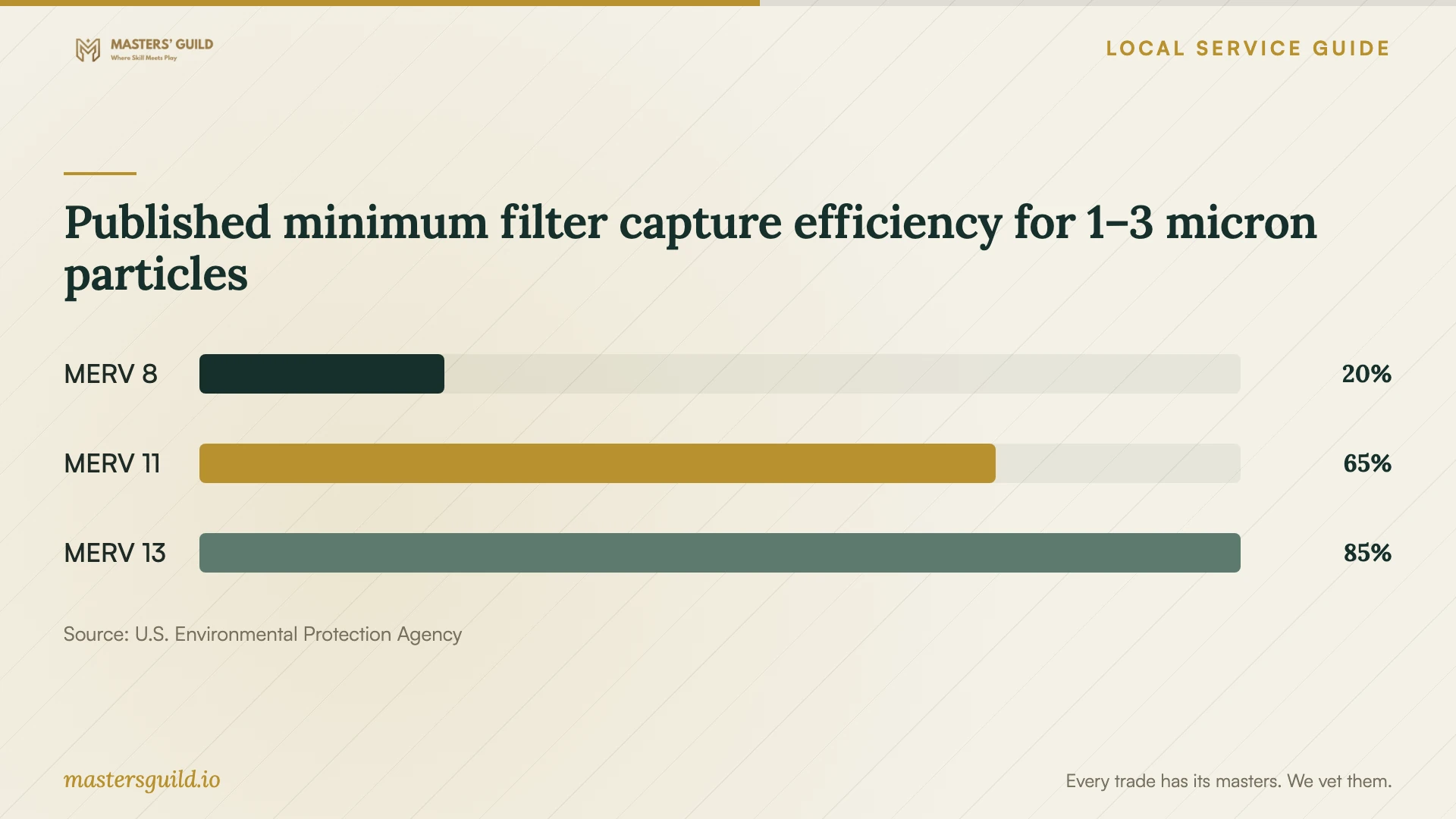
Discuss ongoing filtration with your HVAC technician. EPA recommends choosing a filter your system fan and filter slot can accommodate and following the manufacturer’s replacement instructions. The chart compares published filter capture thresholds for one particle-size band. It does not measure duct-cleaning results or identify the right filter for your equipment. [5]
Published minimum filter capture efficiency for 1–3 micron particles
Local details that affect your job
Send permit questions to the city
Johnson County issues building permits for unincorporated areas and directs projects inside a city to that city’s permitting authority. For an address inside Overland Park, ask the city to review proposed duct replacement, relocation, or vent alteration. Send the repair scope separately from the cleaning scope so the reviewer can assess the actual work. [3]
Check the classification for added HVAC repairs
Johnson County defines Class DM as covering HVAC, mechanical, and refrigeration services. Class A, B, and C licenses do not authorize HVAC work. If your cleaner proposes mechanical repairs, request the company’s applicable credentials and identify who will perform them. The county lists Contractor Licensing at 913-715-2233, Option 1, for questions. This classification guidance does not establish a separate licensing requirement for cleaning alone. [2]
Confirm which code governs a claimed exemption
The cited Overland Park provision amends International Building Code Section 105.2. Within that provision, the city exempts replacement of a mechanical part when it does not alter approval or make the equipment unsafe, and excludes mechanical work affecting public health or general safety from ordinary repairs. The supplied text does not establish that these provisions govern duct work in detached one- or two-family homes. If a contractor claims an exemption for added work, ask the city to identify the governing code and the exemption applicable to your property before authorizing it. [1]
Choose your next step
| Observation or proposal | Next step | Basis |
|---|---|---|
| Dust on a return grille | Clean the grille and assess the system before booking | EPA says grille dust alone does not indicate heavy duct contamination. |
| Excessive duct deposits or particles leaving supply registers | Request an inspection, identify the cause, and compare cleaning scopes | EPA identifies these conditions as reasons to consider cleaning and advises correcting underlying causes first. |
| Substantial suspected mold in hard-surface ducts or on system components | Investigate the condition and correct its cause before work | EPA says an expert may need laboratory analysis to confirm mold. |
| Wet or moldy insulated ducts | Discuss replacement with a qualified HVAC contractor | EPA advises removing and replacing affected insulated duct material. |
| Duct replacement or vent relocation | Ask the city about applicable permits and check mechanical credentials | County guidance routes city projects to city permitting; Class DM covers mechanical services. |
Your hiring checklist
- Describe what you observed and where; share photographs with each estimator.
- Ask the provider to show the contamination and explain how you will correct its cause.
- Compare ducts, equipment components, access work, and exclusions across estimates.
- Request proof of liability insurance and credentials applicable to proposed repairs.
- Separate dryer-exhaust work, chemical treatments, and mechanical alterations in the quote.
- Ask the city to resolve permit and code-applicability questions for proposed alterations.
- Clear agreed access areas and arrange a place for pets.
- Review completion photographs and system operation with the crew.
Frequently Asked Questions
Should I schedule duct cleaning every year?
EPA recommends cleaning as needed rather than as routine maintenance. Ask for evidence of contamination that meets its cleaning criteria. Keep filter changes and heating-equipment inspections on their own maintenance schedule. [4]
Does a general contractor license cover HVAC repairs?
Johnson County says its Class A, B, and C classifications exclude HVAC work. Class DM covers HVAC, mechanical, and refrigeration services. Ask about the classification applicable to any repair added to your cleaning quote. [2]
Can a provider claim EPA certification?
EPA says it does not certify, endorse, or approve duct-cleaning companies. Ask the provider to identify the organization behind any credential and explain its relevance to your system. [4]
Should I install a higher-MERV filter after cleaning?
Discuss compatibility with your HVAC technician. For a filtration upgrade, EPA recommends MERV 13 or the highest rating your system fan and filter slot can accommodate. Follow the manufacturer’s maintenance and replacement guidance. [5]
Sources and scope
This guide combines the sources below with practical planning guidance. Figures apply to the stated geography and period; request a written quote for your property.