
Local service guide
Special Item Transport in Orlando, FL
Arrange Special Item Transport in Orlando by choosing a mover who can explain how the crew will handle your specific piano, safe, pool table or artwork, then agree on access, setup and damage protection before booking. For a household move within Florida, verify FDACS registration and obtain a signed written estimate and contract. If either address needs downtown curb access, settle parking arrangements before confirming the arrival time. [1] [2] [3]
Choose a crew for the item and the route
Ask the mover to describe the handling plan for your item. For a piano, request details about protection, equipment and any parts the crew plans to remove. For a pool table, ask who will handle the slate, reassembly and leveling. For a safe, provide the model and manufacturer-listed weight if available, and agree on how you will prepare its contents.
Measure door openings, stair landings and the route from the truck to the final position at both addresses. Photograph tight turns and steps. Ask the mover to inspect uncertain access before you accept a quote rather than leaving the crew to decide at pickup.
FDACS recommends having at least three moving companies evaluate the items and provide detailed estimates. Its guidance favors an estimator seeing the items in person over relying on a phone or internet estimate. For a single valuable or awkward item, use that visit to resolve the handling and access questions. [3]
Put the full job in the written quote
For intrastate moving services, FDACS says the mover must provide an estimate and contract in writing before performing services, with both parties signing. Required information includes the mover's registration number, pickup and delivery details, an itemized breakdown of costs and services, and acceptable payment methods. [3]
Ask each bidder to spell out packing, crating, disassembly, reassembly and final placement. Include stairs, elevator use and the carry distance from the legal parking position. FDACS identifies stair or elevator charges, packing and long carries among the possible pricing bases. Ask how the company will document and obtain your agreement to any change. [3]
Request an item-specific total and compare quotes covering the same work. Budget separately for parking. Ask the mover to distinguish any parking charges from labor, equipment and protection charges, and agree on who will arrange and pay for curb access.
Check registration and damage protection
FDACS requires intrastate household movers and moving brokers to register. Use the Business License Lookup linked from its consumer guidance or call 1-800-HELP-FLA (1-800-435-7352). Match the business name and registration number to your contract, and ask whether that business will send its own crew or arrange another carrier. [3] [4]
Ask the mover to explain the written liability terms for your particular item. FDACS describes a limitation of liability at a rate no lower than 60 cents per pound per article and says movers must disclose that limitation and the opportunity to reject it or choose additional valuation before providing services. [3]
Ask what you would receive for damage under the valuation option you select. Review exclusions, any deductible and the claim procedure with the mover. Check with your homeowners insurer about coverage during a professional move; FDACS recommends this check and notes that an insurer may offer a rider. [3]
Agree on preparation and delivery acceptance
Before pickup, photograph the item and record existing chips, scratches or mechanical issues with the crew. Ask the mover to include an agreed condition description in your job paperwork. Keep your own copies of the estimate, contract and any inventory.
Reserve any building elevator or loading dock with the property manager and confirm the truck's access dimensions. Ask who will protect floors and door frames. Agree on a covered loading plan and the circumstances in which you or the mover will postpone the job.
At delivery, inspect the item before the crew leaves and check the setup work you purchased. Record concerns in writing. FDACS advises reporting a claim to the mover in writing as soon as possible and contacting the department if the company does not resolve it satisfactorily. [3]
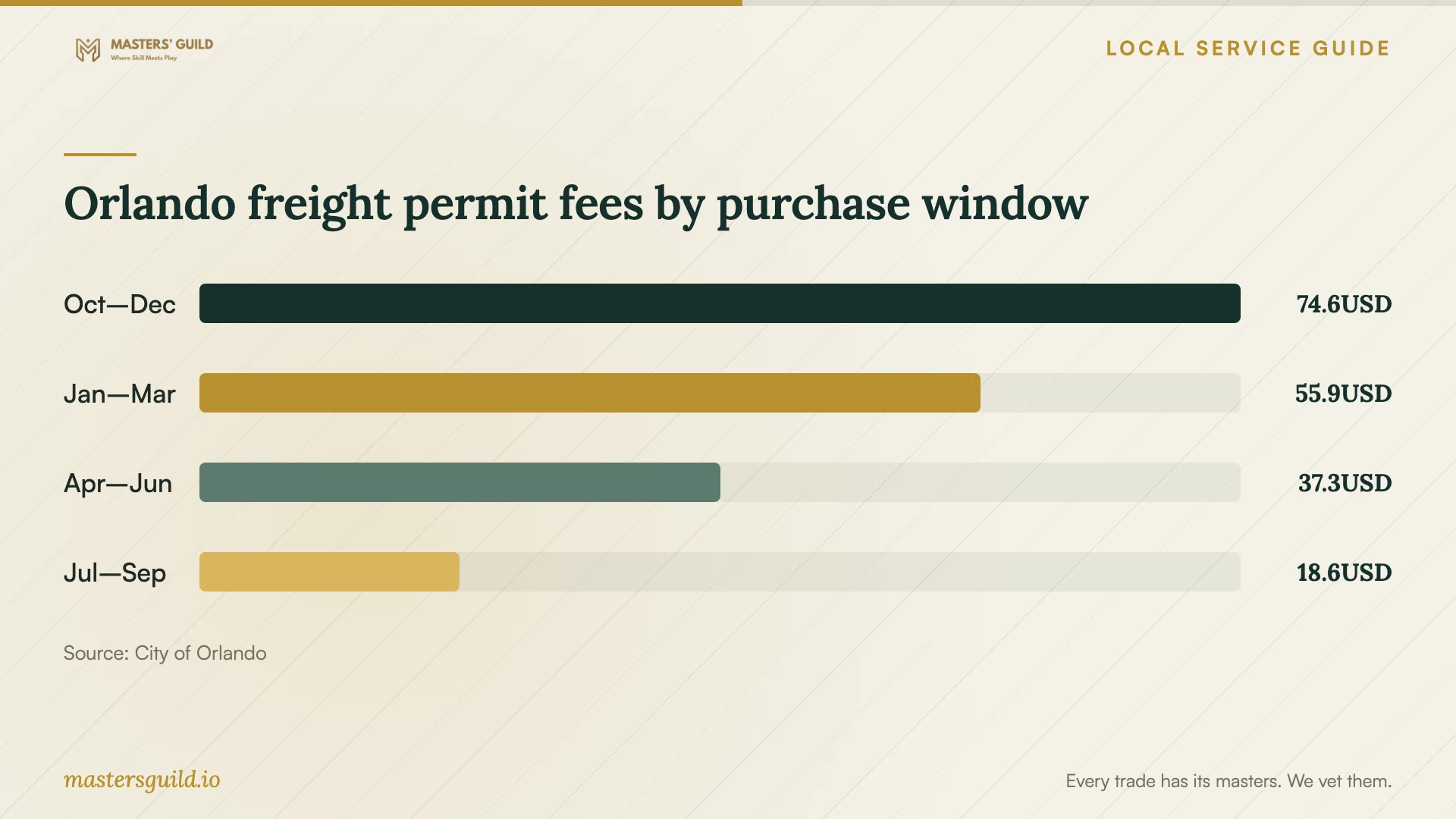
Orlando freight permit fees by purchase window
Local details that affect your job
Downtown freight zones may be too brief for your plan
Orlando grants downtown freight permits to qualifying businesses with a freight-loading need and a gross vehicle weight of 5,000 pounds or a width exceeding 80 inches. The city requires vehicle registration and tag information. Drivers must display the permit at the rear, load or unload during use, stay no longer than 30 minutes and wait 30 minutes before returning. Ask your carrier to confirm eligibility and whether the planned loading fits that limit. [1]
Reserve vehicle spaces before the moving date
Orlando allows on-street space rentals for approved moving activities lasting less than 30 days, at $22 per day per space plus sales tax. Identify the curb-tagged space number and street before applying. Submit the application and full payment at least one business day before the start; for requests within 48 hours, visit the Parking Division office. The city requires payment within 24 hours of approval and, for weekend starts, by noon on the preceding Friday. Confirm the carrier's space needs before paying. This program excludes storage containers. [2]
Choose an access arrangement before booking
| Situation | Arrangement to discuss | Next step |
|---|---|---|
| Downtown loading fits within 30 minutes | Freight-zone use by an eligible permitted business | Have the carrier confirm eligibility, permit display and the 30-minute no-return interval. |
| Loading needs longer curb access | An approved on-street vehicle-space rental | Confirm the space numbers, truck fit and application deadline with the city. |
| You plan to use a storage container | Another approved placement arrangement | The city excludes containers from its on-street space rental program; ask about alternatives. |
| Private driveway or building loading dock | Access agreed with the property owner or manager | Confirm clearances, elevator availability and the route to final placement. |
Your hiring checklist
- Send bidders the item's model, dimensions, known weight, photographs and desired final position.
- Measure the route at both addresses and flag steps, tight turns and elevator access.
- Ask the crew to explain equipment, protection, disassembly and setup responsibilities.
- Match the household mover's registration details to the company named in your agreement.
- Assign responsibility for curb reservations, building access and parking charges.
- Obtain the full written scope, total, payment terms and change procedure before booking.
- Review valuation terms and record the item's condition before pickup.
- Inspect placement and agreed setup at delivery; document any concern with the mover.
Frequently Asked Questions
Does a mover need registration for a single household item?
FDACS requires people operating as intrastate household movers to register. For a household item transported within Florida, check the mover's registration even if you are moving only that item. For a shipment crossing state lines, confirm the applicable requirements before booking. [3] [4]
Can the truck stay in a downtown freight zone for the whole job?
Orlando limits freight-zone use to 30 minutes and prohibits returning within 30 minutes of leaving. Ask the mover to estimate the loading portion of the job and arrange suitable access if it needs more time. [1]
How much should I budget for reserved street parking?
Orlando publishes a daily rate of $22 per on-street space plus sales tax, charging seven days a week. Ask how many spaces the truck needs and who will pay. Budget for this parking charge alongside the item-specific transport quote. [2]
What should I ask about protection for an expensive item?
Ask for the written valuation choice, payout basis, exclusions and claim procedure for that item. FDACS says movers must disclose liability limitations and offer the opportunity to reject them or select additional valuation. Ask your homeowners insurer whether your policy covers the move. [3]
Sources and scope
This guide combines the sources below with practical planning guidance. Figures apply to the stated geography and period; request a written quote for your property.