
Local service guide
NYC office relocation: hiring and setup
For office relocation in New York City, choose a mover who puts the inventory, loading plan, furniture work and delivery sequence in writing. Confirm access with both building managers, assign IT testing to a named person, and arrange electrical installation with a qualified contractor. NYC requires permits for most electrical work and DOB-licensed electrical contractors for electrical installations. [4]
Define the moving and setup scope
Send each bidder the same inventory and destination floor plan. List desks, chairs, cabinets, boxed records, monitors, printers and equipment needing special handling. Identify items you will leave behind. Ask bidders to inspect both premises or review access photos before committing to their scope.
Specify desk disassembly, furniture assembly, placement by workstation label, monitor unpacking, cable reconnection and packaging removal. Ask who will perform each task and who will approve completion. Have your IT contact write the shutdown, packing, transport and testing instructions for computers and network equipment.
Request a written price that identifies crew size, truck arrangements, packing materials, storage, travel charges and any minimum booking. Ask how the mover charges for waiting, extra trips, stairs, a longer carry from the curb or inventory changes. Compare bids against the same scope and ask for exclusions before signing.
Coordinate unloading with building access
Ask both building managers to confirm the loading entrance, elevator arrangements, surface protection and insurance paperwork. Share truck dimensions and the equipment list. Give the mover a contact list and name the person who can approve changes if a dock or elevator becomes unavailable.
NYC DOT distinguishes commercial metered spaces, neighborhood loading zones and truck loading zones. Commercial metered spaces require payment and have time limits. Use the loading-zone map to investigate each address, then ask the mover to check posted restrictions for the planned arrival time. DOT cautions that its map may not reflect all current posted regulations. [2]
Ask bidders how they will coordinate unloading with your elevator window and handle an occupied curb space. Put the contingency and any waiting charges in the quote. NYC DOT limits metered sessions according to the posted sign, so include the block's time limit in your loading plan. [1]
Confirm a route suitable for the truck
NYC DOT prohibits commercial vehicles on the FDR Drive, Belt Parkway and Henry Hudson Parkway north of 59th Street to the Bronx-Westchester county line. It also identifies commercial-vehicle restrictions on portions of Fifth Avenue, Park Avenue and the Brooklyn Bridge. Drivers must obey posted signage. [3]
Ask the mover to confirm the route and approach to each loading entrance for its proposed vehicle. For a move between boroughs, request the planned crossing and an arrival contingency. Have the mover confirm the schedule before you book the freight elevator; avoid relying on a passenger-car navigation estimate.
Arrange power and test the office before handover
Con Edison asks customers starting commercial service for a tax ID and directs existing business-account customers to call to manage service. Prepare your old and new addresses and move dates. Confirm with the landlord who holds the account, then assign the utility arrangements to a named person. [5]
For new outlets or other electrical installations, involve the landlord and a DOB-licensed electrical contractor before approving the workstation layout. NYC DOB requires an electrical permit for most electrical work, including handling electrical wires in a business. The department requires its licensed electrical contractors to perform electrical installations. [4]
Ask your IT contact to confirm internet activation, network equipment placement and responsibility for reconnecting devices. Agree on acceptance tests: power up workstations, connect to the network, print a document and test business-critical equipment. Record unresolved items, assign an owner to each and agree on completion dates before staff return.
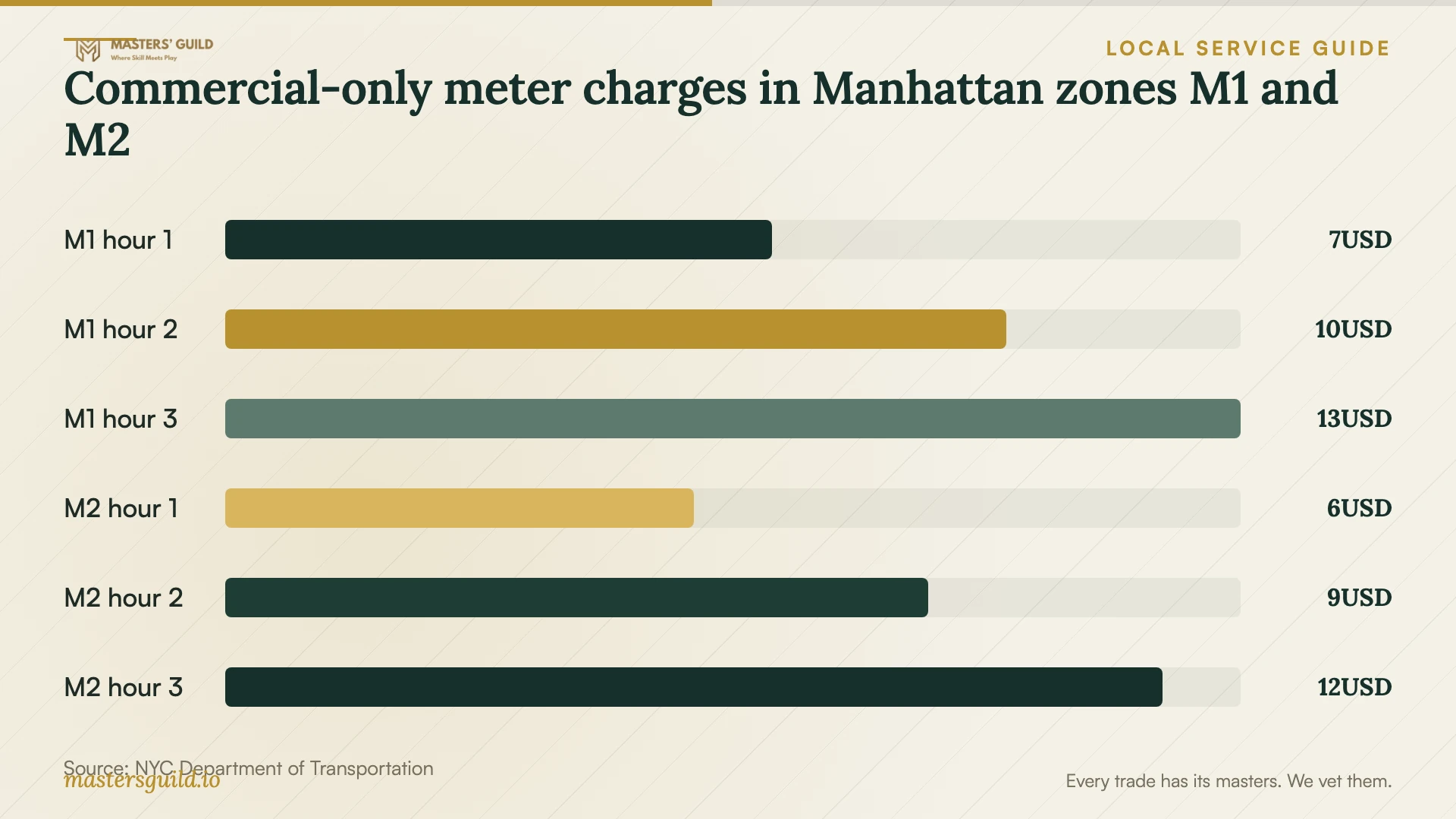
Commercial-only meter charges in Manhattan zones M1 and M2
Local details that affect your job
Include commercial-meter payments in the quote
NYC DOT lists commercial-only meter charges in Zone M1, Midtown Core and Lower Manhattan, at $7 for the first hour, $10 for the second and $13 for the third. Zone M2, Manhattan south of 96th Street with mapped exceptions, lists $6, $9 and $12. Ask whether the mover includes meter payments, and check the actual block's signs and meter before unloading. [1]
Assign electrical permits to the electrical contractor
NYC DOB requires permits for most electrical work and DOB-licensed electrical contractors for electrical installations. Ask the landlord and contractor to confirm permit responsibility and scope before approving new outlets or wiring. Coordinate their completion date with equipment delivery and IT testing. [4]
Use the utility's business-account process
Con Edison directs business-account customers to call to manage service and asks for a tax ID when starting commercial service. Confirm account ownership with the landlord and contact the utility about the move. Keep this responsibility explicit when a mover offers a setup package. [5]
Choose the scope your office needs
| Your situation | Arrange | Confirm before booking |
|---|---|---|
| Furniture and boxed records | Mover with written packing and placement scope | Inventory, access arrangements and damage-reporting procedure |
| Desks need disassembly | Furniture disassembly and assembly in the quote | Included furniture, parts handling and final placement |
| Computers and network equipment | Mover plus your IT contact | Packing responsibility, shutdown sequence and acceptance tests |
| New outlets or electrical installations | DOB-licensed electrical contractor and permit coordination | NYC requires permits for most electrical work |
| Existing Con Edison business account | Account holder to call Con Edison | Service arrangements at the old and new addresses |
Your hiring checklist
- Send bidders one inventory, destination floor plan and setup task list.
- Confirm access arrangements and insurance paperwork with both building managers.
- Ask for a truck route, loading plan and occupied-curb contingency.
- Get written charges for waiting, extra trips, storage and inventory changes.
- Label furniture and equipment by destination workstation or room.
- Assign utility arrangements, internet activation and electrical coordination to named contacts.
- Back up business data and agree on IT shutdown and reconnection instructions.
- Inspect delivered items and test workstations before approving setup completion.
Frequently Asked Questions
How should I budget for an office move?
Request written quotes for your inventory and both addresses. Ask bidders to separate transport, packing, furniture assembly, storage and waiting charges. Confirm who pays meter charges and how the mover prices changes. Use the parking figures here for curb payments; obtain the moving price from a scoped quote. [1]
Can a moving truck use the FDR Drive?
NYC DOT lists the FDR Drive among roads where commercial vehicles are prohibited. Ask the mover to confirm a permitted route for its vehicle before committing to an arrival time or freight-elevator booking. [3]
Does office setup include installing electrical outlets?
Ask the bidder to define setup in writing. NYC DOB requires permits for most electrical work and DOB-licensed electrical contractors for electrical installations. Coordinate outlet installation with the landlord and electrical contractor, and identify who handles permits. [4]
Can I rely on the loading-zone map for unloading?
Use it as a planning reference. NYC DOT describes the map as informational and cautions that it may not reflect all current posted regulations. Ask the mover to check signs and meter rules at each address and prepare an alternative unloading plan. [2]
Sources and scope
This guide combines the sources below with practical planning guidance. Figures apply to the stated geography and period; request a written quote for your property.