
Local service guide
New Haven, CT basement remodeling: Hiring Guide
For basement remodeling in New Haven, CT, define how you will use the space, test for radon and check the contractor’s Connecticut registration before hiring. Ask the city which permits your proposed work needs, and verify approval before construction starts. Connecticut DPH recommends testing before and after converting an unfinished basement into living space. Include testing, permit responsibility, trade work and payment milestones in your written agreement. [1] [2] [3]
Define the room before asking for bids
Tell each bidder whether you want a recreation room, home office, bathroom or sleeping space. Draw the intended layout and mark existing stairs, windows, plumbing and heating equipment. Confirm the intended use with New Haven, including whether you propose a bedroom or separate dwelling. Ask the city about the requirements for that use before committing to a layout.
Give contractors the same photographs, approximate dimensions and finish preferences. Ask them to inspect staining, dampness or previous repairs and explain what they propose to investigate before covering walls or floors. Request separate prices for the agreed finish work and unresolved investigation or repair. Discuss access to equipment and shutoffs while reviewing the layout.
Arrange radon testing around construction
Connecticut DPH recommends testing before a structural renovation that converts an unfinished basement into living space, then testing after completion. It also recommends testing the basement when you begin occupying that level. Give your contractor the results before agreeing on the final scope, and ask who will arrange any mitigation and the completion test. [1]
DPH identifies November through March as the best testing season, when homeowners keep the house closed. For the short-term test it describes, you leave the detector in place for 2 to 7 days before sending it to a laboratory. Follow the test instructions and keep windows and outside doors closed as much as possible during testing. Allow time for the laboratory result before committing to work that could affect mitigation planning. [1]
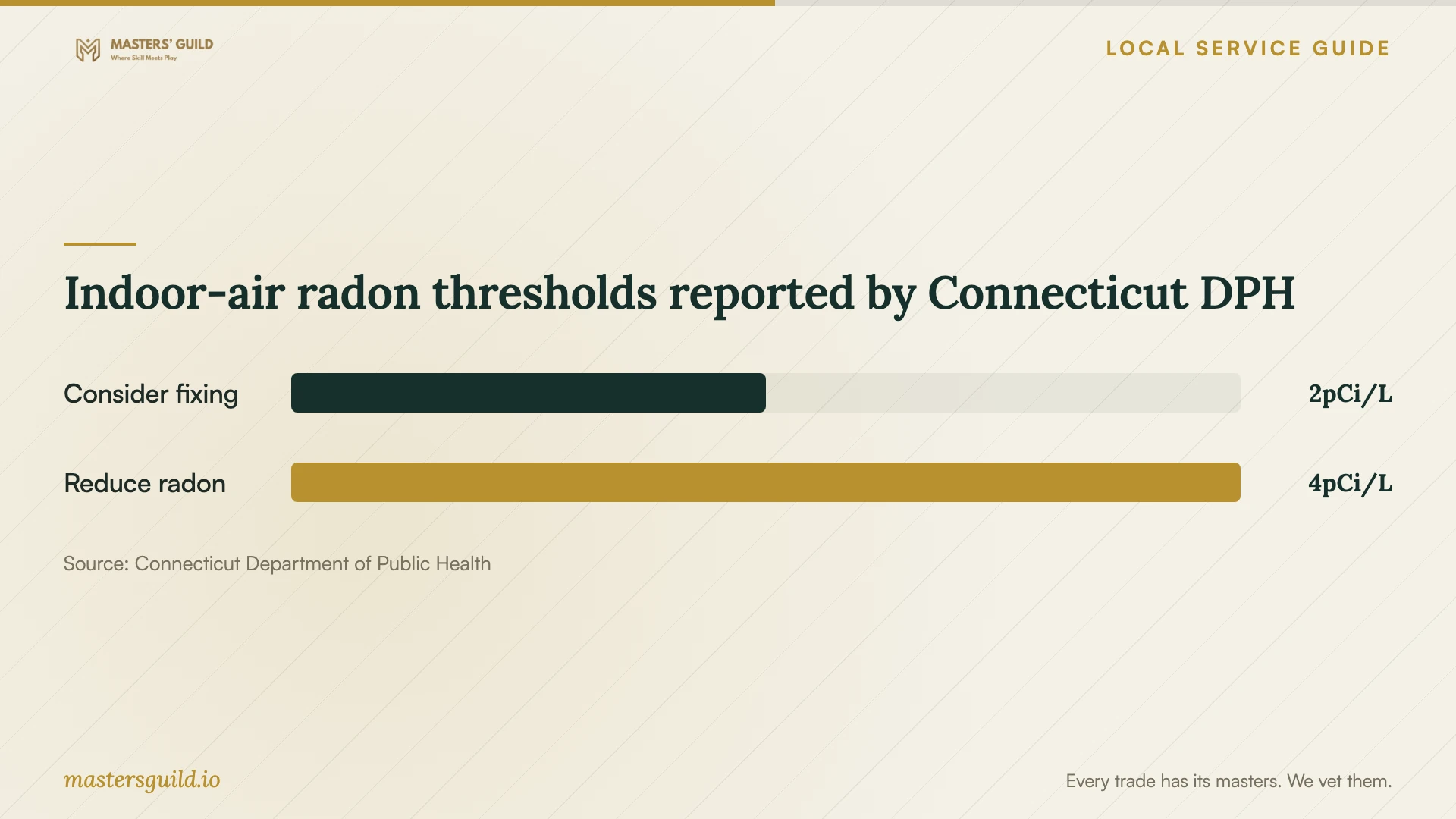
DPH reports EPA guidance to reduce radon at 4 pCi/L or higher and to consider fixing levels between 2 and 4 pCi/L. These are indoor-air decision thresholds. Test your own house: DPH cautions that neighboring homes can have different radon levels. [1]
Check registration and the proposed trade team
Connecticut DCP says home improvement contractors must register with the department. It distinguishes that registration from the more specific licenses that electrical, plumbing and HVAC work may require. Use the state license-verification service identified on DCP’s consumer page before hiring. Ask the remodeler to name the people or businesses responsible for each part of the work. [2]
Request references from projects with a similar scope. For a bathroom addition, ask how the bidder will assess the existing plumbing before quoting. For a room conversion, ask how the bidder will coordinate the intended use with the city’s requirements. Have each contractor list exclusions in writing so you can compare offers without assuming that each included the same work.
Set permit duties, payments and changes in writing
Connecticut DCP says every home improvement job requires a written, signed and dated contract. Required contents include the contractor’s name, address and registration number, both parties’ signatures, start and completion dates, the work and price, and cancellation information. DCP describes a three-business-day cancellation right and notes that Saturday counts as a business day in Connecticut. [3]
DCP recommends including material quality or brands, cleanup responsibility, permit responsibility and a payment schedule. You can assign permit applications to the contractor, but DCP says the homeowner remains responsible for obtaining the required permits. Verify approval with the city before construction starts. [3]
Ask New Haven about application steps, fees and permit and inspection requirements for your address and proposed scope. Have the contractor identify which applications they will handle and how they will provide approval documentation. Keep those responsibilities in the agreement.
DCP recommends progress-based payments in three or four parts and says an upfront payment generally should not exceed one-third of the project total. Treat that as consumer guidance rather than a statutory deposit cap. DCP also advises against cash payments and calls for receipts. Require written, specific changes and keep your copy before authorizing added work. [3]
Agree on the handover before work starts
Ask the bidder to define completion: cleanup, agreed finishes, documentation and any required inspection closeout. Walk through the proposed layout together and record how you will access shutoffs and equipment after finishing. If the bidder leaves a major condition unresolved, request the investigation first and a revised scope afterward.
Include the post-renovation radon test in your handover plan, following Connecticut DPH’s recommendation to test after converting the basement into living space. Agree on who will arrange the test and give you the result. [1]
Indoor-air radon thresholds reported by Connecticut DPH
Local details that affect your job
Connecticut radon guidance changes your project sequence
For this New Haven project, apply Connecticut DPH’s statewide recommendation to test before and after converting the basement into living space. DPH identifies November through March as the best testing season. Arrange testing before settling the construction scope, and agree on who will coordinate mitigation if needed. Use your home’s test result to plan the work; this guidance does not establish a New Haven-specific radon rate. [1]
Check Connecticut registration and trade credentials
DCP says home improvement contractors must register and that electrical, plumbing and HVAC work will likely require a more specific license. For your basement project, request the remodeler’s registration details and the proposed trade team’s names before signing. Verify credentials appropriate to the work through the state service identified by DCP. [2]
Follow up on permits even when the contractor applies
Connecticut DCP says the homeowner retains ultimate responsibility for required permits, even when the contract assigns applications to the contractor. For your New Haven address, verify approval with the city before work begins. Ask the contractor to supply approval documentation before scheduling construction. [3]
Choose the next step before signing
| Your situation | Next step | Ask the bidder |
|---|---|---|
| You will convert an unfinished basement into living space | Follow DPH guidance to test before renovation and after completion. | Who will coordinate testing and any mitigation? |
| Your radon result is 4 pCi/L or higher | Follow the reduction guidance reported by Connecticut DPH. | How will you incorporate a qualified mitigation contractor? |
| The scope includes plumbing, electrical or HVAC work | Verify credentials appropriate to the work as well as the remodeler’s registration. | Who will perform each trade’s work? |
| The contractor will apply for permits | Verify approval with the city before work begins. | How will you provide approval documentation? |
| The bidder requests most of the price upfront | Review DCP’s guidance favoring progress payments and reconsider the agreement. | Can you tie payments to defined work milestones? |
Your hiring checklist
- Write down the intended use, layout and finish preferences for each bidder.
- Photograph existing conditions and flag dampness or previous repairs for investigation.
- Arrange a pre-renovation radon test and share the result before finalizing scope.
- Verify the remodeler’s registration and the appropriate trade credentials.
- Ask New Haven about applications, fees and requirements for your address and scope.
- Verify permit approval with the city before construction starts.
- Review the written scope, exclusions, cancellation information and progress payments.
- Keep written changes, receipts and a completion plan that includes radon retesting.
Frequently Asked Questions
Do I need to test radon before finishing the basement?
Connecticut DPH recommends testing before converting an unfinished basement into living space and after the work finishes. Include both tests in the project plan, and give the contractor the initial result before finalizing the scope. [1]
Does contractor registration cover plumbing and electrical work?
DCP distinguishes home improvement registration from specific trade licenses. It says electrical, plumbing and HVAC work will likely require additional licensing. Ask who will perform those tasks and verify the credentials appropriate to the work. [2]
Who should obtain the permits?
You can assign permit applications to the contractor in the written agreement. Connecticut DCP says the homeowner remains responsible for obtaining required permits and should verify approval with the town before work starts. Ask New Haven about the requirements for your address, intended use and proposed work. [3]
How much should I pay before construction starts?
DCP says an upfront payment generally should not exceed one-third of the total and recommends a three- or four-part schedule tied to progress. Treat that as consumer guidance. Review the requested deposit, material purchases and milestones together before signing. [3]
Sources and scope
This guide combines the sources below with practical planning guidance. Figures apply to the stated geography and period; request a written quote for your property.