
Local service guide
Tree cutting in Montreal: permits and hiring
Tree cutting in Montreal starts with checking your borough’s permit rules and choosing a crew qualified for the work. Before booking removal, identify the tree species, confirm whether it stands on private property, and ask the borough which documents it needs. For covered arboriculture work performed for an employer, Québec requires a qualification certificate or valid apprentice card. Work that could bring a person, tool or tree part within three metres of a medium-voltage wire requires Hydro-Québec or its authorized professional. [1] [2] [3]
Choose an assessment, pruning or removal scope
Ask the arborist to explain the tree’s condition and whether pruning or another intervention could address your concern. Request a written recommendation if you need evidence for a removal application. Describe the problem you want solved: a damaged limb, suspected decline, contact with a building or interference with planned work. Avoid asking for a broad cut without discussing which branches the crew would remove.
The city lists dead trees, irreversible decline, significant property damage and public-safety danger among permitted removal grounds, with borough-specific wording and conditions. Falling leaves, shade and visible roots do not justify removal under the listed restrictions. A contractor’s willingness to remove the tree does not establish municipal approval. [1]
Check the rules before ordering heavy pruning or root cutting. Some boroughs include those operations in their felling-permit requirements. Villeray–Saint-Michel–Parc-Extension, for example, requires a permit for removing at least 50 per cent of living branches or cutting at least 40 per cent of roots. [1]
Prepare the borough application before setting a date
Open the city’s private-lot felling page and select the borough for your address. Follow that borough’s measurement height and diameter threshold. To calculate diameter, the city instructs applicants to measure the trunk circumference in centimetres and divide by 3.14. Record both the result and the height where you measured it. [1]
Prepare a plan showing numbered trees, their locations, diameters and species if known. Borough document lists commonly include photographs and, depending on the application, an expert report, owner authorization or condominium approval. Confirm the accepted expert credentials before paying for a report. [1]
Read the certificate’s work deadline and replacement conditions before signing the final scope. Boroughs use different permit-validity periods and planting requirements. If removal relates to a building, pool or parking project, ask the permit counter about the sequence: several boroughs direct applicants to obtain the project permit first. [1]
Check the workers and electrical clearance
Québec’s arboriculture qualification rules cover work for an employer, including pruning outside forests, tree trimming, specified tree felling outside forests, stump removal, chipping outside forests and cabling. Ask the company to identify the workers assigned to your job and show their applicable qualification certificates or valid apprentice cards. The province requires apprentices to learn under a certified worker’s supervision. [3]
Assess electrical proximity before choosing the crew. Hydro-Québec states that only its crews or professionals it authorizes may prune or fell a tree if a person, tree part or tool could come within three metres of a medium-voltage wire at any point during the work. A general arboriculture credential does not establish that authorization. Ask the contractor how it will confirm the line type and arrange any required utility involvement. [2] [3]
Request current liability-insurance documentation and ask whether the proposed climbing, lifting and removal work falls within the coverage. Have the contractor explain how it will protect your roof, fencing and neighbouring property. Keep these answers with the written quote.
Compare the complete job, including access and cleanup
Give each bidder the same tree photos, application status and access information. Include gate width, steps, the route from the street and any need to enter a neighbour’s property. Request separate descriptions for pruning or removal, stump work, branch disposal, retained firewood and cleanup. Specify whether you want the contractor to remove grinding debris and restore the surface.
If the crew needs equipment or debris on a street, sidewalk or alley, check the borough’s temporary public-space occupation procedure. The city lists equipment placement and public-road closures among permit triggers. Assign responsibility for the application, signs and municipal charges in the contract. [5]
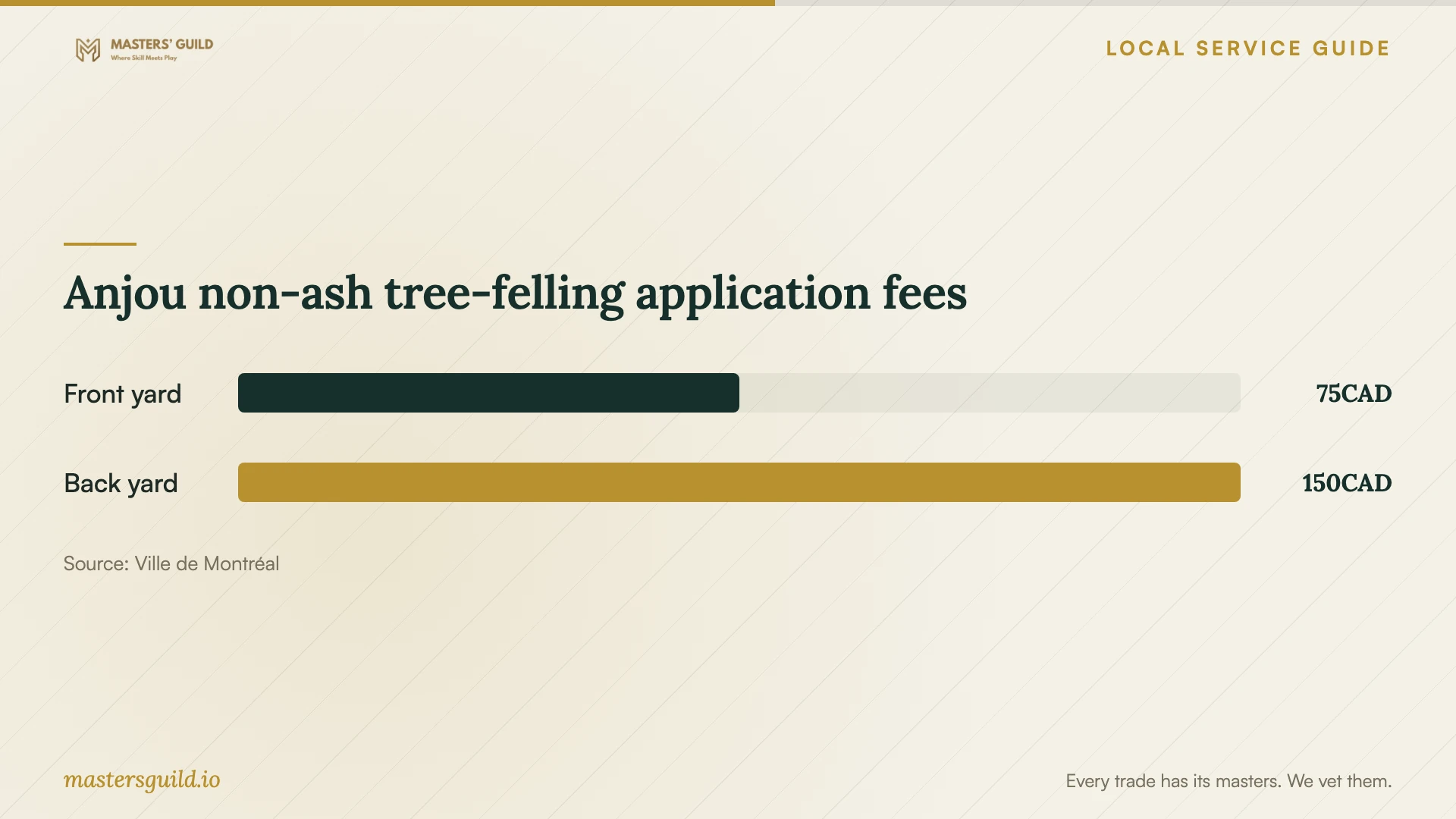
The Anjou fees shown in the chart are municipal felling-application charges. They do not establish the price of an arborist’s labour, equipment, disposal or stump work. Ask bidders to separate their service price from permit charges and any replacement planting. [1]
Anjou non-ash tree-felling application fees
Local details that affect your job
Plateau removal needs an expert report
Le Plateau-Mont-Royal requires an arboriculture or related-field expert report explaining the reason for removal. The borough states that a contractor quote does not count as a recognized expert report. Arrange that report before submitting the application. For public-space occupation, the borough requires receipt of the application at least 10 working days before work starts, so check staging needs while planning the removal. [1] [5]
Rosemont applicants should allow time for review
Rosemont–La Petite-Patrie publishes an indicative felling-application analysis time of six to eight weeks after applicants submit all required documents. The borough does not guarantee that timeframe. Arrange the application before committing to a fixed removal date, and ask the contractor how it handles scheduling if approval takes longer. [1]
Ash trees use a separate application route
Select your borough on the city’s ash-removal page before applying. For example, Anjou lists a free ash-felling permit and a six-month removal period after issuance. Replacement and subsidy conditions also need attention: the city explains that choosing self-funded replacement prevents access to the described felling-cost subsidy. Confirm your borough’s conditions before arranging planting. [4]
Verdun asks the contractor to apply for public-space use
In Verdun, when a contractor performs the work, the borough asks that contractor to submit the public-space occupation application rather than the client. It requires submission at least two working days before work begins and specifies Wednesday as the latest submission day for Monday work. Confirm that responsibility before the crew reserves equipment. [5]
Choose your next step before booking
| Your situation | Next step | Booking condition |
|---|---|---|
| You want removal because of leaves or shade | Ask about a suitable maintenance scope | The city lists these concerns as insufficient removal grounds |
| You need a removal report in Le Plateau-Mont-Royal | Arrange an accepted expert’s assessment | A contractor quote does not satisfy the report requirement |
| Work could approach a medium-voltage wire | Confirm Hydro-Québec involvement or contractor authorization | Apply the three-metre rule throughout the proposed work |
| The tree is an ash | Use the borough’s separate ash procedure | Confirm permit, deadline and replacement conditions |
| Equipment will occupy public space in Verdun | Have the contractor arrange the occupation application | Allow the borough’s required submission lead time |
Your hiring checklist
- Confirm the tree’s species and whether it stands within your property boundary.
- Photograph the whole tree, the concern and the equipment-access route from a safe position.
- Select your borough and ask which permit documents and expert credentials it accepts.
- Identify nearby wires and ask how the contractor will confirm any utility authorization.
- Check the assigned workers’ credentials and request insurance documentation.
- Compare written scopes covering stump work, hauling, cleanup and property protection.
- Assign responsibility for permits, street signs, municipal charges and replacement planting.
- Keep the authorization, quote and agreed completion conditions together before work begins.
Frequently Asked Questions
Can I remove a dead tree without a permit?
Do not assume that a dead tree is exempt. Montréal lists death as a possible justification for approval and instructs applicants to obtain authorization before proceeding. Select your borough to check the applicable threshold, documents and inspection process. [1]
Does a felling permit cover equipment on the sidewalk?
Check the separate public-space occupation requirements. Le Plateau-Mont-Royal states that applicants must request that permit in addition to permits for the work itself, including tree removal. Confirm the equipment location with your contractor before applying. [5]
Is a contractor quote enough for my permit application?
Le Plateau-Mont-Royal requires an expert report and states that a contractor quote does not count. Other boroughs specify their own report requirements and accepted experts. Ask your permit counter before commissioning the assessment. [1]
Can I hire someone to cut the tree beside the curb?
Confirm ownership first. The city prohibits private cutting of trees on public property, including the strip between the curb or sidewalk and your property line. The Lachine guidance directs readers to call 311 when a public tree needs attention. [1]
Sources and scope
This guide combines the sources below with practical planning guidance. Figures apply to the stated geography and period; request a written quote for your property.