
Local service guide
Mobile, AL tree cutting: permits and hiring
Before arranging tree cutting in Mobile, AL, check whether the tree stands in the public right-of-way and whether your property lies in a historic district. Those details affect permit requirements. Request arborist credentials, a written scope and debris removal. For work around power lines, contact Alabama Power for an evaluation; the utility says only line-clearance qualified personnel should perform tree work around or adjacent to power lines and electrical equipment. [1] [2] [3]
Check the tree's location before booking
Mobile considers trees in the city right-of-way or on city-owned property to be city trees. Urban Forestry responds to requests for trimming, removal and stump removal, prioritizing public safety. Report a city-tree issue through Mobile 311 at 251-208-5311 during normal business hours. For an after-hours emergency such as a tree blocking a roadway, the City lists Mobile Police at 251-208-7211. [2]
To hire your own arborist to trim or remove a right-of-way tree, obtain a Mobile Tree Commission permit and use a properly certified, licensed and bonded arborist. Ask Urban Forestry to clarify the tree's location before approving a contractor's start date. [2]
Match the permit rule to your property
For developed residential sites outside historic districts, Mobile requires no permit for trees outside the public right-of-way. Inside historic districts, it requires a permit to trim or remove a Heritage Tree measuring at least eight inches in diameter at breast height, abbreviated DBH. Ask the arborist to identify the species and measure the diameter before deciding whether to apply. [1]
On undeveloped residential sites outside historic districts, the City requires a permit for trimming or removing a live oak measuring at least 18 inches DBH. Within historic districts, the eight-inch Heritage Tree threshold applies to undeveloped residential sites too. Check this classification if you are clearing a vacant lot. [1]
The City's Heritage Tree list includes hickory, longleaf pine, magnolia, oak other than water oak, river birch, sweet gum, sycamore and yellow poplar. Its permit page directs residents to My Place for an address-based zoning and historic-district check. Confirm the address classification and species before authorizing cutting. [1]
Choose an arborist for the work you need
Have each bidder explain whether they recommend pruning, removal or an assessment before cutting. Request a description of the branches or trees involved and the reason for the proposed work. If you want to retain the tree, discuss the options and their limitations before you authorize removal.
Alabama's regulator issues Horticulture Professional Services Licenses to businesses engaging in and soliciting Tree Surgery and other listed horticultural categories. Those businesses must have a certified operator for the corresponding category. The regulator states that licenses renew annually, with the license period beginning October 1 and expiring September 30. Request the firm's current license and operator information relevant to your scope. [5]
Mobile identifies ISA certification as an arborist credential and directs readers to the ISA arborist directory for credential checks. Ask who will assess your tree and who will supervise the crew. Request proof of liability coverage and discuss how the contractor covers workers and subcontractors. Keep those documents with the written quote. [2]
Resolve electrical hazards before cutting
Alabama Power says trees and limbs can conduct electricity when they contact power lines. If you see a fallen tree touching a line or a downed line, stay away and contact the utility. Assume the downed line is energized. Do not touch it, drive over it or climb a tree near power lines. [3]
For planned work around or adjacent to power lines, request an Alabama Power evaluation. Alabama Power says only line-clearance qualified personnel should perform tree work around or adjacent to power lines and electrical equipment. Discuss utility coordination with your contractor before agreeing to cutting near electrical equipment. [3]
After emergency utility clearance, arrange the remaining cleanup. Alabama Power states that when it cuts trees and brush to restore facilities after severe weather or other natural events, the property owner bears responsibility for disposing of the resulting wood, limbs and debris. Request a separate disposal quote if the utility has completed clearance. [3]
Compare complete quotes and plan the application
Give bidders the same tree list and photographs. Have each quote specify pruning or removal, equipment access, protection for fences and planting beds, stump work, haul-off and final cleanup. For stump work, agree on grinding depth, treatment of chips and who will restore the ground. Review exclusions before comparing totals.
Mobile makes a paid tree trimming or removal contractor responsible for collecting its debris and taking it to the landfill. Leaving contractor debris at the curb for routine City pickup does not meet that rule. Put debris removal in the agreement and identify any wood you want to keep. [4]
For a required permit, use Build Mobile's Customer Self Service portal, choose Apply, search for tree and select the right-of-way or private-property application. The City says a new account may take up to 24 hours for approval before you can complete the application. Urban Forestry then inspects the proposed work and issues or denies the permit based on its findings. Allow for that process before committing to a cutting date. [1]
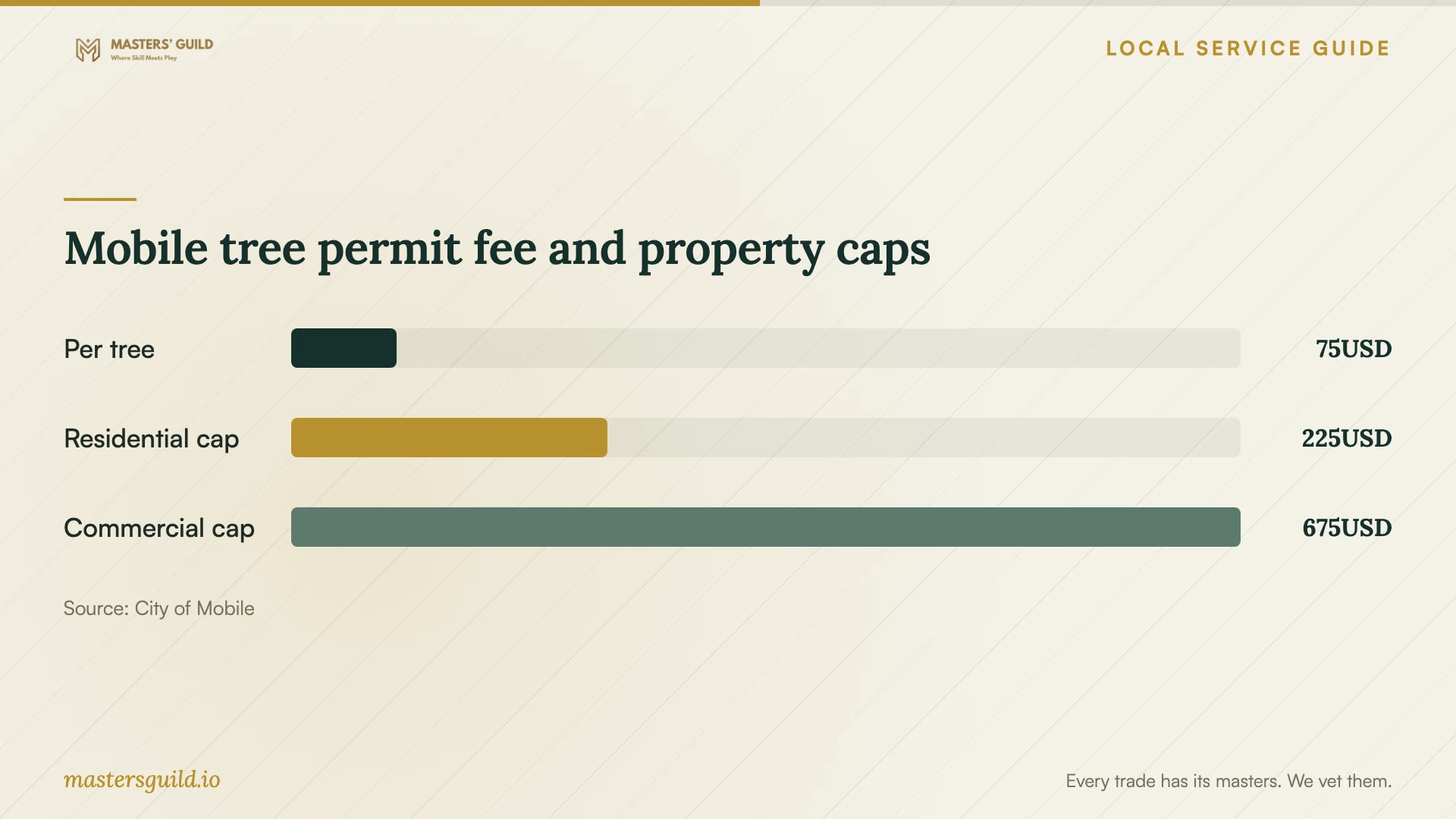
Mobile tree permit fee and property caps
Local details that affect your job
Historic status changes the permit check
Use the City's My Place address lookup before booking. A Heritage Tree on a developed residential lot within a historic district needs a trimming or removal permit at eight inches DBH. On a developed residential lot outside a historic district and outside the public right-of-way, the City requires no tree permit. [1] [2]
Contractor debris needs contractor disposal
Mobile assigns collection and landfill disposal of paid tree-service debris to the contractor. Require haul-off in the quote rather than budgeting around routine municipal curbside collection. [4]
City-tree requests have a separate route
For a tree in the city right-of-way, request Urban Forestry service through Mobile 311. If you arrange private trimming or removal instead, obtain a Mobile Tree Commission permit and use a certified, licensed and bonded arborist. [2]
Choose your first step before hiring
| Situation | First step | Booking implication |
|---|---|---|
| Tree in the city right-of-way | Request Urban Forestry assessment through Mobile 311. | Private trimming or removal needs a Tree Commission permit and a certified, licensed and bonded arborist. |
| Developed residential lot outside a historic district | Confirm the tree is outside the public right-of-way. | The City requires no tree permit under this residential rule. |
| Heritage Tree on residential property in a historic district | Have the arborist confirm species and DBH. | Trimming or removal requires a permit at eight inches DBH or greater. |
| Undeveloped residential lot outside a historic district | Check whether the tree is a live oak and measure DBH. | Trimming or removal of a live oak at least 18 inches DBH requires a permit. |
| Tree touching a power line | Stay away and contact Alabama Power. | Alabama Power says only line-clearance qualified personnel should perform tree work around or adjacent to power lines and electrical equipment. |
Your hiring checklist
- Photograph the tree and surrounding roof, fence, driveway and overhead wires from a safe location.
- Clarify the property boundary, right-of-way location and historic-district status with the City.
- Have the arborist identify the species and measure its diameter for the permit check.
- Request current credentials, insurance documents and the name of the person supervising the crew.
- Give each bidder the same pruning or removal scope, including stump work and debris disposal.
- Assign responsibility for the permit application and obtain confirmation of approval before scheduling work that needs a permit.
- Agree on access, items to move, wood to retain and the condition you expect after cleanup.
Frequently Asked Questions
Do I need a permit to prune a tree at my home?
Mobile requires a permit for pruning, moving or removing any tree in the public right-of-way. On developed residential property outside historic districts and outside the right-of-way, it requires no tree permit. On residential property within a historic district, trimming or removal of a Heritage Tree needs a permit at eight inches DBH or greater. [1]
How much should I budget for a tree permit?
Mobile publishes a $75 per-tree fee, capped at $225 for residential property and $675 for commercial property. These amounts cover permit fees. Request separate contractor quotes for cutting, equipment, stump work and disposal. [1]
Can my contractor leave the limbs for City pickup?
Mobile requires paid contractors to collect and remove the debris from their work and take it to the landfill. Include that responsibility in the written agreement, with any wood you want to retain identified before cutting. [4]
Will Alabama Power remove all debris after storm clearance?
For emergency operations following severe weather or other natural events, Alabama Power assigns disposal of the resulting wood, limbs and debris to the property owner. Arrange cleanup after the utility has addressed the electrical hazard. [3]
Sources and scope
This guide combines the sources below with practical planning guidance. Figures apply to the stated geography and period; request a written quote for your property.