
Local service guide
Website design in Minneapolis: Hiring and Planning
Arrange website design in Minneapolis by giving designers the same written brief: what customers should do, which pages and integrations you need, who supplies content, and what you expect at handover. Compare the initial build and ongoing charges separately. Before commissioning work, investigate the City's business consulting program, include accessibility testing, and decide which privacy features your business needs. [1] [2] [3]
Prepare a brief around customer tasks
Choose the main action you want a visitor to complete: call, request an estimate, book an appointment or buy a product. Give designers the steps that action requires. For a shop, specify product information and pickup instructions. For an appointment business, identify the booking system and the information customers must provide.
List the pages, languages, photographs and text you want at launch. Assign someone to supply and approve each item. Ask the designer to identify dependencies before agreeing to a launch date, including access to existing accounts and approval of payment or booking integrations.
For a redesign, inventory the current pages and download your content before work starts. Ask for a written plan for old page addresses, form submissions and business email. Set an acceptance condition that the designer must demonstrate those functions before switching the public site.
Compare proposals using the same scope
Request separate prices for design, implementation, content work, integrations, migration and training. Ask each designer to name the platform and explain how you will edit it. Require a list of exclusions, revision rounds, payment milestones and charges for changes after approval.
Ask for a recurring-cost schedule covering hosting, domain renewal, software subscriptions and support. Identify who pays each supplier and controls each account. Request itemized taxes rather than assuming one tax treatment covers the entire proposal.
Use a demonstration to assess a portfolio. Ask the designer to show a comparable customer task on a live site and explain their contribution. Then ask them to demonstrate how you would change opening hours, replace an image and respond to a failed form submission.
Make accessibility part of acceptance
The Department of Justice states that ADA requirements apply to goods and services offered online by businesses open to the public. Its guidance identifies barriers such as poor contrast, missing image descriptions, mouse-only navigation and inaccessible forms. Ask the designer to include these checks in the project scope. [3]
Before accepting the site, try the main customer task using a keyboard. Enlarge the text, inspect image descriptions and submit a form with a missing required field. Ask the designer to show how a screen-reader user receives the error message and knows how to correct it. [3]
Request both manual testing and an automated accessibility report. DOJ cautions that a clean automated report does not establish that everything is accessible. Put responsibility for correcting identified barriers and handling future accessibility reports in the agreement. [3]
Scope privacy features before adding tracking
Minnesota's Consumer Data Privacy Act applies to certain entities doing business in the state or targeting its residents, subject to thresholds and exclusions. The law excludes qualifying SBA-defined small businesses from most provisions, but section 325M.17 prohibits them from selling a consumer's sensitive data without prior consent. Confirm your business's classification before requesting a standard compliance package. [2]
For businesses subject to the relevant controller requirements, the statute calls for an accessible privacy notice, a conspicuous homepage privacy link and mechanisms for exercising consumer rights. Additional opt-out duties concern activities such as targeted advertising and personal-data sales. Ask a qualified adviser to identify applicable duties, then have the designer price the implementation. [2]
Prepare an inventory of forms, analytics, advertising tools and booking providers. Record what information you collect, who receives it and who can delete it. Ask the designer to explain each proposed tracking tool before you authorize installation, and assign responsibility for maintaining the privacy text after launch.
Agree on launch and handover
Write a launch test that follows a customer's full journey. Check contact details, opening hours, mobile layouts, submissions, confirmation messages and purchases or bookings where relevant. For a redesign, also test the agreed treatment of old page addresses and confirm that business email still works.
Require account access, backups, editing instructions and a list of subscriptions at handover. Specify which design files and content you receive and which third-party licenses you must maintain. Agree on the support period, response arrangements and the cost of later updates before making the final payment.
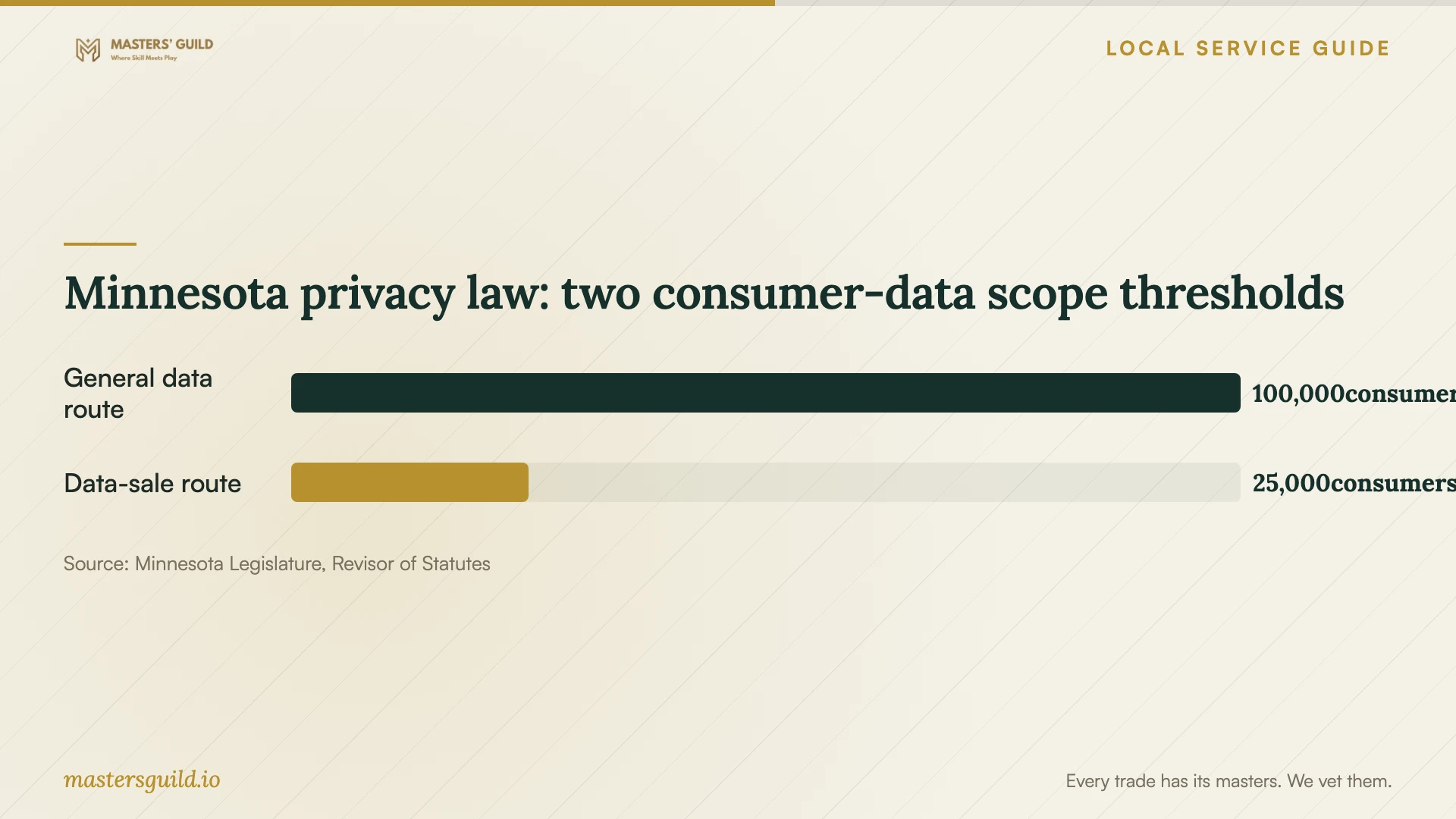
Minnesota privacy law: two consumer-data scope thresholds
Local details that affect your job
Use Minneapolis business assistance before buying
The City's Business Technical Assistance Program offers up to 50 hours of no-cost consulting, with marketing plans among its listed areas of help. Contact the Small Business Team at 612-673-2499 to ask about a suitable consultant and current participation requirements. Use that conversation to clarify your audience and marketing priorities before requesting design proposals. The page describes consulting assistance; it does not promise a free website build. [1]
Check Minnesota's small-business privacy distinction
For a Minneapolis business serving Minnesota consumers, distinguish the Act's general scope from its specific small-business rule. Section 325M.12 includes an exclusion for SBA-defined small businesses, while section 325M.17 still requires prior consent before selling consumers' sensitive data. Ask an adviser whether your business qualifies and whether your proposed tools involve such sales before approving privacy features or tracking integrations. [2]
Choose the scope before choosing a designer
| Your situation | Scope to request | Evidence to request before acceptance |
|---|---|---|
| You need customers to call or inquire | A focused site with contact information and an inquiry route | A mobile demonstration and a successful test inquiry |
| You need appointments or online sales | Design plus the named booking or payment integration | A complete test booking or order, including confirmation |
| You are replacing an existing site | Content migration, old-address handling and launch coordination | A migration inventory and checks of agreed old addresses |
| Your business serves the public | Accessibility review of the customer journey | Manual keyboard and form checks plus an automated report |
| You collect consumer data or add advertising tools | An applicability review followed by agreed privacy implementation | An inventory of tools, data recipients and approved privacy features |
Your hiring checklist
- Write the main customer action and list the pages and integrations needed to complete it.
- Ask the Minneapolis Small Business Team about consulting help with your marketing brief.
- Give each designer the same content, migration and training requirements.
- Request separate build charges, recurring charges, exclusions and payment milestones.
- Confirm who controls the domain, hosting, platform and payment accounts.
- Assign privacy review and approve tracking tools before installation.
- Require manual accessibility checks alongside automated testing.
- Complete the agreed customer-task tests and collect handover materials before final acceptance.
Frequently Asked Questions
How much should I budget for the site?
Request written quotes against a shared scope rather than choosing a budget from an unsupported local average. Separate the initial build from recurring subscriptions and support. If proposals differ, ask each designer to identify the pages, integrations, content work and testing included in their price.
Can Minneapolis help me plan the project?
The City's BTAP program offers up to 50 hours of no-cost business consulting, including marketing planning. Ask the Small Business Team about current participation requirements and a consultant suited to your needs. Confirm what help is available before assuming the program will fund or build your website. [1]
Does a small business need the same privacy features as a larger company?
The Minnesota statute includes thresholds and exclusions, including an exclusion for qualifying SBA-defined small businesses from most provisions. Those small businesses remain subject to the sensitive-data sale consent rule in section 325M.17. Have an adviser assess your business and data practices before approving the design scope. [2]
Is an automated accessibility report enough?
DOJ recommends pairing automated tools with manual checks and cautions that a clean report does not mean everything is accessible. Ask the designer to demonstrate keyboard navigation, form labels and errors, text enlargement and the main customer task before you accept the site. [3]
Sources and scope
This guide combines the sources below with practical planning guidance. Figures apply to the stated geography and period; request a written quote for your property.