
Local service guide
Minneapolis office relocation and setup guide
For office relocation in Minneapolis, hire against a written inventory, confirmed loading access at both buildings, and a defined setup scope. Assign truck parking before booking: the City's ROWay system says residents or moving companies must secure parking for commercial moves because the City does not post temporary no-parking signs for them. Separate furniture handling, IT reconnection, and electrical installation in the quote, with a named person responsible for each handover. [2]
Choose a mover against a defined scope
List desks, chairs, cabinets, meeting-room furniture, boxed files, printers, and equipment. Flag items that need disassembly, specialist handling, or secure custody. Give bidders photographs and a destination floor plan with workstation labels. Ask them to inspect both sites or identify the access assumptions behind their quote.
Ask who supplies crates, packs monitors, empties cabinets, reassembles desks, and collects packing materials. Specify whether the crew must place items at assigned stations or leave them in a staging area. Request proof of insurance, written damage terms, and the name of the crew supervisor. Ask who handles a claim involving a subcontractor.
Confirm truck access at both addresses
Ask each building manager to confirm the loading location, freight-elevator reservation, permitted truck dimensions, access hours, and protection for floors and doors. Walk the route from the truck to the office. Send the mover photographs of stairs, thresholds, tight turns, and restrictions the manager identifies.
Minneapolis requires an obstruction permit to block public right-of-way, including streets, sidewalks, alleys, and parking lanes. The City also requires the permit for meter hooding and parking vehicles in a blocked area. Apply through ROWay. The permit itself has no cost, but separate charges may apply for lane closures, meter hooding, lost meter revenue, and traffic-control agents. [1]
Keep sign application timing separate from sign posting notice. The City's general page specifies 48 hours' notice for posting no-parking signs. ROWay requires temporary no-parking-sign applications at least seven business days before the permit start time, subject to Sign Shop availability. That application deadline concerns signs, not all obstruction permits or meter hooding. ROWay also says the City will not post temporary no-parking signs for residential or commercial moves. Ask the permitting team to confirm the approved access option for your move. [1] [2]
Assign IT setup and electrical work
Assign physical transport and furniture tasks to the mover. Name an IT contact for backups, shutdown, equipment labeling, reconnection, and testing. Agree on custody arrangements for computers and sensitive files. Ask the IT contact to test internet service, phones, printers, and business applications before staff return. Include a fallback work arrangement if testing reveals an unresolved problem.
For new outlets, circuits, or other wiring work, consult an electrical contractor and use Minnesota DLI's license-check resources. DLI licenses electrical contractors and provides permit and inspection resources. Its guidance says electrical permits filed on or after August 17, 2026 must comply with the 2026 National Electrical Code. [3]
Include inspection scheduling in the move plan. Minnesota Rule 3801.3780 requires installers to schedule final inspection of permitted electrical work before the intended user uses the wiring and occupies the associated space. Ask the contractor and inspector to confirm your project's installation, inspection, and occupancy sequence before you announce the staff return date. [4]
Compare quotes and agree on completion
Request a written quote that separates labor, trucks, packing materials, assembly, storage, IT tasks, and access charges. Ask whether the provider quotes a fixed price or bills by time. Confirm charges for waiting, extra trips, changed inventories, and after-hours work. Agree on who can approve additional work and require written approval before the crew proceeds.
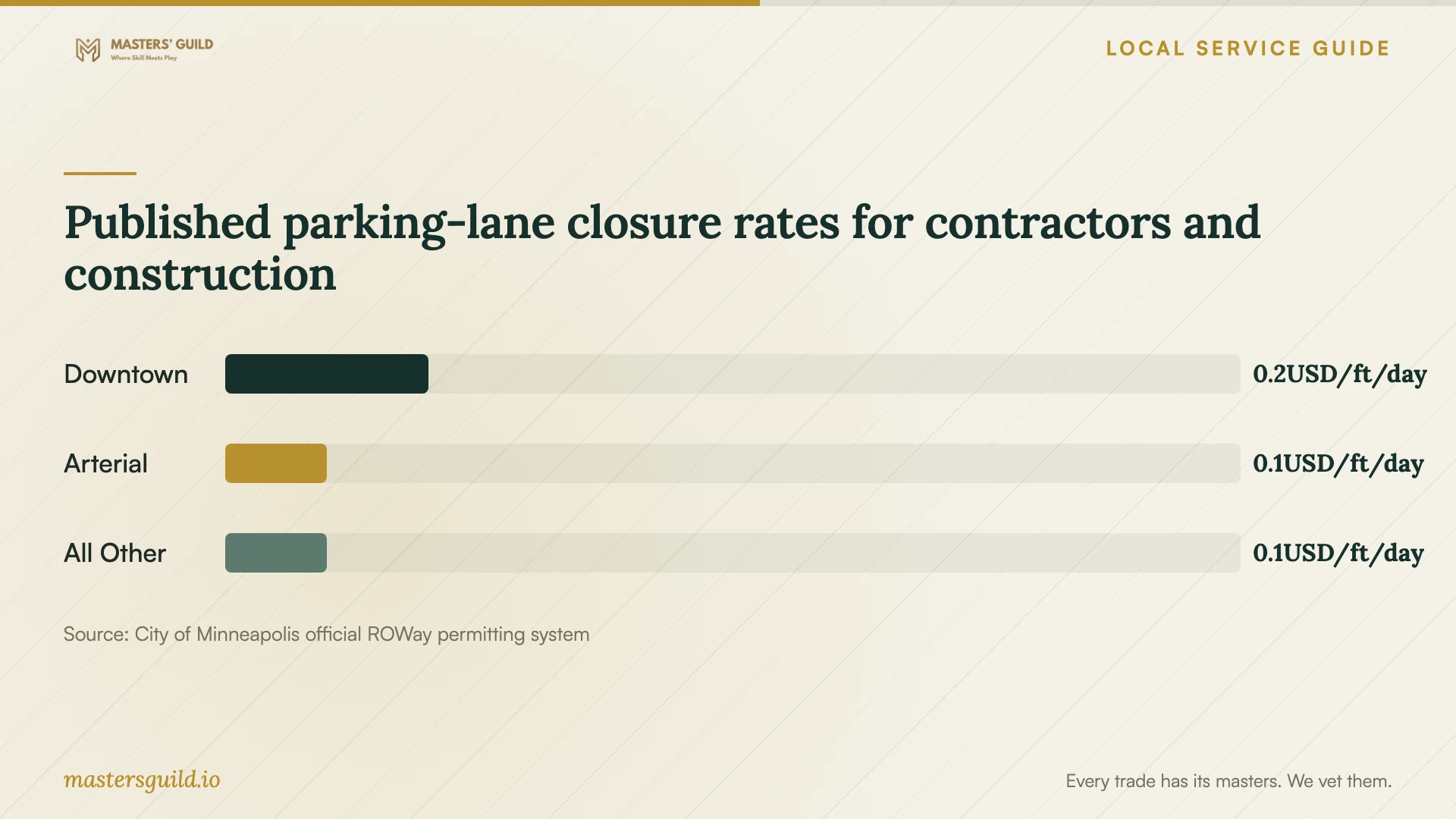
Use the chart as a reference for discussing lane closures associated with office fit-out work. ROWay labels these rates for contractors and construction; confirm applicability with the City before budgeting them for your move. They do not establish a mover's price. ROWay lists meter hooding separately at $25 per meter per day. [2]
At handover, walk the office with the crew lead. Compare furniture placement, assembled items, equipment counts, and visible damage against your inventory. Record outstanding work and agree on who will finish it. Ask the IT contact to sign off on reconnection and testing as a separate task.
Published parking-lane closure rates for contractors and construction
Local details that affect your job
Commercial-move parking is your responsibility
Minneapolis ROWay says the City will not post temporary no-parking signs for commercial moves and assigns parking responsibility to the resident or moving company. Name a parking coordinator and ask the obstruction permitting team to confirm an approved arrangement. The general sign-posting guidance does not establish a parking reservation for your move. [1] [2]
Check weekend and early-Monday hooding
ROWay says the City does not hood or unhood meters on Sundays or listed holidays. Saturday hooding incurs Sunday charges unless the application specifies Saturday removal after noon. For early Monday access, ROWay instructs applicants to select Sunday as the start date and pay for Sunday; normal Monday hooding occurs from 7:30 to 9 a.m. Match the application dates to your loading window. [2]
Coordinate Minnesota electrical inspection scheduling
For permitted wiring, Minnesota requires installers to schedule final inspection before intended use of the wiring and occupation of the associated space. Ask your electrical contractor to coordinate that milestone with the inspector. Keep it in the staff-return plan alongside furniture delivery and IT testing. [4]
Choose the arrangement that fits your move
| Your situation | Arrange | Confirm before booking |
|---|---|---|
| Furniture and boxed contents need transport | A mover with an itemized handling and assembly scope | Inventory, loading route, crew responsibilities, and damage terms |
| Computers and business systems need reconnection | A mover plus a named IT contact | Shutdown, custody, reconnection, and acceptance tests |
| The truck needs hooded public parking meters | An obstruction permit and a parking coordinator | Approved location, hooding dates, and meter charges |
| The layout needs new electrical wiring | An electrical contractor and inspection coordination | License check, permit requirements, and project sequence before use and occupancy |
| Part of the business must keep operating | A phased move proposal | Workstation order, temporary operations, and testing between phases |
Your hiring checklist
- Send bidders one inventory, photographs, and a labeled destination floor plan.
- Confirm loading locations, elevator reservations, access hours, and floor protection at both buildings.
- Assign a parking coordinator to confirm the approved public-space access arrangement.
- Identify who handles packing, disassembly, assembly, storage, and packing-material removal.
- Name an IT contact for backups, shutdown, custody, reconnection, and testing.
- Ask the electrical contractor and inspector to confirm the sequence before staff return.
- Agree on insurance documentation, damage reporting, and written approval for extra work.
- Check the inventory and outstanding tasks with the crew lead at handover.
Frequently Asked Questions
Does an office move require a Minneapolis obstruction permit?
The City requires the permit when you block public right-of-way, including streets, sidewalks, alleys, and parking lanes, or hood parking meters. Describe your truck location and loading plan to the permitting team. Ask the building manager to confirm private loading arrangements. [1]
Will the City post no-parking signs for our move?
ROWay says the City does not post temporary no-parking signs for residential or commercial moves. It assigns parking responsibility to the resident or moving company. Confirm an approved access arrangement before you book the crew. [2]
How much should I budget for the whole relocation?
Request an itemized quote based on your inventory, access, packing, assembly, and IT scope. The supplied City sources do not establish a total office-moving price. ROWay lists meter hooding at $25 per meter per day, with scheduling conditions that can add days. Ask bidders to separate City charges from their own fees. [2]
Who should handle new outlets during setup?
Consult an electrical contractor and check the contractor through DLI's licensing resources. For permitted work, Minnesota requires installers to schedule final inspection before intended wiring use and occupation of the associated space. Confirm the project sequence with the contractor and inspector. [3] [4]
Sources and scope
This guide combines the sources below with practical planning guidance. Figures apply to the stated geography and period; request a written quote for your property.