
Local service guide
Plan tree cutting in Lubbock: Hiring an Arborist
Arrange tree cutting in Lubbock by identifying the tree's location, asking an arborist whether pruning can meet your goal, and getting a written scope for cutting, hauling and stump work. Check with Parks and Recreation before arranging work on a parkway or city-owned tree because the city has authority over those trees. Texas A&M Forest Service recommends a certified arborist for work above ground or involving power tools. [1] [3]
Choose an assessment, pruning or removal
Describe the problem before requesting removal: a dead branch over the driveway, branches rubbing the roof, poor clearance or concern about the tree's condition. Ask the arborist to identify the branches that need attention and explain how the proposed work addresses your concern. If you want to retain the tree, put that preference in the job description.
Texas A&M Forest Service identifies dead-branch removal, structural improvement and risk reduction as reasons to prune mature trees. It cautions that removing too many leaves reduces growth and energy reserves, and advises against removing more than 25% of the crown at one time. Treat that limit as a ceiling in the guidance, rather than a target for your tree. [3]
For a removal proposal, ask why pruning would not meet your goal and request an explanation of the work sequence. Have the contractor identify the equipment access route, nearby structures and areas you should keep clear. Request an assessment before committing if the reason for removal remains unclear.
Resolve street and public-tree questions first
Lubbock's tree ordinance gives the director of Parks and Recreation authority over trees in parkways, parks and city-owned land open to the public. The city or its agent can maintain or remove vegetation in public rights-of-way. If you cannot establish whether the tree stands on private property, ask Parks and Recreation to clarify responsibility before the crew cuts it. [1]
Ask who will confirm city requirements and keep that confirmation with the scope. The cited ordinance addresses public-tree authority and tree-care restrictions; it does not establish a blanket permit answer for every private-yard removal. Avoid treating the contractor's quote as confirmation of permission to work on a public tree. [1]
Specify cuts and timing
Ask the arborist to describe the intended cuts before accepting a broad instruction such as trimming the whole tree. Texas A&M Forest Service advises cutting outside the branch collar, the swollen area where a branch meets the trunk, and avoiding cuts flush with the trunk. For branch shortening, its guidance calls for a lateral branch at least one-third the size of the branch being removed. [3]
State guidance allows most routine pruning to remove weak, diseased or dead branches at any time of year. It advises avoiding heavy live-branch pruning after the spring growth spurt, especially on stressed trees. It also advises avoiding oak pruning from February through June because oak wilt can spread through pruning wounds. Ask the arborist to identify the species and explain the timing for your tree. [3]
Texas A&M Forest Service advises painting pruning cuts on all oak trees immediately to help prevent oak wilt spread. Its guidance says other tree types do not need pruning wound paint. Include the species and agreed wound treatment in the scope so the crew knows what you expect. [3]
Compare complete quotes
Send each bidder the same photographs and description. Ask them to price assessment, pruning or removal, hauling, stump work and site restoration as distinct items. Specify whether you want wood left on site, chips removed, a stump ground or a planting area restored. Compare the completed job each bidder proposes.
Ask who will assess the tree and who will perform the work. Request certification details and evidence of liability insurance, then check that the named person and business match your proposal. Texas A&M Forest Service recommends a certified arborist for work above ground or involving power tools and notes that an arborist can bring a trained crew, safety gear and liability insurance. [3]
Agree on access, protection of fences and irrigation, weather rescheduling, payment stages and cleanup before work begins. Obtain a quote based on a site visit, and ask the contractor to explain any allowance or possible extra charge before you accept it.
Plan care and cleanup after cutting
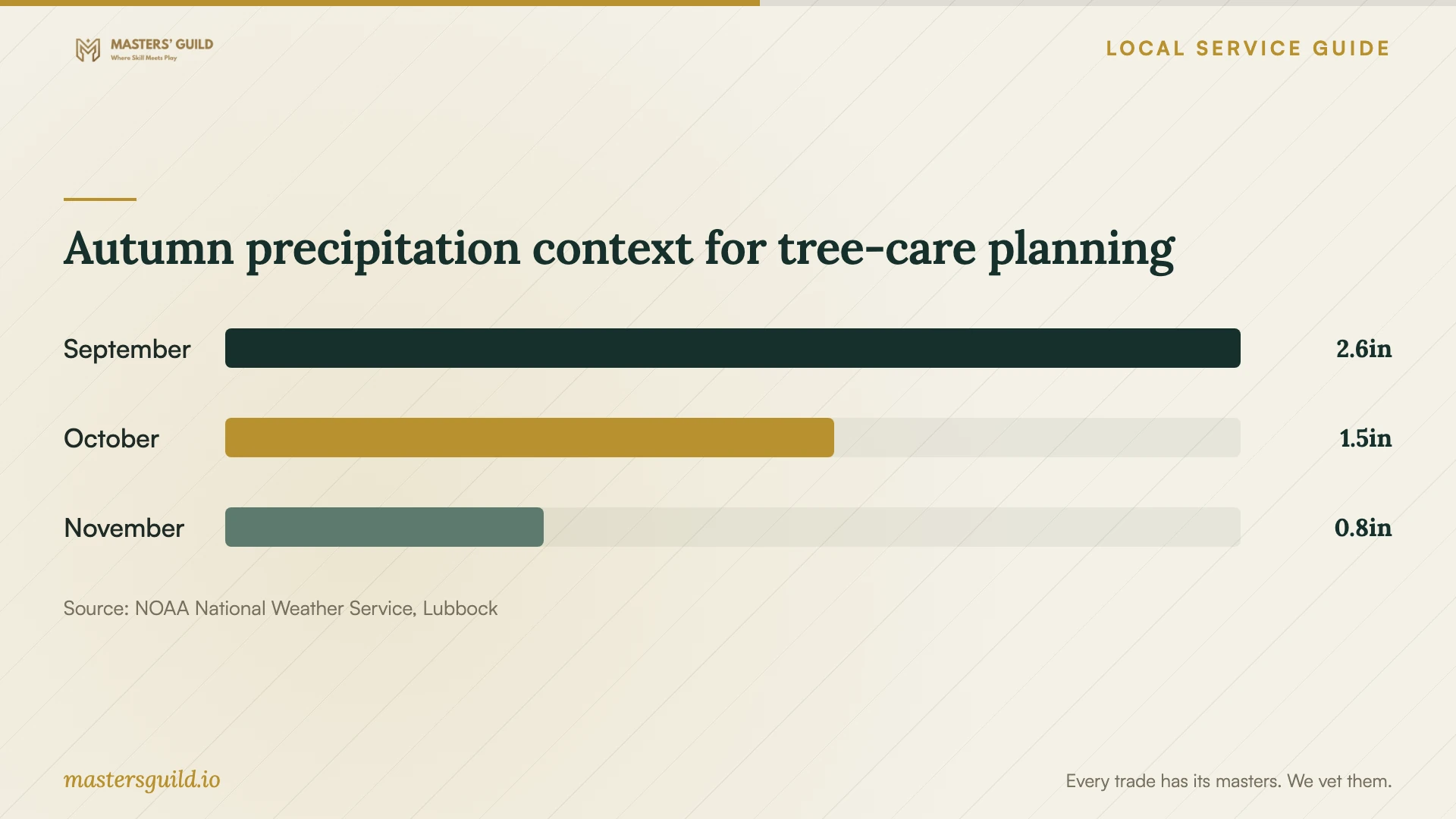
Ask whether the retained tree needs a follow-up visit and request a watering recommendation based on its species, condition and your irrigation setup. Lubbock International Airport's 1991–2020 climate normals report 18.33 inches of annual precipitation. Use that context to start a watering discussion; the station average cannot determine the needs of a particular yard or tree. [2]
Before signing off, walk the site with the contractor. Compare the finished cuts and cleanup with the agreed scope, check the access route and discuss any remaining stump or ground-restoration work. Keep photographs and the final invoice for future tree-care discussions.
Autumn precipitation context for tree-care planning
Local details that affect your job
Clearance over streets and sidewalks
Lubbock requires owners of trees overhanging a street, roadway or parkway to maintain six feet of clear space above the adjacent street, curb or sidewalk. Owners must also prevent branches from blocking streetlamps, intersection views and traffic-control signs or devices. Tell the arborist which public clearance issue you need addressed and include it in the pruning scope. [1]
Public-tree topping restrictions
The city prohibits topping street trees, park trees and other trees on public property. Its definition includes severe cutting to stubs larger than three inches in diameter within the crown, to a degree that removes the normal canopy and disfigures the tree. The director of Parks and Recreation may determine written exemptions for specified storm-damage or obstruction cases. Clarify public-tree status before accepting a topping proposal. [1]
Street and park stump completion
For street and park trees, Lubbock requires stump removal to six inches below ground and soil replacement to match the adjacent grade. If your job involves one of these trees, include depth and soil backfill in the written scope. This provision does not establish a required grinding depth for every private-yard stump. [1]
Match the job to the next step
| Situation | Next step | Detail to confirm |
|---|---|---|
| You want to keep a mature tree | Request a pruning assessment | Ask how the crew will minimize healthy-canopy removal; state guidance advises removing no more than 25% at one time. |
| Tree stands in a parkway or public right-of-way | Clarify responsibility with Parks and Recreation | Confirm city requirements before arranging private cutting. |
| Branches obstruct a sidewalk or street view | Request a clearance-focused scope | Address the city's six-foot clearance and visibility requirements. |
| An oak needs pruning | Discuss timing and wound treatment | State guidance advises avoiding February through June and painting oak pruning cuts. |
| A street or park tree needs stump removal | Specify depth and backfill | City code requires removal six inches below ground and soil backfill to the adjacent grade. |
Your hiring checklist
- Photograph the whole tree, the problem branches and the equipment access route.
- Clarify ownership and responsibility if the tree stands beside a street or on a parkway.
- Ask the assessor to identify the species and explain the proposed work.
- Request certification details and evidence of liability insurance.
- Compare quotes covering the same cuts, hauling, stump work and ground restoration.
- Agree on access protection, rescheduling and payment stages.
- Inspect the completed scope with the contractor before final sign-off.
Frequently Asked Questions
Do I need city permission to remove a tree?
Establish where the tree stands first. Lubbock gives Parks and Recreation authority over trees in parkways, parks and city-owned land open to the public. Ask the city to clarify requirements for those locations. The cited ordinance does not give a universal permit answer for private-yard removals. [1]
Can I ask the crew to cut the canopy back hard?
Ask for a pruning plan tied to your goal. Texas A&M Forest Service warns against excessive canopy removal and advises removing no more than 25% at one time. Lubbock also prohibits topping public trees, subject to specified written exemptions. [1] [3]
Should tree removal include stump grinding?
Specify it in the quote rather than assuming the crew will include it. Agree on depth, chip removal and soil restoration. Street and park tree stumps have a local requirement: removal six inches below ground and soil backfill to the adjacent grade. [1]
What should I ask before scheduling oak pruning?
Confirm the species, proposed date and wound treatment. Texas A&M Forest Service advises avoiding oak pruning from February through June and painting pruning cuts immediately to help prevent oak wilt spread. [3]
Sources and scope
This guide combines the sources below with practical planning guidance. Figures apply to the stated geography and period; request a written quote for your property.