
Local service guide
Pest Control Services in Louisville, KY
To arrange Pest Control Services in Louisville, start with an inspection, ask who will apply pesticides and which Kentucky license category covers the work, and request a written treatment and follow-up plan. Kentucky distinguishes structural pest management from structural fumigation. For termite or other wood-destroying-organism treatment, ask for the property-owner treatment drawing required by state regulation. [1] [2]
Describe the problem before choosing treatment
Tell the provider what you have seen, where you have seen it, and when you first noticed it. Send clear photos if you can take them without disturbing a nest or entering an unsafe space. Describe affected rooms, accessible basement or crawlspace areas, and any treatment you have already tried. Ask the inspector to identify the pest before you approve a treatment.
Ask the inspector to explain the evidence behind the recommendation and separate pest control from building repairs. Kentucky's structural pest management competency standards include integrated pest management, with sanitation, structural repair, mechanical controls, education, and pesticide application among its possible components. Use that framework to ask which steps you can handle and which steps the provider proposes to include. [1]
Check Kentucky credentials for the actual job
Ask for the operator's or applicator's name, current Kentucky credential, and category. The state regulation requires covered pesticide operators and applicators to hold certification and licensing consistent with the application, with an exception for a registered trainee under direct supervision. If the company sends a trainee, ask it to identify the supervising license holder and explain the supervision arrangement. [1]
For household pest work involving pesticides other than fumigants, ask about the structural pest management category. Kentucky places structural fumigation in a separate subcategory that includes structures intended for human occupancy. If someone proposes fumigation, ask for that specific credential and a written explanation of preparation, access restrictions, and return arrangements before you book. [1]
Ask for proof of liability insurance alongside the credentials. Match the business name on your proposal to the documents the provider supplies, and resolve any mismatch before agreeing to work. Keep copies with the inspection findings and treatment plan.
Compare scope, price, and follow-up
Request a quote based on the identified pest and proposed treatment area. Have the provider list inspection charges, treatment charges, included return visits, and any separate repair or exclusion work. For a recurring plan, ask for the payment schedule, minimum commitment, cancellation terms, and pests excluded from coverage. Compare the total commitment rather than the first visit alone.
For suspected termites or other wood-destroying organisms, ask the provider to explain the proposed treatment boundaries and any inaccessible areas. Kentucky requires a graph at the time of treatment for control or prevention of wood-destroying organisms. That drawing must identify the structure, approximate dimensions, visible activity and damage, and treatment locations, including partial treatments. Review it alongside any written warranty or retreatment terms. [2]
Agree on how you will judge progress. Ask which signs to record, when the provider wants an update, and what triggers another inspection or visit. Have the company explain whether a return visit falls within the quoted scope. Keep a dated record of sightings so you can describe changes without guessing.
Prepare access and discuss outdoor conditions
Get preparation instructions before moving furniture, washing belongings, or clearing storage. Tell the provider about children, pets, aquariums, and rooms you cannot vacate. Ask for the product names, application locations, and written instructions for leaving and returning to treated areas. Kentucky's certification standards require applicators to understand and comply with pesticide label restrictions and directions. [1]
For outdoor work, point out drains, water features, and areas where water collects. Ask the provider how site conditions affect the proposed application and whether weather could change the appointment. Kentucky's competency standards cover weather, drainage patterns, and non-target organisms. These are useful subjects to discuss when someone proposes treatment around your home. [1]
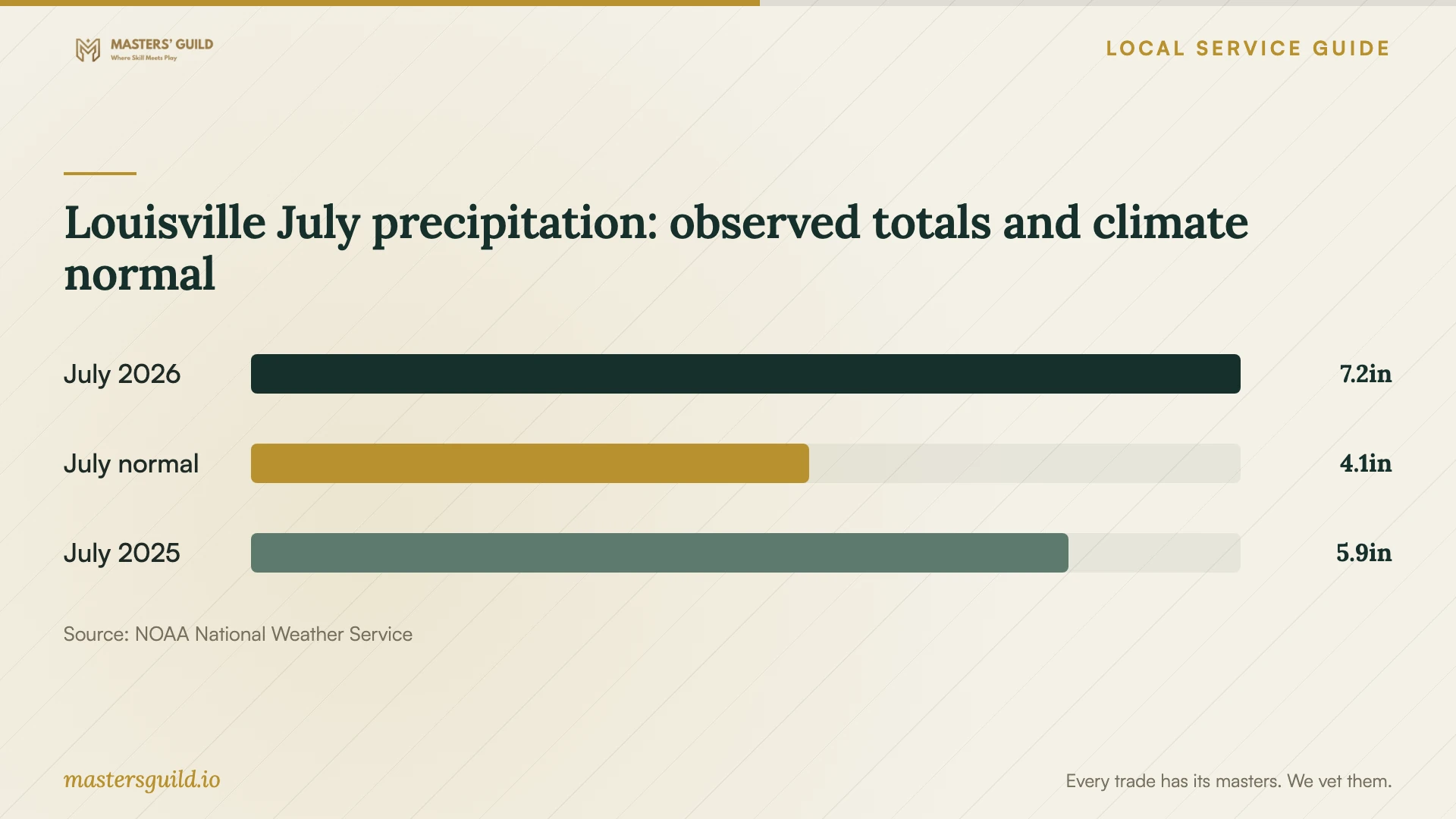
The National Weather Service's fetched July 2026 Louisville report records 7.18 inches of precipitation, compared with a July normal of 4.05 inches for 1991–2020. Use the accompanying chart as historical weather context when discussing outdoor access and drainage. Ask the provider to inspect your property rather than infer its conditions from a city reporting location. [3]
Louisville July precipitation: observed totals and climate normal
Local details that affect your job
Kentucky category and trainee checks
Kentucky's statewide requirements apply to pesticide work in Louisville. Structural pest management covers general pests and wood-destroying organisms using pesticides other than fumigants; structural fumigation has its own category. Ask for credentials that match the proposed method. If the worker is a registered trainee, ask the company to identify the licensed person providing direct supervision. [1]
Owner's drawing for wood-destroying-organism treatment
For control or prevention of wood-destroying organisms, Kentucky requires the provider to issue the property owner a graph at treatment time. Ask to receive it with your service paperwork and check the marked activity, damage, and treatment locations. If you approve treatment of selected areas, confirm that the drawing records those partial treatments. [2]
Match your concern to the next step
| Situation | Next step | Question to ask |
|---|---|---|
| Pest identity is uncertain | Arrange an inspection before approving treatment | What evidence identifies the pest? |
| Household pesticide treatment | Check the structural pest management credential | Does your Kentucky category cover this application? |
| Proposed structural fumigation | Check the separate structural fumigation credential | Who holds that credential and explains access restrictions? |
| Wood-destroying-organism treatment | Request the required owner's graph at treatment time | Will it show activity, damage, and partial treatment locations? |
| Recurring service proposal | Compare the full contract commitment | Which visits and pests are included, and how do I cancel? |
Your hiring checklist
- Record sightings, affected rooms, photos, and previous treatment attempts.
- Ask the inspector to identify the pest and explain the proposed scope.
- Request current credentials matching the proposed pesticide application.
- Ask who will supervise if the company sends a registered trainee.
- Compare inspection, treatment, repairs, follow-up, and recurring charges.
- Get preparation and return instructions before the appointment.
- Request the owner's drawing for wood-destroying-organism treatment.
- Keep the proposal, service paperwork, and written coverage terms together.
Frequently Asked Questions
How should I compare pest control prices?
Ask providers to quote the same identified pest, treatment area, and follow-up scope. Separate inspection, treatment, repair work, and recurring payments. Read the written coverage and cancellation terms before choosing a plan.
Does each worker need an individual Kentucky license?
Kentucky's regulation requires covered pesticide operators and applicators to have certification and licensing consistent with the application, but allows a registered trainee to work under direct supervision of a licensed person. Ask the company to explain the status of the worker attending your home. [1]
What paperwork should I receive after termite treatment?
Kentucky requires a graph for treatment or prevention of wood-destroying organisms at treatment time. It must record the structure, approximate dimensions, visible activity and damage, and treatment locations, including partial treatments. Also request your service record and any agreed coverage terms. [2]
Do I need to leave my home during treatment?
Ask the provider for instructions specific to the product, method, and application locations. Kentucky's certification standards require compliance with pesticide label restrictions and directions. Arrange access and any time away after the provider explains those requirements. [1]
Sources and scope
This guide combines the sources below with practical planning guidance. Figures apply to the stated geography and period; request a written quote for your property.