
Local service guide
Planning interior design in Lincoln, NE
Arrange interior design in Lincoln by defining the help you need before comparing proposals: furniture and finish selections, space planning, purchasing, or renovation drawings. Ask candidates to identify deliverables, fees, and responsibility for coordinating other professionals. Nebraska protects the registered interior designer title while allowing traditional design and decorating without that registration. For construction work, confirm the required professional involvement and local requirements before approving drawings or placing custom orders. [1] [3]
Define the assignment before requesting proposals
Write a brief that names the rooms, the problems you want to solve, and the items you want to retain. Include photos, rough dimensions, your total spending limit, and any deadline you cannot move. Describe how you use the space: cooking together, working from home, accommodating guests, or moving through rooms with a mobility aid.
Ask for deliverables you can review. For a furnishings project, request a dimensioned layout, product specifications, and a purchasing plan. For a renovation, ask the candidate to identify the drawings they propose to prepare and the work they expect other professionals to handle.
Request a sample from a comparable assignment. Check whether you can understand the dimensions, material selections, and approval points. Ask who will measure the room and delivery route before you authorize furniture or cabinetry. Include doorways, stairs, and existing pieces that must remain.
Check the credential the designer claims
Since January 1, 2025, Nebraska has restricted the registered interior designer title to people registered under its Interior Design Voluntary Registration Act. The act does not require registration for traditional interior design or decorating, including services limited to kitchen and bathroom planning, design, implementation, or product specification. [1]
If a candidate uses the protected title, ask for their registration number and match their name and number against the State Treasurer’s public registry. Use that check to verify the claimed credential. Ask separate questions about comparable work, availability, insurance, and who will perform your assignment. [2]
For technical submissions, ask who will prepare, supervise, sign, and seal the documents. Nebraska requires registered interior designers to obtain a seal and sets requirements for signatures, dates, and its use on submissions. Their registration does not authorize structural alterations or design of the building systems excluded by the act. [1]
Confirm renovation requirements for your property
Flag wall removals, door relocations, bathroom moves, and changes to heating or electrical systems at the first meeting. Nebraska’s Board of Engineers and Architects identifies alterations affecting systems, structure, or means of egress as relevant to whether a project needs an architect or professional engineer. [3]
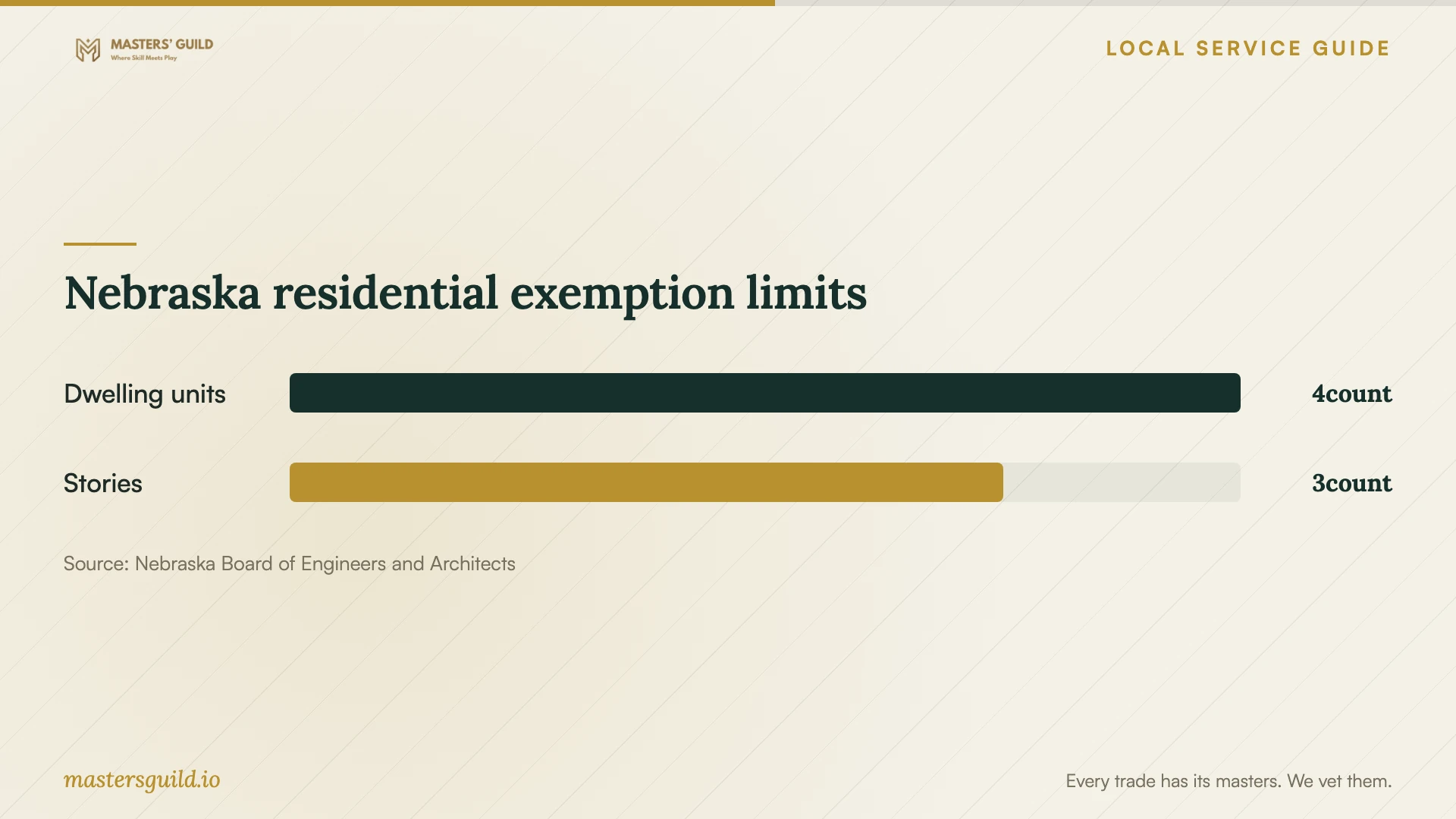
The board describes its residential three-part renovation exemption test for single-family through four-family dwellings that do not exceed three stories. Within that scope, the project must meet the applicable area limit, avoid adverse impacts on mechanical or electrical systems, structural integrity, or means of egress, and avoid changing or conflicting with occupancy classification. Projects with more than four dwelling units face different requirements. [3]
The board also warns that cities and counties can impose stricter requirements than state law. For your Lincoln property, ask local building officials to confirm the applicable analysis and permit requirements. Give them the dwelling count, number of stories, affected area, and proposed changes rather than asking whether interior design needs a permit in general. [3]
Assign responsibility for that discussion in the agreement. Ask who will coordinate any architect or engineer, prepare required submissions, and respond to review comments. Set a written approval point before demolition or custom orders.
Compare fees, purchasing, and approvals
Request separate amounts for design work, furniture and materials, purchasing charges, delivery, installation, and construction coordination. Ask candidates to state their billing method, included revisions, site visits, payment milestones, and process for approving additional work. Compare the same scope across proposals.
For purchasing, establish who places orders and handles freight damage, returns, storage, and substitutions. Ask the designer to disclose product markups or purchasing fees. Require your approval before anyone changes a selected item’s dimensions, material, finish, or price.
Ask for a schedule that identifies your decisions alongside design and construction tasks. Agree on when you will approve the layout, finishes, and orders. Request supplier lead times before setting installation dates, and decide how you will handle an unavailable product or a delayed delivery.
Nebraska residential exemption limits
Local details that affect your job
Nebraska registration changes how you screen candidates
For a Lincoln decorating assignment, do not treat a lack of registration as an automatic disqualification: Nebraska preserves traditional design and decorating services without requiring it under this act. If a candidate claims to be a registered interior designer, check the individual’s name and registration number in the State Treasurer’s registry. The kitchen and bathroom exception concerns this registration act; confirm any separate professional or permit requirements for construction. [1] [2] [3]
Dwelling count and height affect renovation review
Before applying the Nebraska board’s residential three-part exemption test, establish whether your property is a single-family through four-family dwelling with no more than three stories. The board says projects with more than four dwelling units face different requirements and that local governments may impose stricter rules. For a condo, converted house, or other multiunit property in Lincoln, ask officials to confirm the applicable category before relying on a designer’s exemption assessment. [3]
Match your project to the hiring questions
| Your project | Scope consideration | Question for the candidate |
|---|---|---|
| Furniture, colors, and finishes | Nebraska does not require registration under this act for traditional design and decorating. | Which layouts, specifications, and purchasing services will I receive? |
| Kitchen or bathroom planning | The act’s registration exception includes services limited to these spaces. | Who will identify separate professional and permit requirements for construction? |
| Interior construction documents | Registered interior designers must follow statutory scope and seal requirements. | Who will prepare and seal the submissions, and which review responses are included? |
| Wall, system, or exit changes | Professional involvement depends on the applicable exemption analysis and local requirements. | Who will confirm the requirements with officials before I approve the work? |
Your hiring checklist
- List the rooms, problems to solve, retained items, and total spending limit.
- Gather photos, rough dimensions, and delivery-access measurements.
- Request sample deliverables and a written scope with included revisions.
- Ask candidates to explain any credential they claim and how to verify it.
- Record the dwelling count, stories, affected area, and proposed construction changes for review with officials.
- Assign responsibility for permits, professional coordination, and review responses.
- Agree on purchasing charges, substitutions, returns, storage, and approval milestones.
Frequently Asked Questions
Does every Nebraska interior designer need registration?
No. Nebraska protects the registered interior designer title, but its act allows traditional interior design and decorating without registration. It also includes an exception for services limited to kitchen and bathroom planning, design, implementation, and product specification. Separate requirements may apply to construction. [1] [3]
Can a registered interior designer design a structural wall removal?
Structural-system alterations fall outside Nebraska’s statutory scope of registered interior design. Ask who will handle the structural design and have officials confirm the required professional involvement before approving the removal. [1] [3]
Does the residential renovation exemption apply to a condo?
Do not assume it does. The board describes its residential three-part test for single-family through four-family dwellings not exceeding three stories and states that projects with more than four dwelling units face different requirements. Ask officials which requirements apply to your building and proposed work. [3]
How should I compare design fees?
Give candidates the same brief and request itemized proposals. Compare deliverables, revisions, purchasing arrangements, site visits, and construction coordination. Agree on written approval for additional charges and identify who handles orders, returns, and damaged deliveries.
Sources and scope
This guide combines the sources below with practical planning guidance. Figures apply to the stated geography and period; request a written quote for your property.