
Local service guide
Website Design in Lexington, KY: Hiring Guide
For Website Design in Lexington, hire against a written scope that names your pages, customer actions, content responsibilities, account ownership, and launch checks. Compare the build price alongside hosting and ongoing support. Before signing, check the provider’s applicable local business registration, ask how the provider handles Kentucky hosting tax, and assess whether your business needs Kentucky privacy-law workflows. [1] [2] [3]
Define the customer task before requesting quotes
Start your brief with what a customer should accomplish: request an estimate, book an appointment, buy a product, or find your location and hours. Name the primary action for each proposed page. Ask designers to explain how they would arrange the content around those actions, then review an example on your phone.
List the pages and features you want priced. Separate writing, photography, product entry, booking tools, payment setup, and migration from visual design. For a redesign, identify the existing pages and addresses you want to retain. Ask who will map changed addresses, move content, and check links before launch.
Give bidders the same brief and request an itemized proposal. Ask them to identify assumptions, exclusions, revision rounds, and charges for additions. Set the launch date after assigning responsibility for copy, images, feedback, and approvals. Require a revised schedule if either party misses a dependency.
Check the provider and secure account control
For a provider doing business in Lexington-Fayette County, ask how it meets the city’s occupational-license requirement. The city requires an initial license before business begins. Use its Revenue office to clarify applicability if the provider works remotely or describes an unusual business arrangement. [1]
Review finished work with the designer and ask what they contributed. Request a demonstration of a contact form, navigation on a phone, and a routine content edit. Ask a reference about communication, changes to the agreed scope, and the handover process. Choose examples that resemble the tasks your own customers need to complete.
Require written ownership and access terms. Name who controls the domain, hosting account, website administrator login, design files, and purchased assets. Ask the provider to identify any licenses you must renew and any material you cannot transfer. Arrange business-controlled recovery details and document the steps for changing providers.
Compare the build price with ongoing charges
Request separate figures for the initial build and recurring services. Ask about hosting, software subscriptions, maintenance, backups, content edits, and support. Have the designer state what each charge covers, its billing interval, and the cancellation terms. The supplied official sources do not establish a local website-design price range; use project-specific written quotes.
Kentucky’s Department of Revenue says a Kentucky customer owes 6% sales and use tax on web hosting received in the state, even when the hosting provider and server are outside Kentucky. Ask the provider to show hosting and its tax treatment as separate items. Confirm the treatment of design and other bundled services with your accountant rather than applying the hosting example to the entire contract. [3]
For taxable services bought from an out-of-state provider that does not collect Kentucky tax, state guidance places use-tax responsibility on the purchaser. Check invoices for the tax charged and ask your accountant how to handle an omission. [3]
Scope privacy work and agree on launch acceptance
The Kentucky Consumer Data Protection Act took effect January 1, 2026. The Attorney General describes coverage thresholds of at least 100,000 Kentucky consumers’ data, or at least 25,000 Kentucky consumers with 50% of gross revenue from selling personal data. The guidance also identifies exempt entities and data. Have a qualified adviser assess your business before you buy a compliance package. [2]
For covered controllers, the law requires a privacy notice and consumer-rights procedures; it also requires specified provisions in controller-processor contracts. If your adviser determines that coverage applies, ask the designer to price implementation of the approved notice, request route, and relevant vendor arrangements. Assign responsibility for responding to requests after launch. [2]
Agree on acceptance checks before paying the final project balance. Test forms through to the receiving inbox, complete a sample booking or purchase where relevant, and try navigation with a keyboard and phone. Confirm access to business accounts, receive editing instructions, and record who handles launch defects and later maintenance.
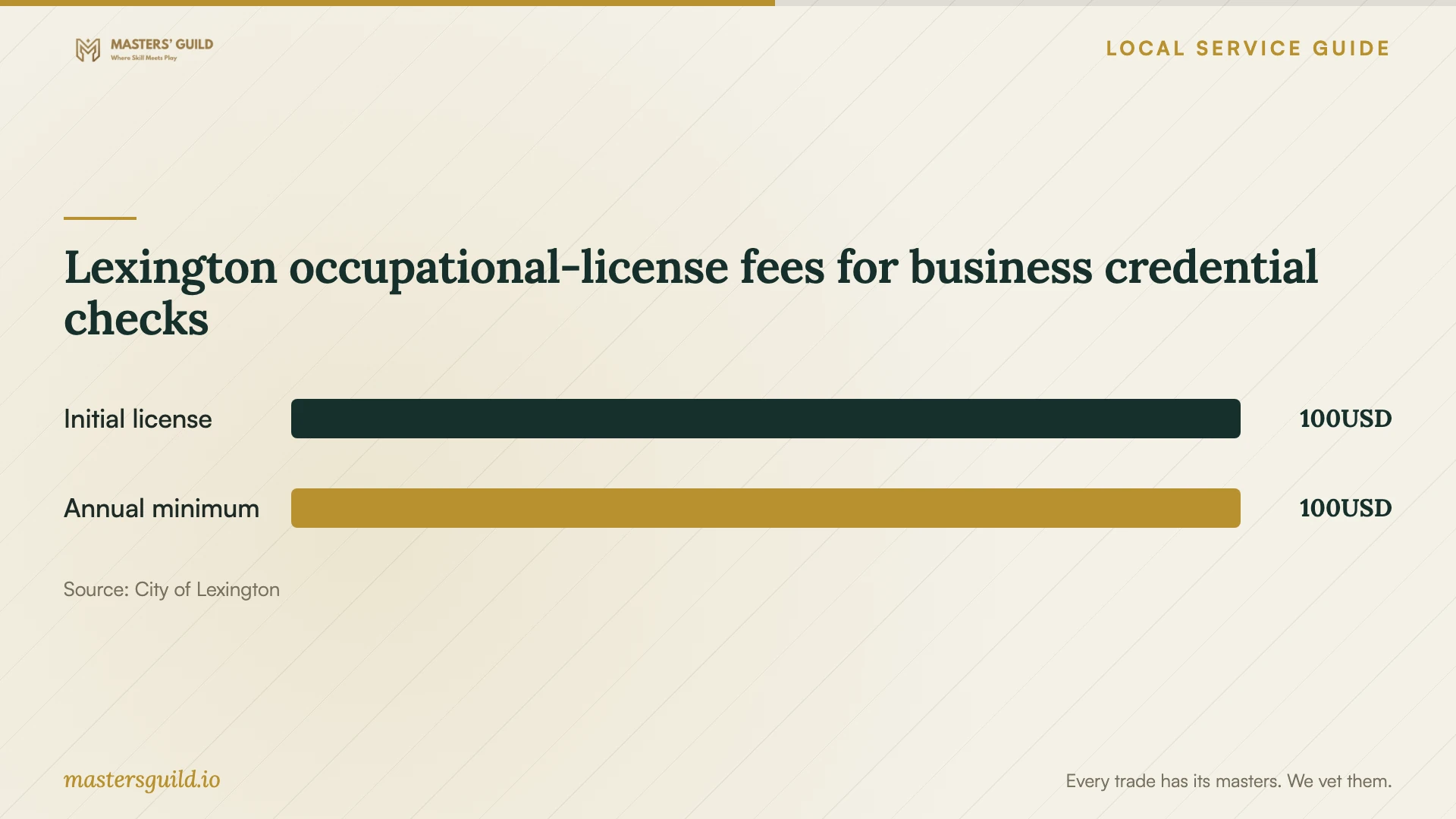
Lexington occupational-license fees for business credential checks
Local details that affect your job
Check Lexington registration without confusing it with design ability
The city lists a $100 initial occupational-license fee and a $100 annual minimum fee, with an exemption from the minimum fee for qualifying individuals and sole proprietorships reporting gross receipts of $4,400 or less. Ask an applicable local provider about registration; do not use the published fee as a website-project charge or a measure of technical skill. [1]
Include hosting tax when comparing remote proposals
An out-of-state hosting address does not remove Kentucky tax in the state’s example: a Kentucky customer receiving web hosting owes 6%. Ask local and remote bidders to identify hosting charges and tax collection. If a seller omits tax on a taxable purchase, check your use-tax responsibility. [3]
Assess statewide privacy coverage before adding features
Kentucky’s privacy law applies to certain businesses and includes thresholds and exemptions. Before approving a privacy-related add-on, give your adviser an inventory of forms, analytics, advertising tools, and customer-data vendors. Then ask the designer to quote the implementation your adviser specifies. [2]
Choose the scope to request
| Your situation | Scope to request | Question before signing |
|---|---|---|
| You need inquiries | Service pages and an inquiry form | Who tests delivery and receives submissions? |
| You need appointments | Booking setup and confirmation testing | Who owns the booking account and pays renewals? |
| You sell products | Product entry, checkout, and order testing | Who configures shipping, taxes, and payment accounts? |
| You are replacing a website | Content migration and address mapping | Which existing pages and addresses will you preserve? |
| You collect customer information | Data inventory and adviser-approved privacy work | Who approves the requirements and handles requests? |
Your hiring checklist
- Write down the customer action for each proposed page.
- Give bidders the same page list, features, and content responsibilities.
- Request separate build, hosting, subscription, maintenance, and tax items.
- Ask the provider about applicable business registration and review relevant work.
- Put ownership, administrator access, renewal costs, and transfer terms in writing.
- Assign privacy review and ongoing consumer-request responsibilities where needed.
- Agree on launch tests, training, defect support, and final acceptance.
Frequently Asked Questions
How much should I budget for the website?
Request written quotes against a shared scope. The official sources used here do not establish local design prices. Compare the build amount, recurring charges, included revisions, content work, and exit costs before choosing.
Does a Lexington occupational license establish design expertise?
The city describes an occupational license as a requirement for doing business in Lexington-Fayette County. Assess technical suitability through relevant work, references, demonstrations, and the written scope. [1]
Do I owe Kentucky hosting tax if I hire outside the state?
The Department of Revenue’s example says Kentucky customers receiving web hosting owe 6% tax even when the provider and server are out of state. Confirm collection on the invoice and check use-tax obligations if the seller omits applicable tax. [3]
Does every business website need a KCDPA compliance package?
The Attorney General identifies coverage thresholds and exemptions, so assess applicability before commissioning work. If your business falls within the law, arrange legal review of notices, consumer-request procedures, and relevant processor contracts. [2]
Sources and scope
This guide combines the sources below with practical planning guidance. Figures apply to the stated geography and period; request a written quote for your property.