
Local service guide
Lexington tree cutting and arborist services
For tree cutting in Lexington, first check whether the tree stands between the sidewalk and curb or near electrical lines. The city requires approval before owners remove or replace street trees, while LG&E and KU direct customers to coordinate service-line drops or covers before affected work. Then ask an arborist for a written scope covering the tree, access, debris, stump work and any replacement planting. [1] [2]
Choose an assessment or a cutting scope
Ask for an assessment before authorizing removal if you want to retain the tree or do not understand the proposed work. Explain your concern: a branch over the roof, clearance above a walkway, visible damage or a tree you want evaluated. Ask the arborist to describe the proposed cuts and explain why they recommend pruning, removal or further assessment.
For street-tree removal or replacement, Lexington tells property owners to choose an ISA-certified company. Ask who will assess your tree, request that person's credential details and identify who will supervise the crew. Also request current insurance documentation and ask how the contractor handles property damage. [1]
Give each bidder the same description and identify each tree with photographs or a marked site sketch. Ask bidders to separate assessment, pruning, removal, stump grinding and planting so you can compare the work you intend to buy.
Resolve street-tree approval before scheduling
Lexington describes street trees as typically standing between the sidewalk and curb, and assigns their maintenance to the property owner. Owners must obtain approval to remove or replace one. The city also requires a permit to plant a street tree in an easement that has none. [1]
The city evaluates the property before issuing a street-tree permit. Applications are available online or through Urban Forestry at (859) 258-3404 or 311. If you are unsure whether your tree falls under this process, ask Urban Forestry before agreeing to a removal date. [4]
Owners must replace removed street trees within one year. Ask the contractor to include a proposed replacement and planting scope, then check the city's approved and prohibited lists before applying. Assign responsibility for the application, planting and follow-up care in your agreement. [1] [4]
Coordinate electrical-line work with the utility
LG&E and KU state that trimming within 10 feet of high-voltage power lines is prohibited because of the danger. Do not use that distance as permission to judge a work area yourself. Tell the utility about the tree and let it determine the necessary coordination before cutting begins. [2]
For low-voltage service lines entering a home or business, LG&E and KU say they do not handle trimming and recommend a professional tree service. Customers can request a service drop or cover-up through the Service Orders tile or Additional Service in My Account. Agree with the contractor who will arrange that request and how it affects the work date. [2]
Compare complete quotes and cleanup duties
Request an itemized quote for your property rather than relying on an unsourced local average. Ask each bidder to describe equipment access, protection for gates and paving, where the crew will place wood, and whether they will haul branches and logs. Specify whether you want to keep any wood.
Treat stump grinding as a separate scope question. Ask for the intended grinding depth, whether the crew will remove grindings, and who will fill and finish the area. If you plan to replant nearby, discuss the proposed planting location before accepting the stump-work scope.
Utility clearance and homeowner cleanup involve different responsibilities. During storm restoration, LG&E and KU remove trees from affected lines and restore the lines, but homeowners handle the resulting branches and large limbs. During routine utility trimming, crews chip and haul smaller branches while leaving larger pieces for the owner. [3]
For storm work, ask the contractor to separate the immediate cutting work from later hauling, stump work and planting. Require your approval for added work and charges. Agree on an access plan and a way to reschedule if site conditions prevent the proposed equipment from entering.
Lexington minimum street-tree clearance
Local details that affect your job
Street-tree clearance affects the pruning request
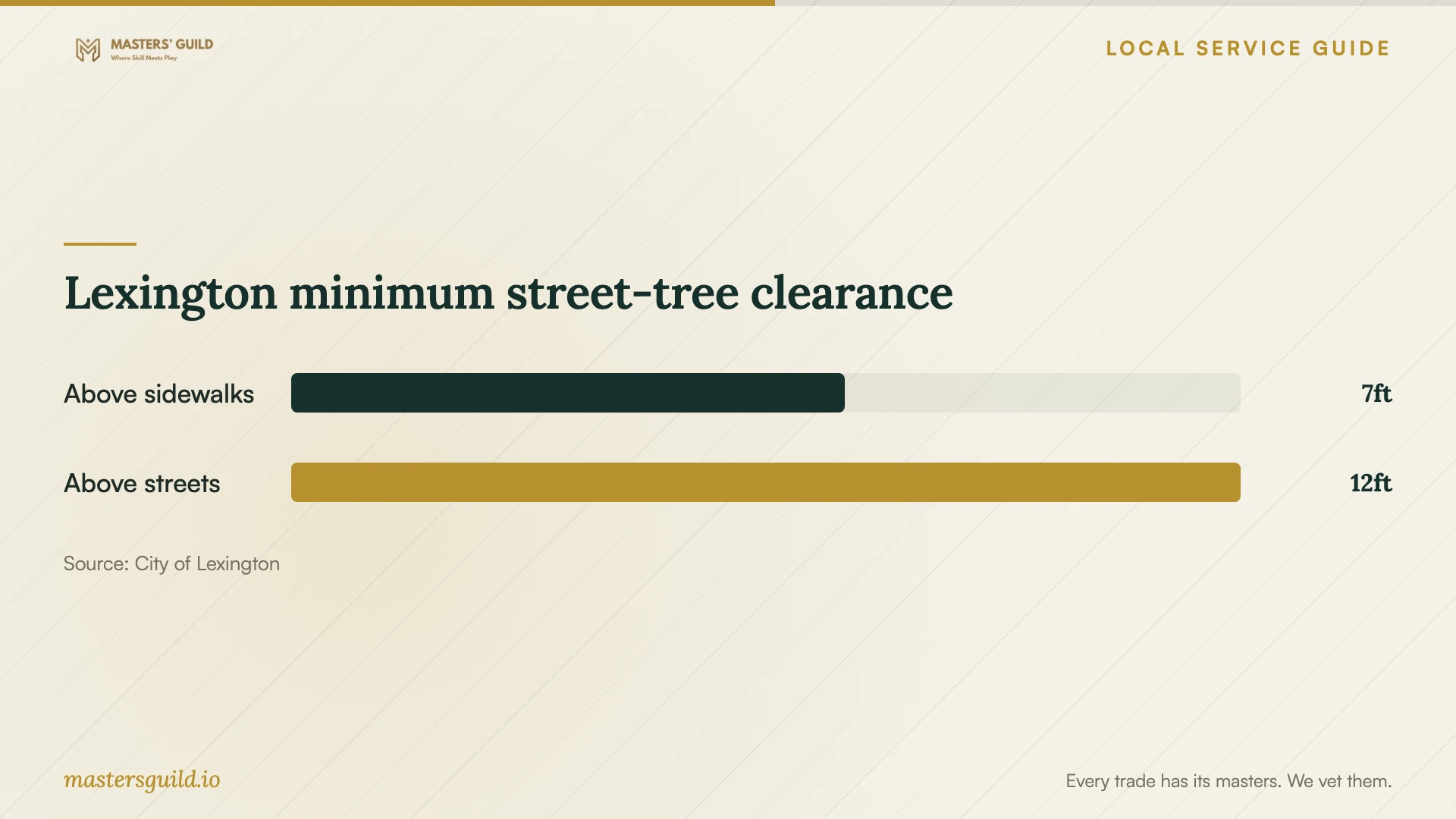
Lexington requires street-tree clearance of at least 7 feet above sidewalks and 12 feet above streets. Describe which route needs clearance when requesting a quote, and ask the arborist to plan the pruning around the city's requirement. [1]
Hazard street-tree assistance requires estimates
The city's FY27 hazard street-tree cost-share application requires two estimates for removal and replacement. The city allocates funds first come, first served until funding runs out. Applicants seeking 100% funding must indicate that request and meet household-income and family-size qualifications. Check eligibility and remaining funding with Urban Forestry before committing to the work. [1]
Replacement selection belongs in the permit plan
The city evaluates your property before issuing a street-tree permit and publishes approved and prohibited tree lists. Ask your contractor to propose a replacement for city review, rather than treating the replacement species as a choice to make after removal. [4]
Choose the next step for your tree
| Situation | Next step | Include in the scope |
|---|---|---|
| You want to retain the tree | Request an assessment before authorizing cuts | Pruning objective and explanation of proposed work |
| Street tree needs removal | Obtain city approval | Removal and replacement within one year |
| Branches approach household service lines | Coordinate with the utility and a professional tree service | Service drop or cover-up arrangements |
| Utility crews cleared storm damage | Clarify remaining homeowner cleanup | Branch and log hauling, plus any stump work |
| Hazard street-tree assistance may apply | Check FY27 eligibility and funding with Urban Forestry | Two removal-and-replacement estimates |
Your hiring checklist
- Identify each tree and photograph it from a safe position.
- Resolve street-tree status and application responsibility before scheduling removal.
- Ask who will assess the tree and supervise the cutting crew.
- Request credential details and current insurance documentation.
- Agree who will coordinate any utility service drop or cover-up.
- Separate cutting, hauling, stump work and planting in the quote.
- Record access arrangements, surface protection and cleanup expectations.
- Require approval for scope changes and added charges.
Frequently Asked Questions
Do I need approval to remove a tree in my yard?
The cited city guidance requires approval for street-tree removal and replacement. It does not establish a permit rule for every private-yard tree. Ask Urban Forestry whether the tree falls within its street-tree process before authorizing removal. [1]
Will the utility trim branches around the line to my house?
LG&E and KU say they do not trim trees or limbs growing into the low-voltage service lines entering a home or business. They recommend a professional tree service and offer service drops or covers to coordinate the work. [2]
Does utility storm restoration include debris hauling?
LG&E and KU assign storm-restoration tree-debris removal to the homeowner. Ask a contractor to quote hauling the branches and large limbs that remain after utility crews finish their work. [3]
What should I ask before accepting a removal quote?
Ask which tree and tasks the price covers, who handles approvals and utility coordination, whether hauling and stump grinding are included, and who repairs disturbed surfaces. For a street tree, include replacement planning and assign responsibility for planting. [1]
Sources and scope
This guide combines the sources below with practical planning guidance. Figures apply to the stated geography and period; request a written quote for your property.