
Local service guide
Special Item Transport in Laval, QC
For Special Item Transport in Laval, choose a mover who can explain how the crew will handle your particular item and the access at both addresses. Send photographs, dimensions and route details before accepting a written quote. Check goods insurance and liability coverage, and settle responsibility for any street occupation before fixing the date. Québec’s consumer protection office recommends insurance checks and a detailed written agreement; Laval requires permission for many public-space obstructions. [1] [3]
Give the mover an item-specific brief
For a piano, slate pool table, safe or fragile cabinet, ask who will perform the handling and what equipment they intend to use. Give the make or model, dimensions, available weight information and photographs of existing damage. Ask the mover to identify any information they still need before committing to the job.
Photograph the full route at pickup and delivery: exterior steps, doorways, landings, turns and the final placement area. Measure narrow openings and tell the mover about elevator reservations or building access hours. Québec’s consumer protection office advises describing the premises, distance, floors, stairs and elevators when requesting an estimate. [3]
Ask for a site assessment if the mover cannot confirm the route from your information. Before accepting an exterior lift or crane proposal, ask who will assess the setup space, arrange building approval and handle any municipal application.
Compare the complete written price
Request the same scope from each mover: pickup, protection, transport, unloading and placement. Specify whether you want disassembly, reassembly, crating or table setup. Ask the mover to list exclusions and explain what happens if the item cannot pass through the agreed route.
Québec’s consumer protection office recommends comparing two or three companies. It notes that movers commonly charge travel time between their warehouse and your home, and recommends recording the rate, crew size, truck size, total-cost calculation and extra-labour charges in the contract. [3]
Ask whether the offer is a fixed price or an hourly estimate. For hourly work, request the minimum charge, when billing starts and ends, and how waiting time works. Have the mover identify charges for stairs, long carries, equipment, packing, municipal arrangements and taxes before you agree.
Check coverage and the carrier
Ask for evidence of insurance covering the goods and civil liability. Québec’s consumer protection office recommends at least $1 million in liability coverage. For your item, ask the mover to explain the coverage limit, deductible, exclusions and claim procedure in writing; do not assume a general insurance statement answers those questions. [3]
If the mover uses a heavy vehicle, check its registration with the Commission des transports du Québec. The consumer protection office identifies this requirement for movers using heavy vehicles. The Commission’s register provides information about operating rights and safety ratings, subject to its registration rules and exceptions. [3] [4]
Photograph the item before packing and after placement. Keep the quote, contract and correspondence together. At delivery, inspect accessible surfaces with the crew and record any concern before signing an acknowledgment of condition.
Settle curb access before booking equipment
Tell the mover where the truck and any lifting equipment would stand. Laval lists specialized machinery, fixed obstacles and occupation of sidewalks or bicycle paths among situations requiring a street-occupation permit. Assign responsibility for checking the proposed setup with the City before you approve the equipment booking. [1]
Laval also describes situations requiring a declaration without a permit, including certain short obstructions on arterial roads outside peak hours. Do not assume your specialty move fits an exception because unloading will be brief. Describe the vehicle, equipment, footprint and duration when confirming the applicable process. [1]
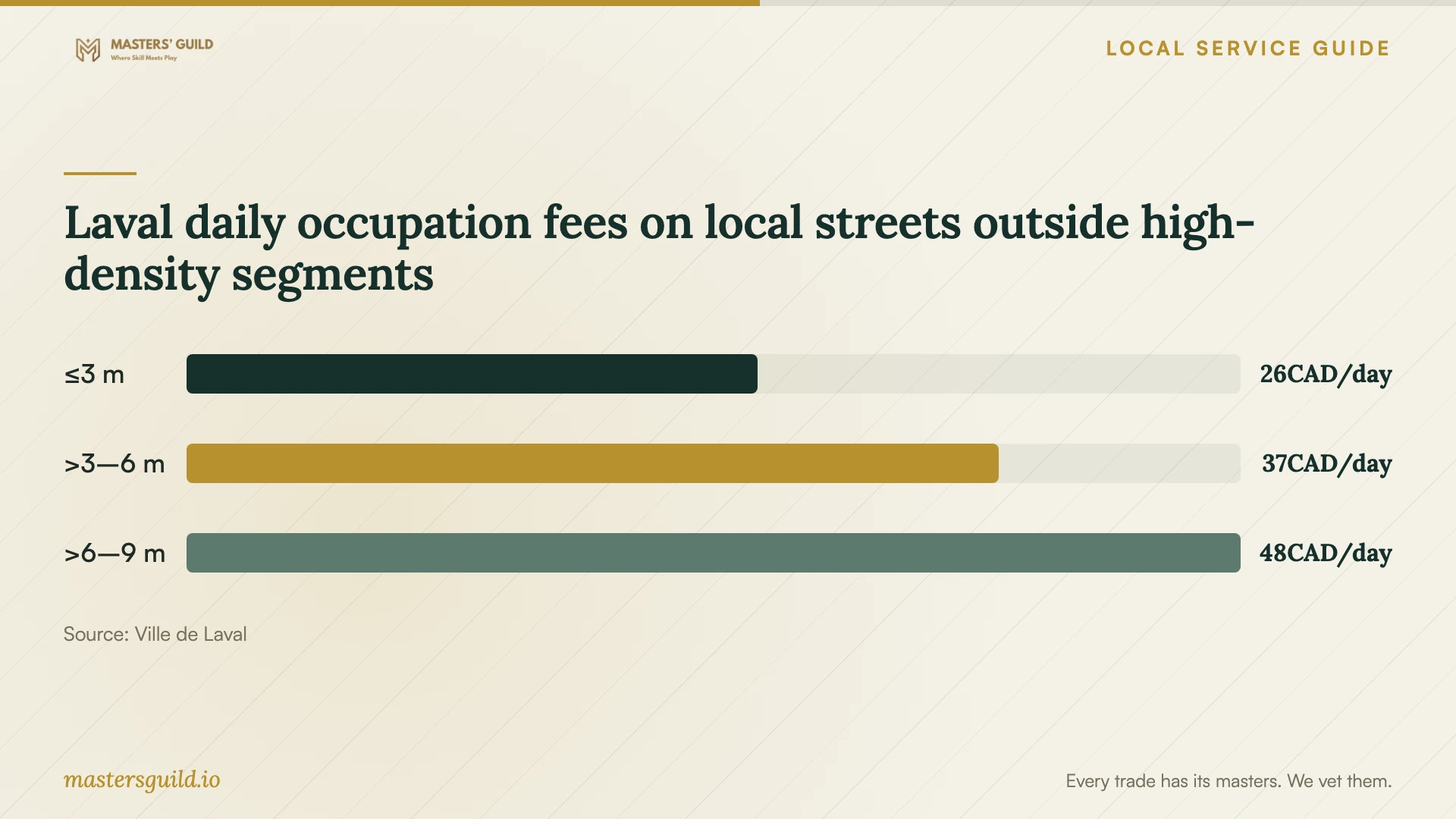
Laval daily occupation fees on local streets outside high-density segments
Local details that affect your job
Street occupation requires advance planning
Laval accepts street-occupation applications through Mon dossier. The City states a review period of 10 business days, increasing to 15 when traffic management requires intervention on a traffic signal. You must receive the permit before occupying the roadway. Ask the mover who will submit the application and arrange the required temporary signage before you confirm a crane-assisted move. [1]
Loading space can change with maintenance restrictions
Laval applies seasonal restrictions from October 1 through April 30 in areas with permanent alternate-parking signs, and year-round restrictions in areas with dynamic illuminated signs. The City identifies Pont-Viau, Laval-des-Rapides and Chomedey as sectors using this system. Check Info-Stationnement for the address, then inspect street signs before the crew arrives. Temporary orange signs take priority over permanent signs, and street signage takes priority over the app. [2]
Resolve these points before accepting an offer
| Your situation | Next step | Confirm in writing |
|---|---|---|
| The item needs disassembly or setup | Ask the mover to describe the method and who performs it. | Included work, protection and final placement. |
| The route includes stairs or an elevator | Provide access details before requesting a final quote. | Crew, equipment and any access-related charges. |
| Equipment will occupy public space | Confirm Laval’s permit or declaration process for the proposed setup. | Applicant, signage responsibility, fees and approved dates. |
| The mover uses a heavy vehicle | Check the carrier’s CTQ registration and record. | The legal name of the carrier performing the transport. |
| The item has a high declared value | Ask how the goods insurance applies to that item. | Coverage limit, deductible, exclusions and claim procedure. |
Your hiring checklist
- Send item photographs, dimensions, model information and any documented weight.
- Measure openings and photograph stairs, landings and tight turns at both addresses.
- Confirm elevator reservations, building access hours and the final placement area.
- Get the handling method, crew, equipment, included setup and exclusions in writing.
- Request insurance evidence and written answers about limits, deductibles and claims.
- Assign responsibility for checking street occupation, applications and signage.
- Recheck the loading location and photograph the item before packing.
Frequently Asked Questions
How much should I budget for the move?
Request an item-specific written quote after the mover reviews both access routes. Separate handling and transport from packing, setup, equipment and municipal arrangements. The municipal fees shown here cover specific street occupations; they do not establish a piano, safe or pool-table moving price. [1]
Does a brief loading stop avoid a permit?
Confirm the exact setup with Laval. The City distinguishes permit applications from declaration-only situations using conditions such as location, timing, duration and the type of obstruction. Specialized machinery and occupation affecting a sidewalk or bicycle path can require a permit. [1]
Can I arrange the job by telephone?
Yes. Québec’s consumer protection office explains that a moving contract concluded by telephone or online must be recorded in writing and sent within 15 days of conclusion. Ask for the complete written terms before moving day so you can review the scope, price, schedule and restrictions. [3]
Does the app guarantee the loading space is available?
Use Info-Stationnement to check planned maintenance, then inspect the signs at the loading address. Laval states that street signage takes priority over the app. Ask the mover to agree on an alternative legal loading location if restrictions affect the planned space. [2]
Sources and scope
This guide combines the sources below with practical planning guidance. Figures apply to the stated geography and period; request a written quote for your property.