
Local service guide
Duct and Vent Cleaning in Laval: Hiring Guide
Arrange Duct and Vent Cleaning in Laval by requesting an inspection, then comparing written quotes for the work your system needs. Québec’s housing authority summarizes guidance that distinguishes light dust from substantial debris, airflow obstruction and mould. Ask the contractor to explain the findings and identify any underlying moisture problem before you approve cleaning. [2]
Decide whether you need cleaning or a diagnosis
Describe the problem you want the contractor to solve. Québec’s technical sheet summarizes recommendations to investigate substantial debris, visible particles entering rooms, microbial growth and reduced airflow or blocked components. It recommends professional diagnostic help when you see water or mould, or have doubts about the system’s condition. [2]
Tell the assessor which rooms have weak airflow, where you see deposits and whether you have completed renovations. Request photographs that identify the inspected locations. For a suspected moisture problem, ask who will find and correct the cause and how that work affects the cleaning appointment.
The Société d’habitation du Québec directs housing offices to clean when excessive debris obstructs airflow or pathogens such as mould are present, and to correct the causes beforehand. Those formal directions address housing offices. Private homeowners can use the technical discussion to frame inspection questions without treating it as a universal cleaning requirement. [2]
Compare quotes with the same scope
Ask each bidder to identify the system and name the included areas: supply ducts, returns, registers and equipment components. If you want dryer-exhaust cleaning, request its own description, including the route and exterior outlet. Have the contractor identify which parts the crew will reach and which parts the quote excludes.
Get the total, applicable taxes, inspection charge and exclusions in writing. Ask how the contractor handles inaccessible sections, additional access openings and work discovered during the visit. Require approval before extras begin. Compare the scope behind each total before choosing from an advertised starting price.
Ask which cleaning standard the contractor follows and how the technician will assess the result. Québec’s technical sheet recommends the latest NADCA ACR edition or a recognized equivalent when cleaning is necessary. It also warns that poor cleaning can resuspend settled particles. [2]
Check qualifications and proposed repairs
Québec’s technical sheet states that no regulated professional practice governs duct cleaning in the province. For diagnostic help, it recommends an accredited professional and gives NADCA as an example. Ask who will assess your system, what relevant training that person holds and who will supervise the cleaning. [2]
The RBQ distinguishes housekeeping aimed at building cleanliness from construction work requiring a contractor’s licence. Its FAQ does not classify every duct-cleaning method. If your quote includes ventilation repairs or alterations, describe that scope to the RBQ and confirm the required licence before authorizing it. [4]
Request proof of liability insurance. Have the contractor explain how the crew will protect floors, contain removed debris and close access openings. For insulated ducts, ask how the proposed method accounts for the material’s condition.
Prepare access and agree on completion checks
Send equipment labels and access photographs before the visit. Clear the mechanical area and registers, and agree on parking and equipment entry. If a building manager controls access to shared equipment, settle those arrangements before booking.
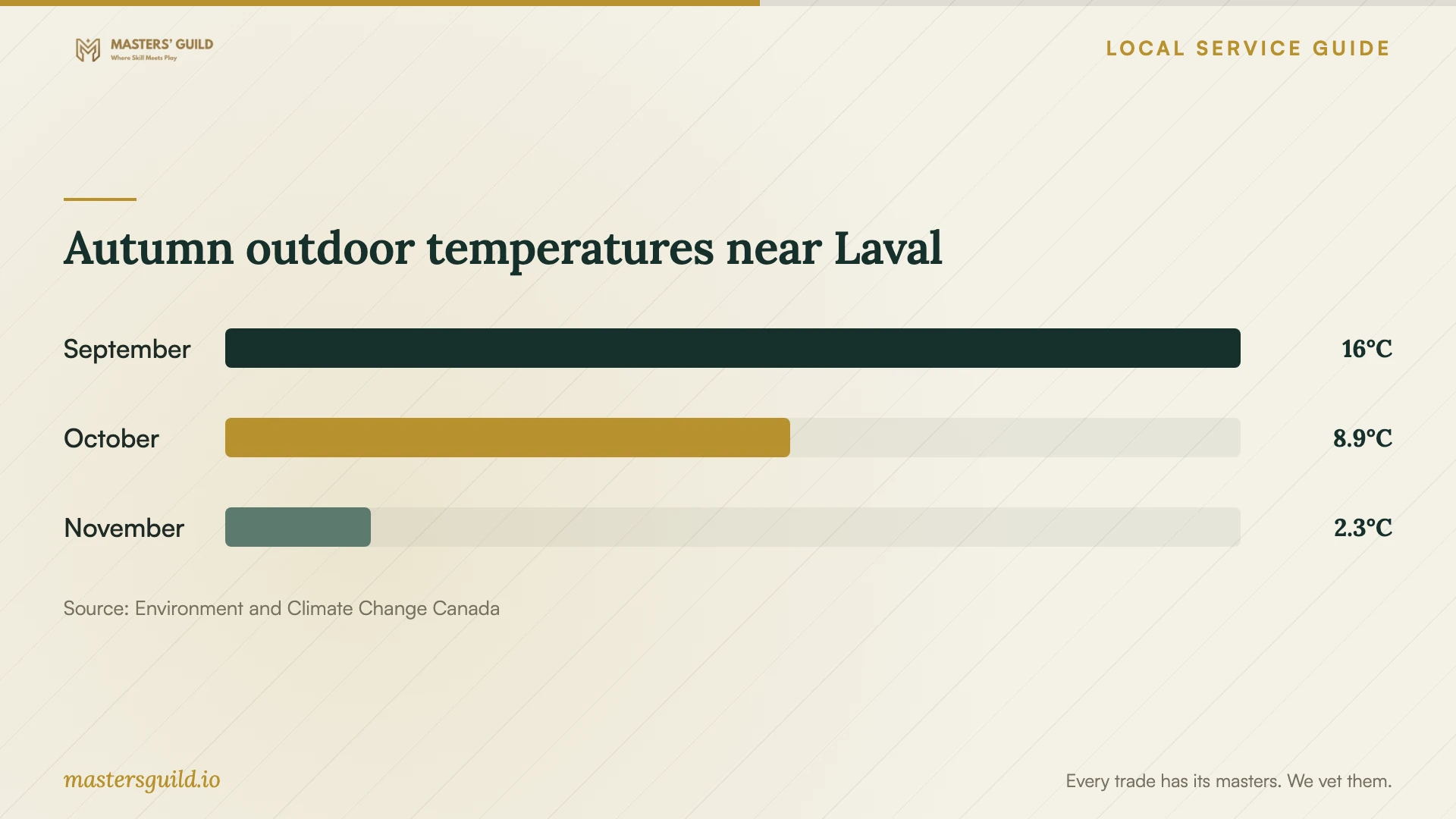
Ask about expected heating or ventilation interruptions and plan around your household’s needs. For a cold-weather appointment, discuss how the crew will manage any opening needed for equipment. Use the regional temperature chart as seasonal context, then check the forecast for your appointment.
Before the crew leaves, compare the completed work with the contract. Review photographs from the agreed inspection locations, ask about sections the crew could not reach and have the technician demonstrate equipment operation. Keep the findings, exclusions and invoice together for your next maintenance decision.
Autumn outdoor temperatures near Laval
Local details that affect your job
Follow Laval’s process for rental housing problems
For a home you rent out, Laval says owners must maintain safe, habitable and clean housing and make necessary repairs except those assigned to tenants. The city advises identifying responsibility, notifying the other party in writing when the correction falls to them and requesting acknowledgement. If the notice deadline passes without correction, Laval describes recourse to the Tribunal administratif du logement and the option of contacting the city. Follow that process for unresolved housing conditions and establish responsibility before arranging work. [1]
Separate air-exchanger upkeep from duct cleaning
For Québec homes with an air exchanger, Hydro-Québec recommends cleaning its filters at least every three months and keeping the unit operating except during maintenance. Check your equipment instructions and maintenance record before buying a service package. Ask the contractor to distinguish overdue exchanger upkeep from proposed duct cleaning so you can decide which work to arrange. [3]
Match the finding to the next step
| Finding | Next step | Question to resolve |
|---|---|---|
| Light settled dust | Continue routine equipment care; ask what finding justifies cleaning. | What condition needs correction? |
| Debris obstructing airflow | Request diagnosis and a defined cleaning scope. | Where is the obstruction? |
| Water or suspected mould | Arrange diagnosis and correction of the cause before cleaning. | Who will address the moisture source? |
| Ventilation repairs or alterations | Confirm applicable licensing requirements with the RBQ. | Which licence scope covers the proposed work? |
Your hiring checklist
- Write down the symptoms, affected rooms and recent renovation work.
- Send equipment labels and photographs of access points.
- Compare written totals, included areas, exclusions and extra-work approval terms.
- Ask about technician training, insurance and debris containment.
- Confirm responsibility and access for shared or rental equipment.
- Agree on downtime and the completion evidence you will receive.
Frequently Asked Questions
How often should I book duct cleaning?
Base the decision on inspection findings. Québec’s technical sheet describes condition-based cleaning and summarizes guidance that light dust alone does not require it. Follow manufacturer instructions for routine equipment maintenance. [2]
Will duct cleaning improve my family’s health?
Avoid buying on a promised health improvement. Québec’s technical sheet reports that studies have not demonstrated notable occupant health benefits from HVAC duct cleaning. It also notes that water and mould in a system can increase contaminant exposure and affect sensitive occupants. [2]
Should I arrange cleaning after renovations?
Request an inspection before approving a full cleaning. Québec’s sheet notes that renovations can generate particles that settle in ducts. Ask the assessor to show whether debris entered your system and explain what removal work the findings justify. [2]
Sources and scope
This guide combines the sources below with practical planning guidance. Figures apply to the stated geography and period; request a written quote for your property.