
Local service guide
Basement remodeling in Laval, QC
Basement remodeling in Laval should start with a water-protection review, a defined layout and a contractor whose RBQ licence covers the work. Before booking construction, confirm the permit requirements: Laval requires a basement renovation permit when you change the number of rooms or the structure. Ask bidders to separate corrective work, finishing and permit responsibilities so you can compare the same project. [1] [2] [3]
Define the rooms and the work before comparing bids
Give each bidder the same sketch and description of how you want to use the basement. Mark the walls you want to move, storage you need, proposed bathroom fixtures and equipment that must remain accessible. Ask each contractor to visit the space before committing to a scope.
Separate a family room renovation from a proposal to add bedrooms or a separate dwelling. Laval identifies bedroom additions and dwelling additions in its interior-renovation permit guidance. For a proposed rental unit, ask the city to confirm what it allows at your address before paying for a finished design. The interior-renovation page alone does not establish approval for your proposed unit. [1]
Request a written breakdown for demolition, water-related repairs, framing, insulation, electrical work, plumbing, ventilation and finishes. Ask bidders to identify exclusions and allowances, including who pays for drawings, permit fees and debris removal. Treat an unspecified allowance as a question to resolve before signing.
Resolve water problems before enclosing the basement
Show the contractor any water stains, previous repair invoices and photos taken during rain. Laval identifies foundation or window sealing, poor drainage around the house and groundwater near the surface as possible causes of infiltration. Ask for a diagnosis and a separate corrective scope before authorizing wall and floor finishes. [2]
For a sewer backup, Laval directs homeowners to start with an RBQ-licensed plumber who belongs to the CMMTQ. The plumber should identify the source, inspect basement plumbing equipment, clear or install a cleanout and determine whether the city needs to intervene. If the plumber confirms city involvement, call 311 and retain the detailed invoice. [2]
Ask the plumber to mark the backwater valve, cleanout and any sump-pump access on the proposed layout. Laval requires protective devices and tells owners to know their locations and maintain them. Include removable access panels in the finishing scope, then have the plumber demonstrate access before the contractor closes the project. [2]
Prepare the permit application before setting a start date
Laval requires a permit for basement renovations that modify the number of rooms or the structure. Its broader interior-renovation guidance also identifies changes to room dimensions. Describe the complete project to the city, including proposed partitions, stair changes and plumbing work, rather than asking only whether you can finish a basement. [1]
Review the city’s document list with the person preparing your application. Laval requests a recent certificate of location showing existing conditions and lists before-and-after plans, with additional architectural or engineering documents depending on the project. Ask which documents apply to your house and scope before commissioning drawings. [1]
The city says it will email an application status update within five business days. For an incomplete application, it allows 30 days to supply missing documents before closing the request. Its approximate 30-day processing period begins only after receipt of all required documents, and complexity or special approvals can extend it. Agree on a construction start date that accounts for permit issuance. [1]
Check the licence and make the contract specific
Ask for the contractor’s legal business name and RBQ licence number, then verify the licence and subclasses through the RBQ’s licence-holder register. The regulator states that contractors offering construction services in Quebec need a licence in good standing and that paid renovation work requires the necessary subclasses. It includes painting and floor, wall and ceiling finishing in its examples. [3]
Ask who will coordinate the trades, prepare drawings, submit the permit application and answer city requests. Put those responsibilities in the contract alongside the materials, payment stages, cleanup and process for approving changes. Require a written price and schedule adjustment before authorizing additional work.
For budgeting, compare the complete written scopes rather than relying on a single price per square foot. Ask each bidder to distinguish fixed work from items awaiting investigation. Keep a separate owner reserve for unresolved conditions, and decide which optional finishes you would postpone if corrective work uses that reserve.
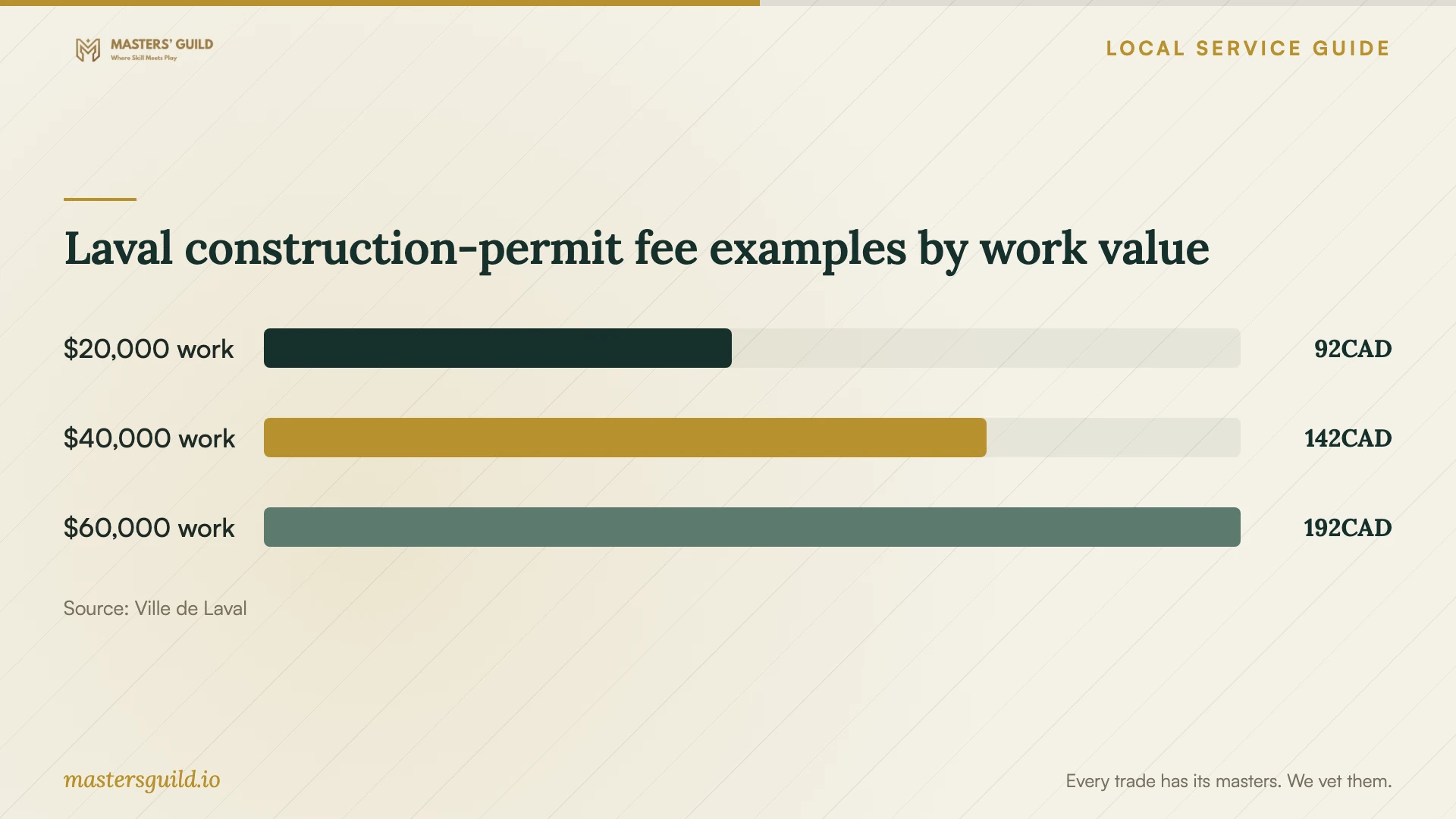
Laval construction-permit fee examples by work value
Local details that affect your job
Laval’s permit fee depends on declared work value
The city publishes a construction-permit fee of CAD 92 for the first CAD 20,000 of work, plus CAD 2.50 for each additional CAD 1,000 or part thereof. Ask who will declare the work value and pay the fee. The city also lists a separate CAD 100 base connection fee; confirm whether your project involves that charge. [1]
Keep backwater-valve maintenance accessible
Laval recommends backwater-valve maintenance at least one to two times a year, in spring and fall, and after heavy rain or a suspected backup. Before approving cabinetry or flooring around the valve, ask the plumber to show how you will reach and service it. [2]
Flag a riverfront or floodplain property during planning
For riverfront or floodplain land, Laval’s application guidance lists identification of the shoreline, flood elevations and flood-zone boundaries on the certificate of location. It also lists engineering documentation concerning structural capacity under flood conditions. Confirm the documents and restrictions that apply to your address before commissioning a basement layout. [1]
Choose the next step for your basement
| Your situation | Next step | What to settle before finishing |
|---|---|---|
| You want to change the room count or structure | Prepare the municipal permit application | Confirm required plans and who handles the application |
| You have signs of exterior water infiltration | Investigate sealing and drainage | Define corrective work before enclosing affected areas |
| You have experienced a sewer backup | Start with an RBQ-licensed, CMMTQ-member plumber | Obtain the diagnosis and detailed invoice; contact 311 if the plumber confirms city intervention |
| You are hiring someone for finishing work | Verify the licence and necessary subclasses | Identify the business responsible for the contracted work |
Your hiring checklist
- Write down the intended rooms, storage needs and optional features.
- Gather water-damage photos, repair invoices and existing plans.
- Ask the plumber to mark service points and maintenance access.
- Confirm permit requirements for the complete proposed scope with the city.
- Verify the contractor’s licence and subclasses using the RBQ guidance.
- Compare quotes with matching materials, allowances and exclusions.
- Assign responsibility for drawings, permits and city follow-up in writing.
- Agree on payment stages and written approval of changes before signing.
Frequently Asked Questions
Do I need a permit to renovate my basement?
Laval requires one when you change the number of rooms or the structure. Its interior-renovation guidance also addresses room-dimension changes. Send the city your full proposed scope so it can confirm the requirements for your project. [1]
How long should I allow for the permit?
Laval lists approximately 30 days, starting when it has all required documents. It warns that the time of year, project complexity and special approvals can add time. Treat this as application processing time, separate from the contractor’s construction schedule. [1]
Does a contractor need an RBQ licence for finishing?
The RBQ says paid renovation work requires the necessary licence subclasses. Its examples include painting and floor, wall and ceiling finishing under subclass 9. Check the licence against the complete scope you plan to hire out. [3]
Can I hide the backwater valve under the new floor?
Plan accessible service space with your plumber before approving the floor detail. Laval tells owners to know the location of protective equipment and maintain it, and recommends backwater-valve servicing in spring and fall and after heavy rain or a suspected backup. [2]
Sources and scope
This guide combines the sources below with practical planning guidance. Figures apply to the stated geography and period; request a written quote for your property.