
Local service guide
Duct and Vent Cleaning in Las Vegas, NV
Arrange Duct and Vent Cleaning in Las Vegas after an inspection identifies substantial contamination, such as excessive debris, pests, or substantial visible mold on hard surfaces. Have the cleaner show you the problem and provide a written whole-system scope before you book. EPA recommends cleaning as needed; a dusty return grille alone does not establish that you need duct cleaning. [1]
Decide between cleaning and an HVAC inspection
Describe what you have observed: debris coming from supply registers, pest evidence, water stains, or suspected growth. Have the provider inspect the affected area and show you photographs with enough context to identify your system. EPA notes that dust on return registers is normal and that homeowners can vacuum or remove and clean those grilles. [1]
Have an HVAC professional investigate moisture alongside suspected mold and correct the moisture source before cleaning. Have a qualified HVAC contractor remove and replace wet or moldy duct insulation. EPA says cleaning cannot resolve that condition and warns that contamination can recur unless you correct its cause. A provider’s visual guess may not establish that a substance is mold; expert identification can require laboratory analysis. [1]
Treat health and energy promises with caution. EPA says duct cleaning has not been shown to prevent health problems, and little evidence supports efficiency improvements from cleaning ducts alone. Cleaning dirty coils, fans, or heat exchangers is a separate consideration. Discuss unexplained symptoms with your doctor instead of relying on a cleaning salesperson’s diagnosis. [1]
Compare the scope before comparing the price
Get written estimates from at least three providers, as EPA recommends. Give each the same description of your home and confirm which heating and cooling systems the price covers. Require the provider to identify the supply and return ducts, registers, grilles, air handler, blower, coils, and drain pans included in the work. EPA warns that leaving a contaminated component untreated can contaminate the system again. [1]
Have each bidder separate inspection, cleaning, repairs, replacement materials, and proposed chemical treatments. Request a total price, exclusions, an expected work window, and the process for approving additional charges. If you want dryer-vent work, name it as a separate requested task and request its own scope.
For a proposed HVAC repair or duct replacement, request the contractor’s license number and check the Nevada State Contractors Board’s official lookup. You can search by license number, company name, or principal or qualified individual. The board cautions that its online information may not reflect recent changes, so resolve discrepancies before agreeing to the work. [3]
Confirm how the cleaner will protect your home
Find out where the vacuum will exhaust. EPA advises equipment that exhausts outdoors or HEPA vacuum equipment when the exhaust remains indoors. Discuss how workers will protect furnishings, reach system components, and close access openings. Have the provider identify the duct material before selecting tools; EPA specifies soft-bristled brushes for fiberglass duct board and fiberglass-lined metal ducts. [1]
Request a separate explanation for any sanitizer, biocide, or interior coating. EPA advises understanding the benefits and risks before approving chemical treatments and says providers should follow the product label. Its guidance distinguishes coatings inside ducts from sealing air leaks. Have the provider explain the purpose, application area, and alternatives before you authorize an add-on. [1]
Before the appointment, clear a route to the air handler and registers. Tell the provider about pets, fragile belongings, access restrictions, and rooms you need to use during the visit. Confirm how long workers expect to leave the system off so you can plan around the interruption.
Check the work and plan filter maintenance
Review the cleaned components with the provider before closing out the job. EPA recommends a thorough visual inspection, including supply and return areas. Request photographs of inaccessible areas. Confirm that workers reattached registers, sealed and reinsulated access openings, and checked system operation after cleaning. [1]
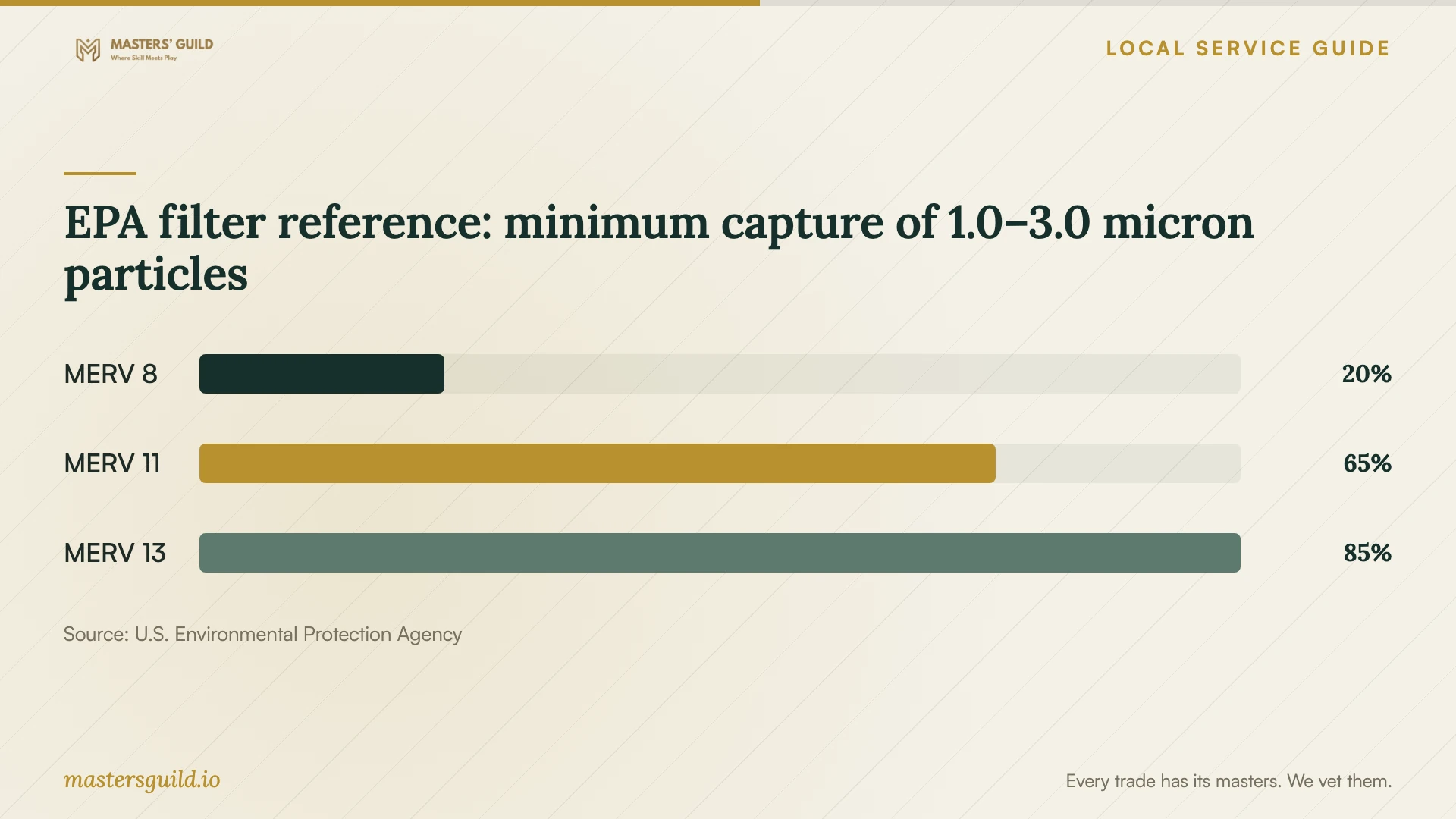
Discuss filter fit and replacement instructions during the visit. EPA recommends preventing air from bypassing the filter and using the highest efficiency the system manufacturer recommends. Its filter guidance advises MERV 13 or the highest rating the fan and filter slot can accommodate when upgrading. Have an HVAC technician confirm compatibility before buying a higher-rated filter. [1] [4]
EPA filter reference: minimum capture of 1.0–3.0 micron particles
Local details that affect your job
Use Southern Nevada dust precautions
Clark County’s August 11, 2026 advisory described Arizona thunderstorm winds pushing dust into Southern Nevada. During dusty conditions, the county advised closing windows and doors and running air conditioning to filter particulates. Follow those precautions and inspect your filter before treating new surface dust as a reason to buy duct cleaning. This historical regional advisory does not establish that your system needs cleaning or that an advisory remains active today. [2] [1]
Report an ongoing outdoor dust source
For excessive blowing dust from a construction site, vacant lot, or facility, Clark County directs residents to its dust complaint hotline at 702-385-3878. Record the location and what you observed before calling. Report the outdoor source and have a cleaner demonstrate indoor contamination before accepting a cleaning recommendation based on nearby construction. [2] [1]
Check a Nevada contractor’s details
Before agreeing to proposed HVAC repairs or duct replacement, compare the business name and license number on the estimate with the Nevada State Contractors Board’s lookup. The board supports searches by license number, company name, or principal or qualified individual, but warns that results may not reflect recent updates. Resolve a mismatch with the contractor and board before authorizing that work. [3]
Choose the next step from what you observe
| Observation | Next step | Reason |
|---|---|---|
| Dust on a return grille | Clean the grille and check filter fit. | EPA says dusty return registers alone do not establish heavy duct contamination. |
| Excessive debris or particles coming from supply registers | Arrange an inspection and request a cleaning scope. | EPA identifies these conditions as reasons to consider cleaning. |
| Suspected mold | Investigate moisture and discuss expert identification. | EPA says identification can require laboratory analysis and advises correcting the underlying cause. |
| Wet or moldy duct insulation | Have a qualified HVAC contractor remove and replace the affected insulation and correct the moisture source. | EPA says affected insulation cannot be effectively cleaned and should be removed and replaced. |
| Blowing dust from a nearby construction site | Follow county exposure precautions and report excessive dust. | Clark County provides a dust complaint hotline for construction sites, vacant lots, and facilities. |
Your hiring checklist
- Describe the problem and have the provider show the affected components.
- Identify each system and confirm which ducts and equipment the quote includes.
- Get the total price, exclusions, work window, and additional-charge approval process in writing.
- Discuss duct materials, vacuum exhaust, furnishing protection, and access-hole repairs.
- Review proposed chemicals and their labels before authorizing treatment.
- Clear access and arrange for pets and household needs during the visit.
- Review completion photographs and inspect accessible components with the provider.
Frequently Asked Questions
How often should I have my ducts cleaned?
EPA recommends cleaning as needed. Request evidence of substantial contamination before accepting a recurring cleaning plan. Continue filter maintenance and equipment servicing according to manufacturer guidance. [1] [4]
Does Las Vegas dust mean I need whole-system cleaning?
Outdoor dust does not establish that your ducts need cleaning. Clark County recommends closing windows and doors during dusty conditions. EPA distinguishes normal dust on return grilles from excessive debris inside ducts or particles coming from supply registers. [1] [2]
Can a cleaner claim EPA certification?
EPA says it does not certify, endorse, or approve duct-cleaning companies. Have the provider name the organization behind any credential and explain how its procedures suit your duct material. [1]
What should I ask about a mold-treatment add-on?
Request evidence of the suspected growth, discuss expert confirmation, and identify the moisture source. Review the proposed chemical’s label and approved use before authorizing treatment. Have a qualified HVAC contractor remove and replace wet or moldy duct insulation and correct the moisture source. [1]
Sources and scope
This guide combines the sources below with practical planning guidance. Figures apply to the stated geography and period; request a written quote for your property.