
Local service guide
Translation Services in Laredo, TX: Hiring Guide
Arrange Translation Services in Laredo by asking the receiving school, court, or agency what it requires, then request a written quote for that exact package. Specify the language direction, document purpose, deadline, and delivery format. For a hearing, ask the court about its language assistance before hiring privately: Webb County’s 406th Judicial District Court states that it provides English–Spanish interpreting at hearings when needed. [2]
Define the assignment before comparing providers
For written work, identify the source language and target language, then describe who will receive the translation. Send readable copies of the complete document, including reverse sides, seals, stamps, and handwritten notes. Ask the recipient which supporting statements or credentials it requires before paying for a package described as certified.
For spoken assistance, give the interpreter the appointment type, language, location, expected duration, and whether you will attend in person or remotely. Ask about experience with the subject matter. The federal judiciary explains that courtroom interpreting involves specialized legal terminology, dialect, registers, and nuances of meaning, so ask about courtroom qualifications for a court assignment. [5]
Request a quote with a defined delivery package
Ask the provider to state the total charge and its billing basis, such as a word count, document charge, or appointment booking. Request separate amounts for any signature statement, notarization, formatting, paper copies, shipping, and expedited delivery. Compare quotes against the same files and instructions.
Agree on the delivery date and time, who will review names and dates, and how the provider will handle corrections. Ask whether the quote includes revisions requested by the recipient and whether the provider will charge for changes you make to the source document after work starts.
For sensitive family, medical, or financial records, ask how the provider will receive, store, and delete files. Confirm who will have access. Before sending originals, ask whether the provider can work from scans and explain how it will return any physical records.
Separate translation from Texas authentication
If you plan to use a Texas public record abroad, ask the receiving authority about authentication before ordering translation. The Texas Secretary of State explains that its universal Apostille validates the Texas origin of public records. Ask the recipient which records and translated attachments it expects. [3]
For a translation submitted for authentication, the Secretary of State requires a notary to witness the translator signing the translation. You must submit the document being translated with that notarized translation. Give the translator these instructions before work begins so you can arrange the signature appointment and document package. [3]
The Secretary of State lists a standard universal Apostille fee of $15 per certificate. For adoption proceedings, it lists $10 per certificate with a $100 maximum for each child’s adoption. Keep those state charges separate from the provider’s translation, notarization, handling, and shipping quote. [3]
Use published interpreter fees within their scope
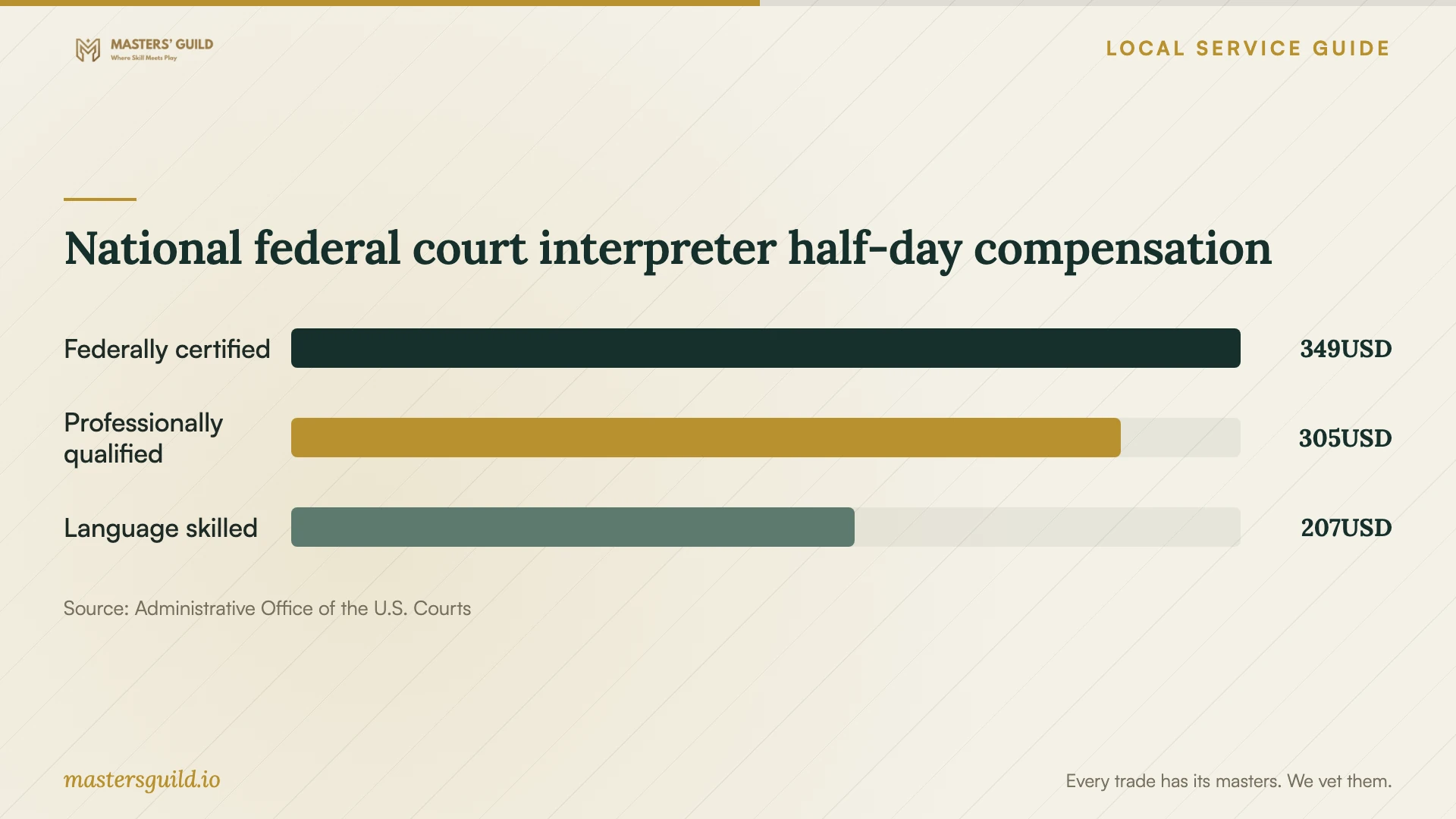
The federal judiciary publishes half-day court-interpreter compensation of $349 for federally certified interpreters, $305 for professionally qualified interpreters, and $207 for language-skilled interpreters. These national court-contract figures provide context for discussing interpreter qualifications and booking units. They do not establish private translation prices in Laredo. [5]
For a private appointment, ask about the minimum booking, cancellation deadline, travel charges, waiting time, and charges if the appointment runs long. For written documents, request a separate quote based on your files. Avoid using a court-interpreter day rate to budget a transcript or birth-certificate translation.
National federal court interpreter half-day compensation
Local details that affect your job
TAMIU applicants need a plan for official records
Texas A&M International University requires international students’ foreign official transcripts in English translation. Its general admissions policy also requires school certification, the school seal, and delivery by the institution in a sealed envelope to Admissions. Before hiring a translator, ask Admissions how to submit the translation alongside those official records. The office lists 956-326-2200 and University Success Center 129, 5201 University Boulevard. [1]
Ask the 406th District Court about existing assistance
The 406th Judicial District Court states that an English–Spanish interpreter is available at hearings when needed and that it has Spanish translations of plea agreements for applicable criminal cases. Contact its staff at 956-523-4954 before booking private hearing assistance. Give your case information, language, and hearing date, and ask what arrangements cover your proceeding and any separate document work. [2]
Federal proceedings have a separate local contact
The Southern District of Texas lists the Laredo staff interpreter at 956-790-1781. It identifies the federal courthouse as 1300 Victoria Street. For a federal matter, use that court’s contact to confirm language arrangements for your proceeding; ask about coverage before making a private booking. [4]
Choose the next step for your assignment
| Your assignment | First step | Confirm before paying |
|---|---|---|
| Foreign transcripts for TAMIU | Ask Admissions how to pair English translations with official school records. | School certification, seal, institution delivery, and translation submission instructions. |
| English–Spanish assistance at a 406th District Court hearing | Contact court staff about the interpreting it says is available. | Your hearing arrangements and whether separate document translation is needed. |
| Language assistance for a Laredo federal proceeding | Contact the listed federal staff interpreter. | Language, proceeding, date, and assistance arrangements. |
| Translation submitted for Texas authentication | Plan the translator’s witnessed signature and accompanying source document. | Recipient instructions and the complete notarized translation package. |
| Personal correspondence | Define the intended reader and preferred tone. | Scope, delivery format, deadline, and correction terms. |
Your hiring checklist
- Get the recipient’s translation and submission instructions in writing.
- Identify the language direction, document purpose, and final deadline.
- Prepare readable copies of all pages, reverse sides, seals, and notes.
- Confirm spelling of names against the identity records you will submit.
- Request an itemized quote and a specific delivery commitment.
- Agree on corrections, file privacy, and return of originals.
- For a hearing, confirm arrangements with the court before hiring privately.
Frequently Asked Questions
Does TAMIU accept a translation instead of an official transcript?
Plan to meet both requirements. TAMIU’s general policy calls for English translations of foreign official transcripts for international students and sets separate requirements for school-certified, sealed records sent by the institution. Ask Admissions how to submit the translation with your records. [1]
Do all translations need notarization?
Ask the recipient before ordering notarization. The Texas Secretary of State’s authentication instructions specifically require a notary to witness the translator’s signature and require the source document with the notarized translation. Apply those instructions to that process rather than assuming they cover every translation assignment. [3]
Should I hire an interpreter for my court hearing?
Ask your court first. The 406th District Court describes English–Spanish interpreting available at hearings when needed. The Laredo federal courthouse lists its own staff-interpreter contact. Confirm arrangements for your particular proceeding before making a private booking. [2] [4]
How much should I budget for written translation?
Request a quote for your actual documents and recipient’s requirements. The published figures shown here cover federal court interpreting compensation, not written translation. Ask the translator to identify its billing unit and itemize any formatting, signature, notarization, delivery, or expedited-work charges. [5]
Sources and scope
This guide combines the sources below with practical planning guidance. Figures apply to the stated geography and period; request a written quote for your property.