
Local service guide
Legal Document Preparation in Knoxville, TN
For Legal Document Preparation in Knoxville, ask for a written scope covering drafting, review, signing arrangements and delivery to the correct office. For a deed or ownership change, follow the Knox County Register of Deeds’ recommendation to consult an attorney or title company. For Chancery or probate paperwork, confirm who will file it: those offices accept hand delivery, mail and fax filing, but do not consider emailed documents filed. [2] [3]
Choose help for the document and the decision
Describe the result you want before requesting a quote: changing a property owner, obtaining a recorded deed copy, or preparing paperwork for an estate proceeding. Ask the provider to explain who will draft the document, who will answer questions about its legal effect, and who will handle signing and submission. Request the name of the person responsible for each part.
For an ownership change, the Register of Deeds says you generally need a new deed prepared, signed and recorded. The office recommends consulting an attorney because small wording changes can change the document’s legal meaning. Ask a prospective attorney or title company to review your existing deed and explain the proposed transfer before you approve the draft. [2]
If you need a replacement copy of a recorded deed, start with the Register’s records service. The office says it can locate most documents using the owner’s name, legal description and approximate recording date. That gives you a concrete first step before paying someone to prepare a new document. [2]
Request a quote with separate preparation and filing charges
Ask the provider to itemize drafting, legal review, revisions, signing arrangements, delivery and government charges. Specify whether you want a finished document to submit yourself or help through submission and return of the original. Ask who pays for corrections if the office returns the paperwork.
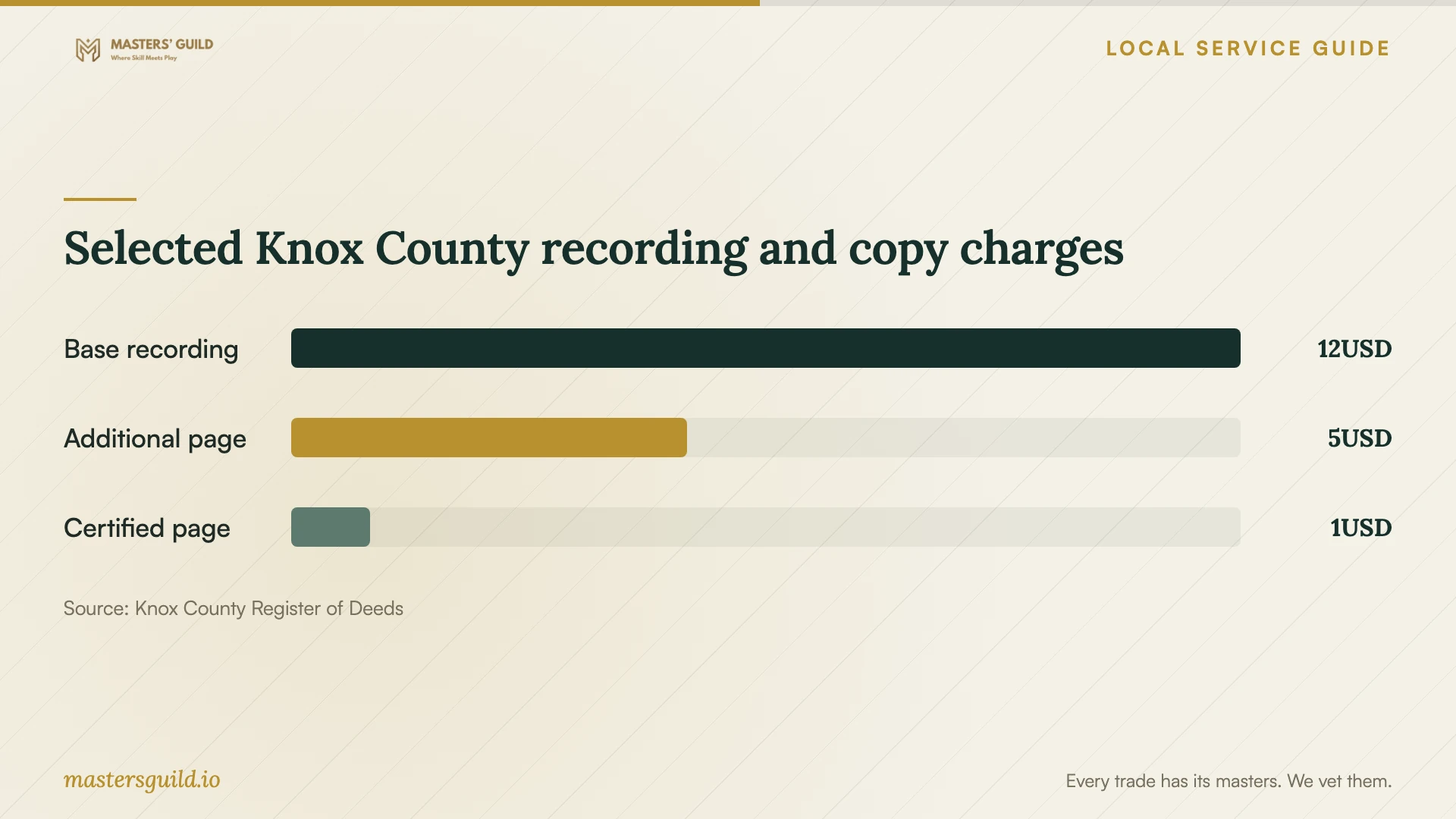
Knox County’s published recording schedule lists $12 for up to two pages of most documents, including warranty deeds, quitclaim deeds, trust deeds and powers of attorney. Each additional page costs $5. Certified copies cost $1 per page. These are government recording and copy charges; the schedule does not establish an attorney’s or preparer’s fee. [1]
The Register also lists transfer and mortgage taxes and an additional $1 charge for each taxable document. Ask the provider to identify which charges apply to your transaction and confirm the amount with the recording office. Use the base recording fee as one budget line rather than a complete transaction price. [1]
Prepare records before approving the draft
Gather your existing document, related correspondence and any case or recording number you have. Write down the names as they appear on those records, your requested change and your deadline. Ask the provider which supporting records they need before sending sensitive information, and agree on a secure way to share it.
For a property matter, ask the provider to distinguish document preparation from a title search. The Register says it cannot determine whether you have clear title and directs readers to a professional title company or abstractor who searches other records. Its records also do not contain all liens, so a search limited to that office cannot settle every title question. [2]
Review the draft against your instructions before signing. Ask the provider to explain any unfamiliar provision and confirm the signing arrangements for your particular document. Keep an approved copy and a written record of the agreed delivery plan.
Plan submission and proof of completion
For Chancery or Probate, arrange hand delivery, mail or fax filing to the appropriate office with applicable fees. The county’s filing page says neither division currently accepts e-filing and that emailed documents do not count as filed. Ask the person handling submission how they will confirm receipt and provide evidence of filing. [3]
For recording, the Register checks whether the document is recordable and whether the correct fees accompany it, assigns an instrument number, scans and indexes it, and returns it to the filer. Ask your provider to give you the instrument number and tell you who will receive the returned original. [2]
Keep drafting completion, signing and submission as separate milestones in your agreement. If you face a deadline, discuss the delivery method and correction plan before hiring. Do not approve an arrangement that leaves you unsure who must take the next step.
Selected Knox County recording and copy charges
Local details that affect your job
Property recording belongs in the property’s county
Knox County records documents for real estate within Knox County. For property elsewhere, confirm the destination with that county before arranging delivery. The Knox County Register of Deeds is at 400 Main Street, Suite 225, Knoxville, and lists 865-215-2330 as its contact number. Its staff cannot prepare your deed or answer legal questions about the transfer. [2]
Choose the correct court counter or fax destination
At 400 Main Street, Chancery uses Suite 125 and fax 865-215-2920; Probate uses Suite 352 and fax 865-215-4289. Confirm which division should receive your paperwork before hiring a delivery service or authorizing fax submission. The county accepts hand delivery, mail and fax filing with applicable fees, and does not treat email as filing. [3]
Choose your first step
| Your task | Suggested first step | Local reason |
|---|---|---|
| Add or remove a property owner | Consult an attorney or title company with the existing deed | The Register recommends professional help and says ownership changes generally require a new deed. |
| Replace a lost recorded deed | Ask the Register for a certified copy | The office offers certified copies for $1 per page. |
| Submit Chancery or probate paperwork | Confirm the division, delivery method and fees | The offices use separate destinations and do not accept email as filing. |
| Determine whether property title is clear | Ask a title company or abstractor about a title search | The Register cannot determine clear title; professionals search other records. |
Your hiring checklist
- Describe the document you need and the result you want.
- Gather existing documents, correspondence and identifying record numbers.
- Ask who will draft, review, arrange signing and submit the paperwork.
- Request an itemized quote separating provider charges and government fees.
- Confirm the receiving office and submission method before setting a deadline.
- Review the draft and resolve questions before signing.
- Agree on proof of submission and return of your original documents.
Frequently Asked Questions
Can the Register of Deeds prepare my deed?
No. The office acts as a recording agency, cannot prepare deeds or answer legal questions, and does not provide standard deed forms. It recommends an attorney or title company for property transfers and ownership changes. [2]
Does the $12 recording fee cover document preparation?
The $12 charge covers recording up to two pages of most documents listed in the county schedule. It does not establish a preparation fee. Ask for a separate provider quote and confirm additional pages, applicable taxes and other charges. [1]
Can I email documents to Chancery or Probate?
The county says emailed documents do not count as filed and neither division currently accepts e-filing. Arrange hand delivery, mail or fax filing to the appropriate office with applicable fees. [3]
Does court acceptance mean my paperwork is legally sufficient?
No. The Clerk and Master accepts prepared documents with applicable filing fees, but acceptance does not confirm accuracy, completeness or legal sufficiency. Ask your provider how they will review the document before submission. [3]
Sources and scope
This guide combines the sources below with practical planning guidance. Figures apply to the stated geography and period; request a written quote for your property.