
Local service guide
Tree cutting and arborist services in Kitchener
Tree cutting in Kitchener starts with confirming who owns the tree and whether City approval or utility coordination applies. The City maintains public trees, and private-property removals may require a conservation permit on lots larger than one acre. For your own tree, ask an arborist to assess pruning versus removal, then get a written quote covering access, stump work and debris disposal before scheduling. [1]
Choose the work before comparing quotes
Describe the problem you want to solve: a damaged limb, branches over the roof, concern about the tree’s condition or a proposed removal. Ask the arborist to explain the recommended work and whether pruning could meet your goal. Request a written assessment if you need documentation for an approval decision.
For each quote, identify the same tree and intended result. Ask the contractor to separate pruning or removal, stump grinding, hauling and site restoration. Specify whether you want logs retained, wood chips removed or the ground prepared for another use. This gives you a clear basis for comparing offers.
Resolve ownership and approvals before booking
The City cares for trees on public property, including road rights-of-way, boulevards and parks. For an ownership question or a concern about a dangerous-looking City tree, call 519-741-2345. Do this before authorizing private work on a tree near the street. [1]
On private property larger than 0.405 hectares, or one acre, you may need a tree conservation permit. The City lists exemptions, including trees under 10 centimetres in diameter at chest height and pruning that does not harm the tree. Dead, diseased or hazardous-tree exemptions require certification by someone designated or approved by the director of planning. Ask Planning to confirm how the rules apply to your proposed work. [1]
For a conservation permit, submit the completed application, a detailed plan or survey, the required fee and written consent from adjacent owners if trees straddle a property line. Development-related removals also require vegetation documentation in the development application. Ask your contractor who will prepare and submit these materials. [1]
Coordinate power lines and protect nearby trees
Enova accepts requests to assess trees hazardous to overhead power lines through its Forestry Service Call Request Form or Operations at 226-896-2200. It then assesses the affected trees and recommends the work required. The utility states that property owners are responsible for keeping their service wires clear of trees and tall vegetation. [2]
Enova permits homeowner pruning only when the person, equipment and all parts of the tree stay at least three metres from the power line. It warns that a cut branch can fall toward a line and become an electrical hazard. If your proposed work could enter that space, contact Enova before proceeding. [2]
Kitchener requires approval and protection measures for work within 6.09 metres, or 20 feet, of City trees. Its tree protection zones depend on tree size. Ask the contractor to confirm any applicable protection requirements before choosing equipment access, staging or stump-work locations near a public tree. [1]
Compare the full price and cleanup scope
Get a site-specific price and ask the contractor to explain its assumptions about access, equipment, obstacles and the amount of material to remove. Request proof of liability insurance and ask what worker coverage applies. Have the contractor identify who will supervise the work and explain any subcontracted tasks.
For stump work, specify the grinding depth, whether the contractor will remove grindings, and who will supply soil or repair the lawn. Agree on the equipment route and how the crew will protect gates, paving and planting beds. Ask how the contractor will confirm underground-service locations before ground-disturbing work.
Waterloo Region’s seasonal curbside service accepts branch bundles up to 92 centimetres long, with branches no thicker than 7.5 centimetres and bundles weighing no more than 23 kilograms. Use jute or cotton twine. The Region excludes stumps and oversized branches, so a promise to leave everything at the curb needs scrutiny. [3]
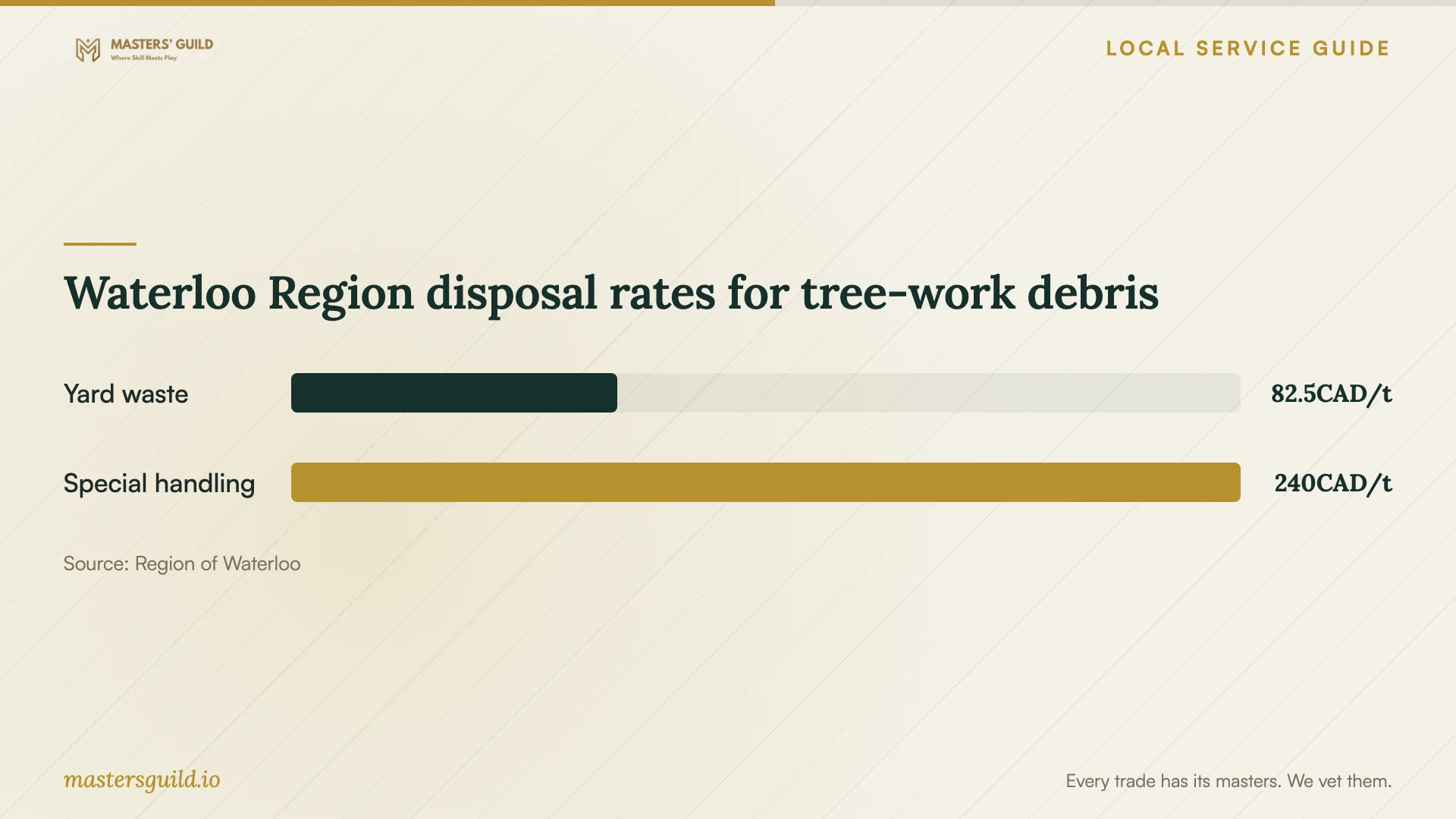
The Region’s published disposal schedule charges CAD 82.50 per metric tonne for yard waste such as brush and leaves. It charges CAD 240 per metric tonne for special-handling garbage, including stumps over 60 centimetres in diameter and brush over 2.4 metres long, at the Waterloo site only. A CAD 15 minimum applies to loads. These are disposal charges, not arborist service prices. [4]
Waterloo Region disposal rates for tree-work debris
Local details that affect your job
A hazardous tree still needs a documentation check
For removals covered by the private tree bylaw, do not rely on a contractor’s informal description of a tree as hazardous. The City ties that exemption to certification by an individual designated or approved by its director of planning. If all proposed removals involve dead, dying or hazardous trees, the City directs you to ask Planning whether a permit is needed. [1]
Utility cutting can leave you with the cleanup
Enova assigns cleanup and disposal of branches and debris from its unplanned tree-trimming service to the tree owner. After Enova assesses the hazard, confirm what it will cut and obtain a separate cleanup price if needed. [2]
Self-hauling requires the right site and vehicle access
Regional drop-off sites accept waste generated within Waterloo Region and charge fees. Waterloo’s Gate 2 accepts small vehicles within its stated limits, while Gate 1 accommodates larger hauling vehicles. The Region accepts its listed oversized stumps and brush as special-handling waste at Waterloo only. Confirm the material category and gate before arranging a trailer. [4]
Choose the first step for your situation
| Situation | First step | Before scheduling |
|---|---|---|
| Tree on a boulevard or other public land | Contact the City at 519-741-2345 | Confirm ownership and City responsibility |
| Private removal on a lot larger than one acre | Ask Planning about a conservation permit | Confirm exemptions and required documentation |
| Tree hazardous to overhead power lines | Request an Enova assessment | Confirm cutting scope and owner-arranged cleanup |
| Stumps or oversized branches will remain | Arrange hauling or confirm regional drop-off acceptance | Do not rely on curbside yard-waste collection |
Your hiring checklist
- Photograph the whole tree, the problem area and the proposed equipment route from a safe location.
- Confirm tree ownership and ask the City about applicable approvals.
- Resolve any power-line coordination before agreeing to a cutting date.
- Request an assessment explaining the proposed pruning or removal.
- Compare written quotes with the same stump, hauling and restoration scope.
- Check insurance documentation and ask who will supervise the crew.
- Agree on access, retained wood, cleanup standards and payment terms.
Frequently Asked Questions
Do I need a permit to prune a private tree?
The City lists pruning as exempt from its private tree conservation permit requirement when the pruning does not harm the tree. Public trees and work near them have separate protections. Confirm ownership and describe the proposed work to the City if you are unsure. [1]
Can I remove a dead tree without a permit?
The City lists an exemption for dead, diseased or hazardous trees when an individual designated or approved by the director of planning certifies their condition. Ask Planning whether your removal needs a permit and what certification it will accept. [1]
Can I leave the stump for yard-waste collection?
No. Waterloo Region excludes stumps of any size from curbside yard-waste collection. Ask your contractor to include disposal or confirm drop-off acceptance and charges before hauling it yourself. [3] [4]
How should I compare tree-removal prices?
Ask each contractor to price the same work after reviewing the site. Compare the cutting scope, equipment access, stump treatment, hauling and ground repair. Have each contractor state exclusions and explain how it will price additional work before you accept an offer.
Sources and scope
This guide combines the sources below with practical planning guidance. Figures apply to the stated geography and period; request a written quote for your property.