
Local service guide
Yard cleanup in Kansas City, MO: Scope and Disposal
Arrange yard cleanup in Kansas City, MO by agreeing on the areas to clear, plants to preserve, and disposal responsibilities before accepting a quote. Get a property-specific price based on debris volume, access, hauling, and disposal. For intentional native beds, request selective cleanup: the city's September 2025 ordinance distinguishes qualifying managed natural landscapes from excessive vegetation. [1]
Define the finished result before requesting prices
Describe the work by area: leaves on the lawn, loose branches along the fence, unwanted growth beside the garage, and debris on paths. Specify whether you want hand cleanup around established plants. Ask the contractor to list exclusions such as pruning, stump removal, chemical treatment, and handling unknown containers.
Send photographs of the yard and debris piles, plus gate openings, steps, and the route to the loading area. Include places where you want the crew to avoid equipment traffic. If photographs leave the amount of work uncertain, request a walkthrough before agreeing to a total.
Ask for a fixed price for the written scope or an hourly rate with a spending limit. Include labor, hauling, disposal charges, and optional work. For leaf removal, decide whether you want a single visit or a separately priced return after more leaves fall. Require approval before the crew adds work or exceeds the agreed limit.
Separate intentional planting from unwanted growth
The council passed Ordinance 250637 as substituted on September 11, 2025. Its text defines excessive vegetation as growth at least 10 inches high, while excluding qualifying managed natural landscapes. For ordinary residential yards, its nuisance provisions also address invasive plants, noxious plants, and plants poisonous to the touch. The ordinance includes an agricultural-land exception for land more than 150 feet from occupied residential property. [1]
Under that ordinance, a managed natural landscape requires intentional, continuous maintenance. Areas containing plants other than trees need defined boundaries through edging or containment. The definition prohibits encroachment onto neighboring property and excludes turf grass at least 10 inches tall, invasive plants, noxious plants, and plants poisonous to the touch. [1]
Flag the planting areas you want to keep and ask the contractor to explain how they will identify unwanted growth before cutting. If you have a city notice, share it during the estimate and ask the city which requirements govern your property. Use the notice to define the corrective work and retain completion photographs.
Assign a destination for each material
Choose whether the crew will leave collected vegetation in an agreed location or remove it from the property. Ask where hauled material will go and who pays disposal charges. Keep general rubbish outside the vegetation scope unless the quote includes it.
MARC identifies lawn and garden products, paint, automotive fluids, bug sprays, and other chemical products as household hazardous waste. Point out these containers during the walkthrough and agree on a separate disposal arrangement before loading starts. [3]
RecycleSpot lists Kansas City, Missouri, among participating communities whose residents can use regional household hazardous waste facilities and collection events free of charge with proof of residency. This resident program information does not establish whether your contractor can deliver products on your behalf. Confirm delivery eligibility, accepted products, and operating hours with the facility before assigning that task. [4]
Set access, weather, and completion expectations
Tell the contractor about locked gates, pets, irrigation equipment, and areas with soft ground. Agree on how you will handle wet conditions and rescheduling. Ask the crew to discuss equipment access with you before driving across areas you want protected.
Walk the yard with the crew before closing the job. Compare the cleared areas, preserved beds, remaining piles, paths, and loading area with the written scope. Record any unfinished work and the agreed next step. For a staged cleanup, confirm which tasks belong to the next visit.
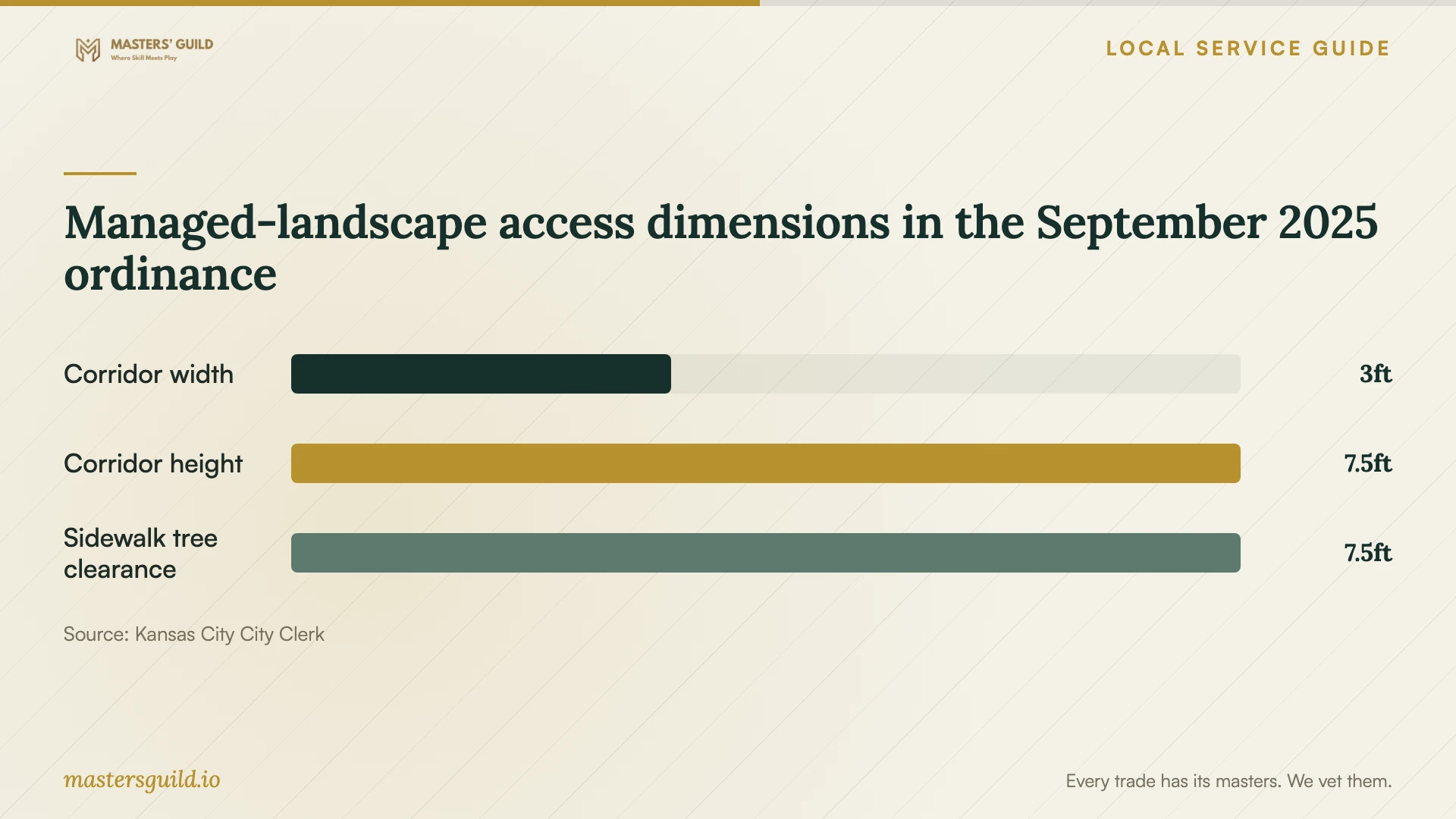
Managed-landscape access dimensions in the September 2025 ordinance
Local details that affect your job
Plan emergency access through managed planting
The September 2025 ordinance requires a qualifying managed natural landscape to include at least one unobstructed safety corridor 3 feet wide and 7.5 feet high. It also prohibits vegetation overhanging the pedestrian sidewalk, except trees providing at least 7.5 feet of clearance. Include corridor and sidewalk clearance in a selective cleanup scope; confirm applicable requirements with the city if your property has an enforcement notice. [1]
Check the Deramus chemical disposal option
RecycleSpot lists the Kansas City household hazardous waste facility at 4707 Deramus, telephone 816-513-8400, for participating communities, with no appointment required. Its regional mobile events operate from April through October. Before scheduling chemical removal, check the facility's current arrangements or a specific event's eligibility and schedule. [4]
Choose the scope for your yard
| Situation | Work to request | Point to resolve |
|---|---|---|
| Loose leaves and small debris | Collection from named areas and path cleanup | Whether hauling and a return visit belong in the price |
| Intentional native beds | Selective removal, boundary maintenance, and access clearance | How the September 2025 managed-landscape conditions apply |
| Overgrown residential lawn | Identify unwanted growth and specify cutting or removal | The September 2025 ordinance defines excessive vegetation at 10 inches or more, with a managed-landscape exception |
| Old lawn chemicals | Separate disposal planning | Resident eligibility, proof of residency, accepted products, and delivery arrangements |
Your hiring checklist
- Photograph work areas, debris piles, gates, and the loading route.
- Flag planting areas to preserve and identify uncertain growth for discussion.
- List tasks, exclusions, and the finished result in the quote.
- Specify on-site collection or hauling, including disposal charges.
- Assign separate arrangements for chemical containers.
- Agree on extra-work approval, weather delays, and any return visit.
- Inspect the finished areas with the crew and record outstanding work.
Frequently Asked Questions
How much should I budget?
Get a property-specific quote based on debris volume, access, hauling, and disposal. Ask the contractor to price optional work separately and explain how they will charge for additional material discovered during cleanup.
Must the crew cut all planting below 10 inches?
The September 2025 ordinance excludes qualifying managed natural landscapes from its excessive-vegetation definition. Those areas must meet maintenance, plant-selection, boundary, encroachment, and access conditions. Discuss the plants to preserve before authorizing cutting. [1]
Can I take old lawn chemicals to household hazardous waste collection?
MARC includes lawn and garden chemical products in household hazardous waste guidance. RecycleSpot lists Kansas City, Missouri, residents as eligible for the participating-community program with proof of residency. Confirm acceptance of your products and delivery arrangements before transporting them. [3] [4]
Sources and scope
This guide combines the sources below with practical planning guidance. Figures apply to the stated geography and period; request a written quote for your property.