
Local service guide
Planning senior care in Kansas City, MO
Arrange senior care in Kansas City, MO by listing the help your household needs, separating daily assistance from clinical tasks, and asking providers to price the same schedule. Before committing to private hours, check MARC’s in-home and caregiver support programs. MARC offers needs-and-eligibility intake at 816-421-4980, and caregiver advocates can help develop a care plan. [1] [2]
Define the work before requesting offers
Write a care brief with the older adult’s preferences, the tasks they want help with and the times someone must attend. Describe assistance in concrete terms: preparing lunch, helping with bathing, accompanying someone to an appointment or staying while a family caregiver leaves home. Ask the older adult whom they want involved in planning.
For transfers, medication tasks, wound care or other clinical needs, ask the treating clinician to clarify the required assistance before you approach providers. Ask each provider which tasks its assigned worker can perform, who supervises that work and which requests require another professional. Request task-specific answers before accepting a promise to handle everything.
For nonmedical help, MARC lists light housekeeping, chores and personal care such as bathing assistance among its in-home services. Use those task descriptions when discussing program support, then identify any remaining needs for a private quote. [1]
Check regional support before fixing your private schedule
MARC’s caregiver advocates can help develop a care plan and connect caregivers with transportation, home-delivered meals, home repairs and legal advice. At intake, identify yourself as a caregiver and describe the gaps you need to cover. Ask about eligibility, available hours, start dates and any household contribution before counting program assistance in your schedule. [2]
MARC also contracts with transportation companies for trips such as groceries and medical appointments. It describes a consumer-directed lift-ramp vehicle program for people who use mobility devices. Ask which option fits the rider, whether someone can accompany them and how to arrange the return trip. [1]
Verify screening and inspect clinical providers
Ask an agency to explain its screening process for the worker it intends to assign. Missouri DHSS says certain provider background requirements include criminal history and the Employee Disqualification List. Its guidance also describes additional checks for home-health and in-home service providers against the Child Abuse and Neglect Registry and Employee Disqualification Registry. Ask which requirements apply to the agency and how it documents completion. [3]
Request confirmation of completed screening alongside FCSR registration. DHSS explains that a worker must register before the registry can provide background information. The registry supplies Missouri-only information and limits disclosure to authorized purposes. If you plan to employ a caregiver yourself, ask FCSR about your eligibility and the correct request process. [3]
For clinical home-health services, Missouri’s Show Me Home Care and Rehab tool provides inspection results for Medicare-certified and/or licensed agencies in its listed categories. Select Home Health and search by city, county or ZIP code. Review the agency under its contracting name, then ask it to explain any findings and corrective steps you do not understand. [4]
Compare written schedules and total charges
Request quotes against the same task list and attendance schedule. Ask each provider to state the hourly or visit charge, minimum booking, cancellation terms, transportation charges and any different rates for weekends or overnight work. For overnight care, describe whether you need an awake worker or someone who can sleep between calls.
Establish who covers a missed shift, how you reach a supervisor and how the agency handles a worker who cannot complete an agreed task. Request a written account of what the worker records after each visit and whom the worker contacts when the older adult’s needs change.
Before signing, calculate the total for your proposed schedule using the provider’s written terms. Keep program-supported hours separate until the program confirms the arrangement. Agree on a review point after care starts so the older adult and family can discuss comfort, attendance and any task that needs adjustment.
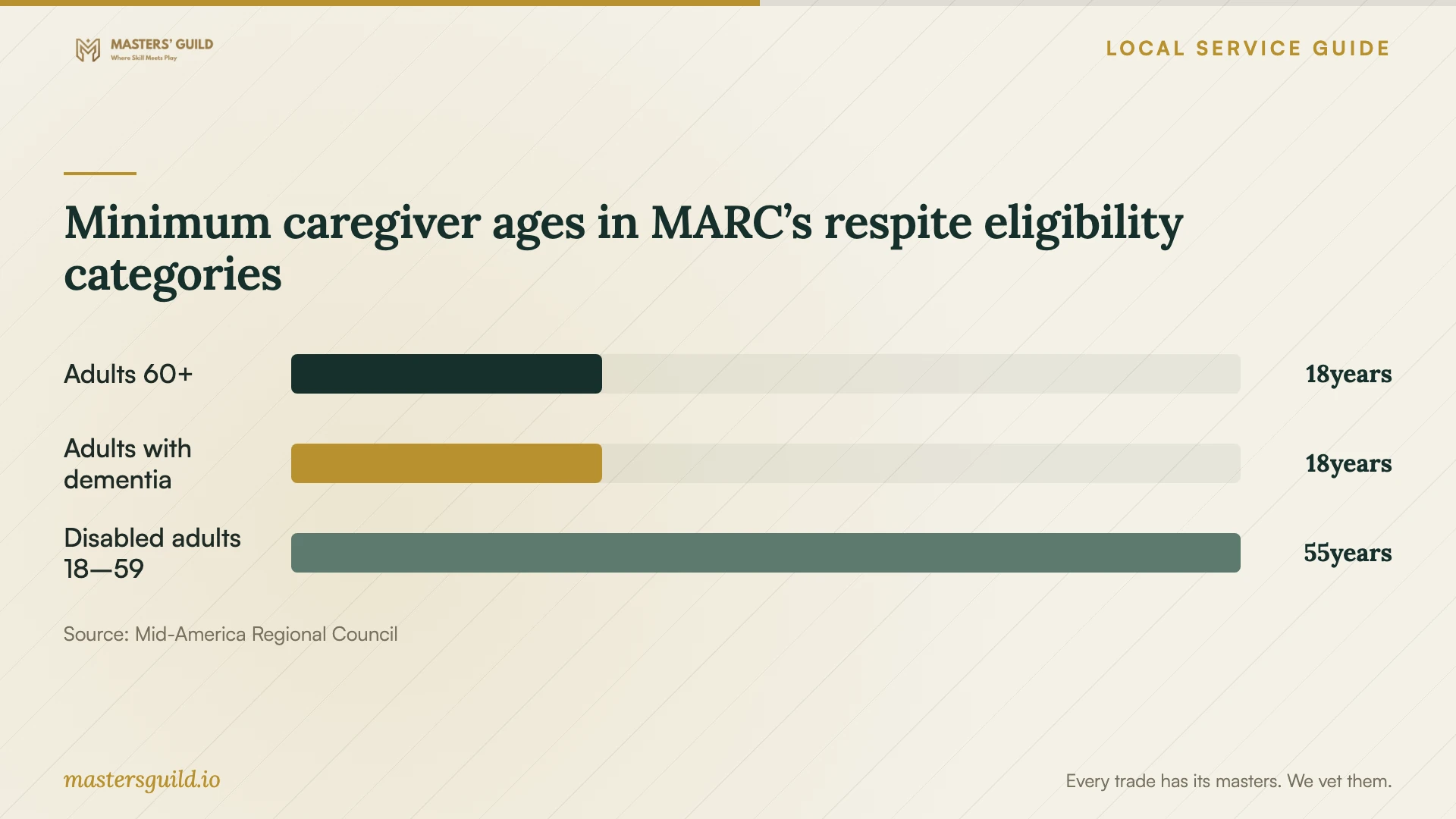
Minimum caregiver ages in MARC’s respite eligibility categories
Local details that affect your job
Regional respite eligibility can change your hiring plan
MARC lists caregivers age 18 or older caring for adults age 60 or older, caregivers age 18 or older caring for adults with dementia, and caregivers age 55 or older caring for adults with disabilities ages 18 through 59. The adults-with-dementia category does not impose the separate age-60 threshold. MARC contracts with agencies for nonmedical respite tasks including meal preparation, light housekeeping and personal care. Apply through 816-421-4980 and confirm approval and scheduling before reducing private coverage. [2]
Meal delivery has a defined Missouri county footprint
MARC lists home-delivered meals for homebound older adults in Cass, Clay, Jackson, Platte and Ray counties in Missouri. Give intake staff the care recipient’s address and ask about eligibility and delivery arrangements. If meals are the main unmet need, explore this option before buying a caregiver visit devoted to meal preparation. [1]
Match the care gap to your next step
| Care gap | Starting point | Question to resolve |
|---|---|---|
| Housekeeping or bathing assistance | MARC in-home services intake | Which needs qualify, and what help can start? |
| A family caregiver needs time away | MARC caregiver respite intake | Does the caregiver-recipient pairing meet eligibility? |
| Meals for a homebound older adult | MARC home-delivered meals intake | Does the address fall within its listed Missouri counties? |
| Clinical home-health care | Missouri home-health inspection lookup | What do inspection findings show for the agency under consideration? |
Your hiring checklist
- Write down the older adult’s preferences, essential tasks and attendance times.
- Ask the treating clinician to clarify clinical tasks and transfer assistance.
- Confirm program eligibility and start dates before relying on supported hours.
- Ask the provider to explain screening for the assigned worker.
- Review applicable home-health inspection results and discuss unresolved questions.
- Get minimum bookings, extra charges and cancellation terms in writing.
- Agree on missed-shift coverage, emergency contacts and a care review date.
Frequently Asked Questions
Can I get help deciding which services to arrange?
MARC’s caregiver advocates help develop care plans and connect caregivers with resources. Its service intake asks questions about needs and eligibility at 816-421-4980. Prepare a task list and describe the time family members can cover. [1] [2]
Does dementia respite require the adult recipient to be 60?
MARC lists a separate category for caregivers age 18 or older supporting adults with dementia, without imposing the separate age-60 threshold. This category retains the adult recipient restriction. Ask intake staff about the application and available service arrangements. [2]
Does registry registration mean a caregiver passed a background check?
Registration and screening are separate steps in Missouri’s FCSR process. DHSS says workers must register before the registry can provide background information. Ask the hiring agency what screening it completed and how it handled the results. [3]
Can I use the state inspection tool for any companion caregiver?
The tool identifies specific agency categories: home health, hospice, outpatient physical therapy clinics and comprehensive outpatient rehabilitation facilities. Use it for the relevant agency category, and ask a companion-care provider to explain its own oversight and screening. [4]
Sources and scope
This guide combines the sources below with practical planning guidance. Figures apply to the stated geography and period; request a written quote for your property.