
Local service guide
Lawn mowing in Kansas City, MO: Hiring and Scheduling
Arrange Lawn mowing in Kansas City, MO with a written scope covering cutting height, trimming, cleanup, and weather delays. Choose visit frequency around growth: MU Extension recommends removing no more than one-third of green leaf area per cut. Before accepting a recurring plan, identify the grass, mark planting beds, and agree on charges for an overgrown first visit. [2]
Compare quotes for the same work
Give each provider the same description: mowable area, front and rear access, gate width, slopes, obstacles, and current grass height. Send photos of narrow passages and any areas you want excluded. Ask the provider to confirm that their equipment can reach the whole lawn.
Request a written price covering mowing, trimming around obstacles, edging along hard surfaces, and clearing clippings from walks and the driveway. Ask whether bagging, hauling, leaf work, and a tall-grass first cut cost extra. Keep aeration, seeding, fertilizing, and pesticide treatments as separate line items unless you choose them.
Request property-specific quotes for your Kansas City lawn. For a seasonal agreement, ask about the billing basis, cancellation terms, skipped visits, and approval of extra work. Compare the same scope across offers before choosing a provider.
Choose frequency and height together
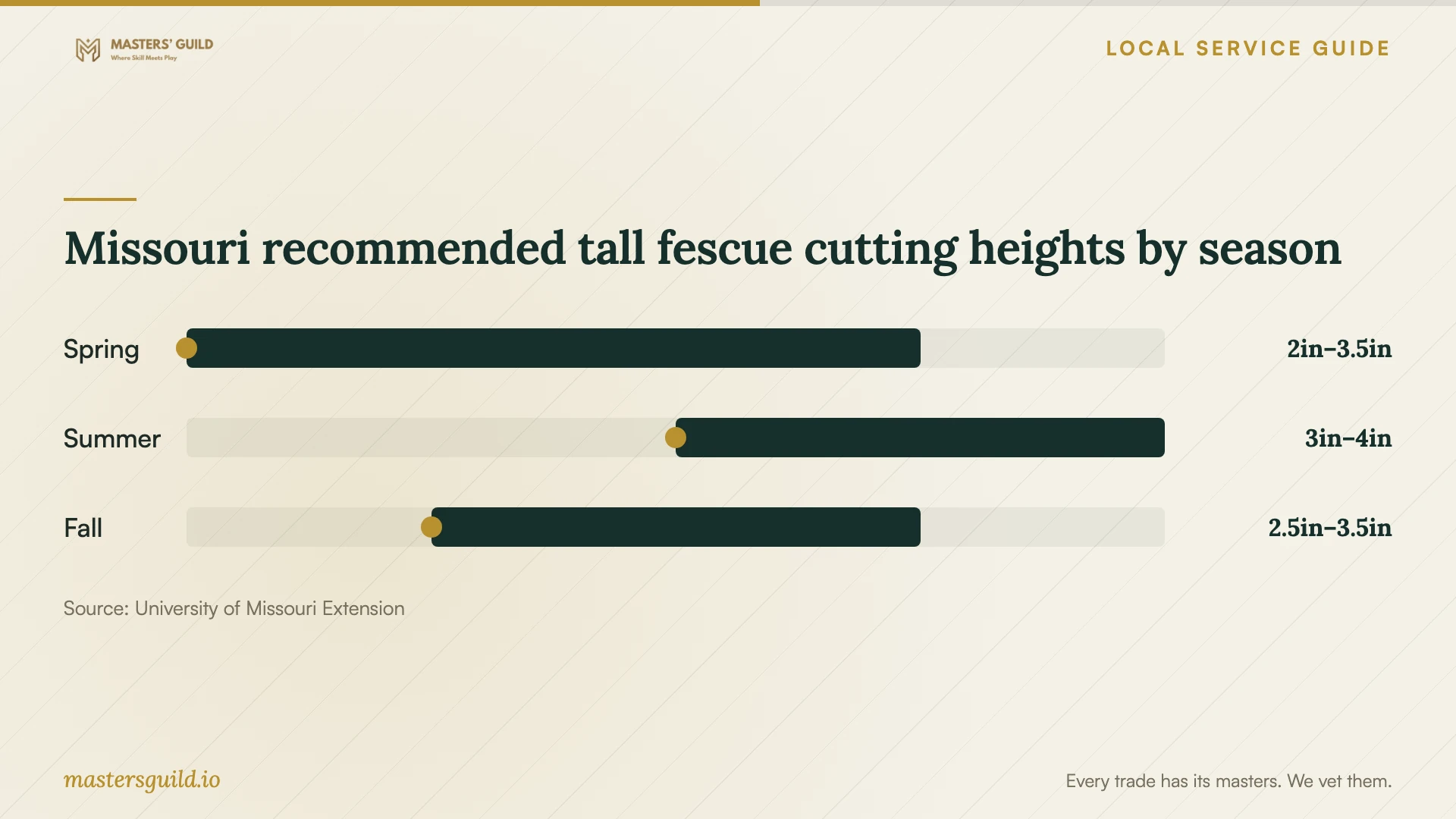
Ask the provider to identify your grass before setting the mower height. MU Extension gives different seasonal ranges for tall fescue, Kentucky bluegrass, and other cool-season grasses. For tall fescue, it recommends 3 to 4 inches in summer and 2.5 to 3.5 inches in fall. For shaded turf, use the summer mowing-height ranges. [2]
Accept a biweekly schedule only with a plan to shorten the interval when growth demands it. MU Extension advises removing no more than one-third of green leaf area in a single mowing and warns that cutting short to reduce mowing frequency harms turf. Ask the crew to flag growth that exceeds the agreed schedule. [2]
For a missed cut, discuss staged recovery before asking the crew to reach the normal height in one pass. MU Extension advises cutting halfway back toward the intended height, then returning a couple of days later to reach the regular level. Agree on the return visit and its charge before work starts. [2]
Decide how the crew will handle clippings
Choose clipping return for routine cuts when the crew can distribute short clippings without clumps. MU Extension explains that clippings decompose and return nutrients to the lawn. Its guidance identifies disease, wet mowing, and excessive grass height as situations where collection may be needed. [3]
Agree on a rain-delay policy and ask the provider to communicate the revised visit date. MU Extension recommends mowing dry grass with a sharp blade for even clipping distribution and warns that mowing during heat or drought stress can injure grass. Include an approval process for delayed cuts that need extra work. [3]
Plan the last visits around growth and leaves
For cool-season turf, keep fall visits tied to growth rather than an automatic calendar cutoff. MU Extension advises mowing at regular heights through October and November until growth stops and keeping leaves from packing down and smothering grass. Its calendar uses approximate central Missouri timing, which can vary by two weeks or more with location and weather. [2]
Ask whether fall visits include leaf mulching or separate collection. MU Extension supports mulching leaves into turf but advises against it when leaves are wet or when a layer more than 2 inches deep leaves turf-smothering clumps. Have the provider inspect the leaf load before choosing the method. [3]
Missouri recommended tall fescue cutting heights by season
Local details that affect your job
Use the city's 10-inch threshold to plan missed visits
Kansas City's passed Ordinance 250637 defines excessive vegetation growth as 10 inches or more, including turf grasses, with specified exceptions. Its nuisance provision covers adjoining sidewalk and right-of-way areas as well as the parcel. Ask the provider to identify which adjoining grass areas the quote covers and arrange a catch-up plan before ordinary turf reaches that height. [1]
Mark managed natural landscapes before mowing
The city distinguishes qualifying managed natural landscapes from unattended growth. Requirements include continuous maintenance, defined boundaries where plants other than trees grow, no turf grass 10 inches or taller, and no prohibited invasive, noxious, or touch-poisonous plants. The ordinance also requires an unobstructed safety corridor and restricts sidewalk overhang. Walk these areas with the crew and mark mowing boundaries; calling an area a native garden alone does not establish the exception. [1]
Check Missouri credentials for pesticide add-ons
Missouri regulates paid pesticide applications, including general-use products. The Department of Agriculture identifies Category 3 as Ornamental and Turf Pest Control and describes licensed technicians working under a certified commercial applicator's supervision. Before adding weed or insect treatment, request the applicator's Missouri license details, relevant category, and supervisor information where applicable. Do not assume a mowing agreement covers these qualifications. [4]
Match the service plan to the lawn
| Lawn situation | Plan to discuss | Condition to confirm |
|---|---|---|
| Rapid spring growth | Weekly visits with flexibility for extra cuts | Keep each cut within the one-third removal guideline. |
| Slow growth | Longer intervals after checking grass height | Shorten the interval if the next cut would remove too much leaf area. |
| Missed or overgrown cut | A staged recovery cut and return visit | Agree on both visits and charges before starting. |
| Managed natural planting | Marked mowing exclusions | Check the city's maintenance, boundary, access, and prohibited-plant requirements. |
| Weed-treatment add-on | A separate treatment scope | Verify Missouri pesticide licensing, category, and required supervision. |
Your hiring checklist
- Send lawn photos, access measurements, and the current grass height.
- Mark native beds, new seedlings, irrigation heads, and other protected areas.
- Confirm cutting height, visit frequency, and who approves schedule changes.
- List mowing, trimming, edging, cleanup, and clipping handling in the quote.
- Agree on rain delays, catch-up cuts, extra charges, and skipped-visit billing.
- Request proof of insurance and a process for reporting property damage.
- Check Missouri pesticide credentials before authorizing treatment add-ons.
Frequently Asked Questions
Can I book mowing every two weeks?
Ask for a growth-based agreement. A two-week interval is suitable only when the crew can maintain the chosen height without removing more than one-third of green leaf area per cut. MU Extension notes that rapid growth can require mowing more than once a week when returning clippings. [2] [3]
Should I pay for bagging at every visit?
Discuss leaving short, evenly distributed clippings as the routine approach. MU Extension recommends returning clippings but identifies disease, excessive height, and wet clumping as reasons to consider collection. Ask for bagging and hauling prices before authorizing them. [3]
Does the city require cutting all plants below 10 inches?
The ordinance provides an exception for vegetation within qualifying managed natural landscapes. Those areas must meet defined maintenance, boundary, safety-access, and plant restrictions. Ordinary turf grass 10 inches or taller does not qualify under that definition. [1]
When should fall mowing end?
For cool-season grass, MU Extension recommends mowing at regular heights until growth stops. Arrange the final visits around actual growth and leaf accumulation rather than a fixed date, and confirm whether leaf work belongs in the mowing price. [2]
Sources and scope
This guide combines the sources below with practical planning guidance. Figures apply to the stated geography and period; request a written quote for your property.